To save content items to your account,
please confirm that you agree to abide by our usage policies.
If this is the first time you use this feature, you will be asked to authorise Cambridge Core to connect with your account.
Find out more about saving content to .
To save content items to your Kindle, first ensure no-reply@cambridge.org
is added to your Approved Personal Document E-mail List under your Personal Document Settings
on the Manage Your Content and Devices page of your Amazon account. Then enter the ‘name’ part
of your Kindle email address below.
Find out more about saving to your Kindle.
Note you can select to save to either the @free.kindle.com or @kindle.com variations.
‘@free.kindle.com’ emails are free but can only be saved to your device when it is connected to wi-fi.
‘@kindle.com’ emails can be delivered even when you are not connected to wi-fi, but note that service fees apply.
This chapter addresses how temple buildings were created during the Archaic and Classical periods. Moving through the challenges of understanding the processes of creating buildings before the Late Classical period in the fourth century, the following observations and arguments orientate one toward specific concerns of design in both standard and innovative temples. Resulting from this exploration, the present chapter highlights the discordance between natural vision and the abstract notion of ichnography in particular.
REDUCED-SCALE DRAWING
No matter how naturalized the relationship between scale drawing and architecture has become for us, we cannot expect the same case to have existed in Hellenic architecture. For material dating to before the Hellenistic period, there has not been scholarly consensus as to whether Greek buildings were products of scale drawing. Vitruvius' writings reflect an understanding of architectural drawing as held in the Hellenistic world, but beyond nonarchitectural writers like Plato and others, we lack testimony on the methods of planning common to architects of the Classical period and earlier.
Metrological and proportional studies bear out the difficulties in recognizing Classical temples as products of scale drawing. Relatively recent criticism of earlier scholarly assumptions about the design process in (as far as architectural writing goes) the poorly documented fifth century helps us recognize that temples of the Classical period were expressions of an extremely rational process of planning. Yet the method of this rational approach need not have been graphic exploration at the drawing board.
The following is an excursus on Plato, Vitruvius, and preceding traditions of thought and craftsmanship going back to Anaximander and architects of the Archaic period. In addressing possible alternative justifications for the existence of ichnography before the Late Classical period, the analysis here supplements the exploration of buildings in Chapter 1. In setting buildings aside for philosophical texts and architectural theory, one may thoroughly enter into the premise at hand: That an interest in drawing among educated architects as intellectuals might have arisen in a literary background from abstract thought, and not just the practical requirements of planning. Along with a subsequent return to visual material in Chapter 2, this evaluation will elicit a nuanced view of connections between craftsmanship, intellectual traditions, and the production of knowledge in the Classical period. As the chapters of the main text elaborate, the genesis of ichnography, linear perspective, and characteristically Greek understandings of order in nature appear to owe a great deal to the design process of Greek architects in the craft of building, particularly in regards to the role of drawing in the creation of individual features at 1:1 scale that preceded reduced-scale drawing.
In carefully examining texts, furthermore, an encounter with additional concerns expressed in intellectual traditions changes the nature of questions asked in relation to the material evidence. Like the ideai that embody the principles of which architectura consists for Vitruvius, for Plato they connect unexpectedly to vision and the related graphic role of nature through representations of cosmic mechanism.
Even with Plato's subsequent elaboration on the relationship between craftsmanship and cosmic mechanism in the Timaeus, the Republic's comparison of the diagrams of Daidalos (or another craftsman or painter) and the motions of heavenly bodies may seem strange, perhaps exceedingly so. In looking into the formal and conceptual connections shared by Greek diagrams of cosmic mechanism and the graphic underpinnings of round and partially round Greek buildings, this chapter attempts to demonstrate the naturalness of Plato's comparison in the larger context of classical visual culture. Specifically, I aim to show how in the Classical period, the design of the Greek theater as a circular and radial construction relates to theories of vision, the recent invention of linear perspective, and astronomical drawings representing the revolutions of bodies in space and the passage of time. The revealed connections help locate an early application of ichnography in the design of the theater as a vessel for communal vision. They also demonstrate a nexus of conceptual associations available to Plato when he referred to the diagrams of Daidalos. Finally, they demonstrate that the relationship (or, just as significantly, a simple lack of separation) between building, mechanism, and astronomical timepieces that together define architecture for Vitruvius may be found in notably earlier Greek traditions. This background will serve to more fully inquire into the origins of linear perspective and ichnography in Chapter 3.
When Renaissance architects like Bramante or Alberti executed or wrote about linear perspective and scale architectural drawings, they engaged in practices and discourses that were already well established by the time Vitruvius picked up his pen near the end of the first millennium b.c. In addition to what Vitruvius tells us about the subject, there are other Roman references to scale drawings used in architectural planning, as well as a few surviving examples that can hardly attest to the frequency with which such drawings surely must have been made. More than just a fact of the design process, the application of geometry in scale drawings during the Imperial era in particular may have engendered the very aesthetic based on the curve and polygon that characterizes Roman vaulted buildings perhaps as best appreciated today in the Pantheon (Figure 1).
This observation, which is far from new, underscores the formative role of reduced-scale drawing not only in the creation of buildings, but also in the guiding approaches to form that underlie their production. In a straightforward emphasis on technical determinism, one may view the fluid, plastic potential of Roman concrete as the primary impetus that transcended the prismatic forms determined by traditional Greek construction with rectilinear blocks. Yet keeping in mind the additional importance of the curvilinear, radial, and polygonal qualities of classical scale drawings, one may perhaps better understand Roman concrete as the material exploited to reflect in three dimensions the forms first explored in ichnography (the art of ground plans), elevation drawing, and linear perspective.
As explored in the previous two chapters, analyses of both texts and buildings may be helpful in interpreting the origins of linear perspective and ichnography. Ultimately, however, these analyses must also integrate what may be learned from preserved drawings and how such drawings may have functioned in the process of designing buildings and their features. The present chapter addresses surviving and hypothetical drawings and their respective roles in design, arguing that linear perspective and ichnography were born of the instruments and techniques first explored in graphic methods of constructing individual elements and refinements. Against the background in philosophy, optics, and astronomy discussed up to this point in the present study, it also considers the contributions of such tools and techniques to the construction of the very notion of order in both nature and the viewer's perception of it.
SINGLE-AXIS PROTRACTION
Direct evidence for ancient Greek architectural drawings is limited by the perishable nature of graphic representation. Although whitewashed wooden tablets, papyrus, or parchment would have made for suitable if expensive surfaces for drawing, it is to our disadvantage that these materials have not endured. We are therefore fortunate that Greek masons and architects also worked out their forms on-site on ashlar blocks. Upon covering these surfaces with red pigment, the use of a graver with a straightedge and compass rendered drawings whose white linear incisions stood out with clarity against their surrounding color. Masons later intended to polish these blocks upon the completion of construction.
In the Parthenon, the long north flank of the stylobate has survived in a suitably well-preserved condition to allow for a detailed study of the measurements of its curvature. G.P. Stevens established seventeen coordinates documenting the incremental rise of the stylobate to a maximum rise of .103 m in the center of this dimension of 69.512 m long. One minor complication in analyzing the curvature is that the two ends of the stylobate are not level, with the temple's northwest corner instead raised ca. 3 cm with respect to that of the southwest. As discussed in Chapter 1, there is some question as to whether this rise and that of the southwest corner (5 cm) represent inaccuracies of construction or deliberate “refinements of refinements” intended to correct an optically inferred convergence in the curved lines that would otherwise take place from the perspective of the Sacred Way (Figure 21). As a result, the theoretical baseline below the curvature is inclined with its slightly diagonal rise ca. 3 cm over the 69 m + distance from east to west. Seybold resolves this inconsistency by analyzing the ordinates in relation to the x-coordinates along a theoretically level baseline corresponding to the easternmost point at 0,0. This method in no way compromises the results because, in the end, an identification of the nature of the curvature (i.e., its optimal conic section) is not affected by this baseline's inclination of less than .03°.
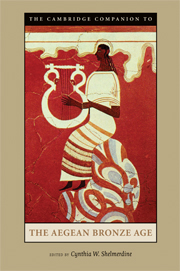
This book is a comprehensive up-to-date survey of the Aegean Bronze Age, from its beginnings to the period following the collapse of the Mycenaean palace system. In essays by leading authorities commissioned especially for this volume, it covers the history and the material culture of Crete, Greece, and the Aegean Islands from c.3000–1100 BCE, as well as topics such as trade, religions, and economic administration. Intended as a reliable, readable introduction for university students, it will also be useful to scholars in related fields within and outside classics. The contents of this book are arranged chronologically and geographically, facilitating comparison between the different cultures. Within this framework, the cultures of the Aegean Bronze Age are assessed thematically and combine both material culture and social history.
First published in 1912, this volume provides a list of all Romano-British structures in the British Isles known at the time of publication, complete with references to published works on each structure, arranged by county. This volume omits burial sites and circumstantial evidence for occupation, focusing on a wide range of excavated structures ranging from military defences to foundations and pavements. The detailed references for each structure provide a valuable resource for researching the extent of previous excavations on a site, and for recovering information on structures which have since been lost or destroyed. Modern discoveries can also be placed in context with earlier excavations in the same area. The author, Arthur H. Lyell (d. 1925), was a prominent archaeologist specialising in Roman Britain.
Jane Ellen Harrison (1850–1928) was a prominent classical scholar who is remembered chiefly for her influential studies of Greek religion, archaeology, literature and art. Introductory Studies in Greek Art (1885) was Harrison's second book, published after a period spent studying archaeology at the British Museum under Sir Charles Newton and writing and lecturing on the subject of Greek vase painting. In her preface to the book Harrison claims that Greek art is distinguished by what she calls 'ideality', a term she defines as a 'peculiar quality ... which adapts itself to the consciousness of successive ages ... a certain largeness and universality which outlives the individual race and persists for all time.' The book covers topics including Chaldaeo-Assyria, Phoenicia, Pheidias and the Parthenon, and the altar of Eumenes at Pergamos.
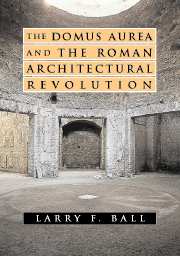
Nero's palace, the Domus Aurea (Golden House), is the most influential known building in the history of Roman architecture. It has been incompletely studied and poorly understood ever since its most important sections were excavated in the 1930s. In this book, Larry Ball provides systematic investigation of the Domus Aurea, including a comprehensive analysis of the masonry, the design, and the abundant ancient literary evidence. Highlighting the revolutionary innovations of the Domus Aurea, Ball also outlines their wide-ranging implications for the later development of Roman concrete architecture.
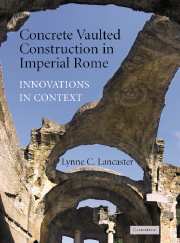
Concrete Vaulted Construction in Imperial Rome examines methods and techniques that enabled builders to construct some of the most imposing monuments of ancient Rome. Focusing on structurally innovative vaulting and the factors that influenced its advancement, Lynne Lancaster also explores a range of related practices, including lightweight pumice as aggregate, amphoras in vaults, vaulting ribs, metal tie bars, and various techniques of buttressing. She provides the geological background of the local building stones and applies mineralogical analysis to determine material provenance, which in turn suggests trading patterns and land use. Lancaster also examines construction techniques in relation to the social, economic, and political contexts of Rome, in an effort to draw connections between changes in the building industry and the events that shaped Roman society from the early empire to late antiquity. This book was awarded the James R. Wiseman Book Award from the Archaeological Institute of America in 2007.
This is the first systematic and detailed study of Pausanias' view of Roman involvement in Greece. It begins with an assessment of Pausanias' life and writings, placing them in their contemporary political, historical, literary and cultural context. Pausanias' attitudes towards the art and artists of the pre-Roman period are also considered, and his attempts to define and analyse the past examined. Much of the book is devoted to the assessment of Pausanias' attitudes to the political Republican leaders Mummius, Sulla and Julius Caesar, emperors from Augustus to Marcus Aurelius, and benefactors such as Herodes Atticus. The study reveals the complexity and sophistication of Pausanias' critique of the actions and attitudes of prominent Roman personalities engaged with the Greek world.