To save content items to your account,
please confirm that you agree to abide by our usage policies.
If this is the first time you use this feature, you will be asked to authorise Cambridge Core to connect with your account.
Find out more about saving content to .
To save content items to your Kindle, first ensure no-reply@cambridge.org
is added to your Approved Personal Document E-mail List under your Personal Document Settings
on the Manage Your Content and Devices page of your Amazon account. Then enter the ‘name’ part
of your Kindle email address below.
Find out more about saving to your Kindle.
Note you can select to save to either the @free.kindle.com or @kindle.com variations.
‘@free.kindle.com’ emails are free but can only be saved to your device when it is connected to wi-fi.
‘@kindle.com’ emails can be delivered even when you are not connected to wi-fi, but note that service fees apply.
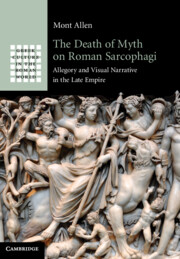
Was the demythologization of Roman sarcophagus reliefs driven by a burgeoning Christian faith? To put it more succinctly, was myth a casualty of Christianity? This long-standing theory proposes that sarcophagi featuring mythless imagery – seasons, shepherds, philosophers, and hunters – gained in popularity because such imagery was religiously neutral and thus capable of appealing to both traditional “pagan” and new Christian clientele alike, a flexibility that the old mythological sarcophagi did not have. Testing this hypothesis requires that we consider Christian numbers and purchasing power in the city of Rome in the third century, as well as the question of who, exactly, was carving early Christian sarcophagi.
This chapter analyzes a very different sense in which “demythologization” is sometimes used: referring not to the wholesale abandonment of mythological narratives but to their fragmentation and deformation as individual characters are ripped out of their narrative context in order to function as stand-alone symbols. Prior scholarship has consistently conflated the two phenomena. For critical leverage here I analyze the development of particular genres of sarcophagi, such as those showing frisky sea creatures, while also stepping outside the funerary domain to consider questions of narrative and allegory raised by sculpture in the round and ensembles of domestic wall paintings.
Was demythologization a response to the Third-Century Crisis? With the empire reeling from the combined pressures of civil war, barbarian invasion, plague, and economic depression, perhaps Rome’s elite were drawn to bucolic, seasonal, and philosophical scenes for the allegorical tranquility they offered, as a form of refuge from the turmoil of real life? This chapter interrogates this thesis, with far-reaching implications for how we understand similar arguments launched about other periods in world art.
One of the most striking things about myth on Roman sarcophagi is that, after exiting the stage during the second half of the third century, it returns with a vengeance in the fourth – this time in Christian guise. How are we to conceive of the relation between the polytheistic myths that had long adorned Roman coffins and the Christian myths that succeeded them? What was their altered view of temporality, allegory, and the afterlife? And what is the relevance of sculptural technique and tooling to understanding this relationship? Such is the subject of this book’s closing chapter.
This chapter unveils the author’s view of what was at stake in demythologization: the viewer’s attitude to chronology, to temporality, to characters defined by their residence in earlier time. For confirmation of this claim, the chapter studies archaeological evidence from Rome’s suburbium, examining the altered spatial relationships between house and tomb that came to dominate in the Late Empire. This reveals what was at stake in the third-century disappearance of mythic figures from sarcophagi: new demands among the living, manifested in multiple domains of Roman life, for greater proximity to their dead.
This chapter turns from religious and political explanations to those that frame demythologization in terms of other social and cultural shifts. Some have proposed that it reflects a rising populism, a widespread decline in education levels, or a diminution in the value Romans assigned to mythological culture. Others have seen in the rise of mythless genres a growing desire for imagery that more clearly projected social status. All are examined.
The Introduction first sets the stage by inviting the reader to consider a few Roman sarcophagi in depth. Serving as an introduction to these compelling objects, this also reveals just how odd it was that deities and mythic heroes came to be expelled from their surface decoration in the third century. It then contextualizes that oddity through an overview of main developments within Roman sarcophagus production from the second through the fourth centuries. The book’s scope and terms are then addressed, and its structure laid out.
This chapter addresses the question of whether we have drawn too strong a distinction between the mythic and the non-mythic. What happens if we consider not iconographic criteria, but modal ones? Taken from the viewpoint of function rather than subject matter, the distinction between mythic and mythless imagery becomes shaky indeed. This chapter first revisits the relationship between the mythological and the so-called biographical sarcophagi, then shows how close attention to Roman sculptural technique – what we might call “material iconography” – provides traction for understanding how Roman viewers imagined the relationship between these genres.
For the Romans, much of life was seen, expressed and experienced as a form of theatre. In their homes, patrons performed the lead, with a supporting cast of residents and visitors. This sumptuously illustrated book, the result of extensive interdisciplinary research, is the first to investigate, describe and show how ancient Roman houses and villas, in their décor, spaces, activities and function, could constitute highly-theatricalised environments, indeed, a sort of 'living theatre'. Their layout, purpose and use reflected and informed a culture in which theatre was both a major medium of entertainment and communication and an art form drawing upon myths exploring the core values and beliefs of society. For elite Romans, their homes, as veritable stage-sets, served as visible and tangible expressions of their owners' prestige, importance and achievements. The Roman home was a carefully crafted realm in which patrons displayed themselves, while 'stage-managing' the behaviour and responses of visitor-spectators.
An artist painted the scene of a painter and a workshop assistant adding colors to a statue of Herakles on the outer surface of a large terracotta bowl used for mixing wine and water.1 Found in Apulia (in southern Italy) in the fourth century bce, the scene included an image of the living Herakles approaching the painter and his assistant in the middle of painting his statue. (Figures 15 and 16).2 In the scene, the statue stands on a plinth and the painter works on the statue’s body in situ, while his assistant warms several implements on a brazier for applying pigments blended with beeswax known as the encaustic technique. This depiction is regularly cited as evidence that ancient Greek sculptures were painted.3
For the opening ceremony of the 2004 Olympic Games in Athens, thousands of volunteers painted their faces and costumed their bodies into embodiments of iconic ancient Greek art objects, capturing their vivid colors and patterns (Figures 1 and 2).1 Staged by director Dimitris Papaioannou, Hourglass (Klepsydra) performed a story of ancient Greek art in vividly polychrome living pictures (tableaux vivants). 2 Unlike the bright colors of those portraying objects from earlier and later epochs, however, volunteers portraying the idealized nude male statues and richly clothed female counterparts produced as dedications in the sixth to fifth centuries bce as well as those playing the figures on the reliefs of the Parthenon wore thick white face and body paint, white muscle suits, or white dresses (Figures 3 and 4).3 The construction of these monochrome white sculptural bodies required significant preparation and stood out dramatically on stage in contrast with the colors of earlier and later art bodies.4 This costume of monochrome whiteness thus visually bracketed the living statues portraying the art of the late sixth, fifth century, and early fourth centuries bce from the actors portraying the rest of ancient Greek art.