To save content items to your account,
please confirm that you agree to abide by our usage policies.
If this is the first time you use this feature, you will be asked to authorise Cambridge Core to connect with your account.
Find out more about saving content to .
To save content items to your Kindle, first ensure no-reply@cambridge.org
is added to your Approved Personal Document E-mail List under your Personal Document Settings
on the Manage Your Content and Devices page of your Amazon account. Then enter the ‘name’ part
of your Kindle email address below.
Find out more about saving to your Kindle.
Note you can select to save to either the @free.kindle.com or @kindle.com variations.
‘@free.kindle.com’ emails are free but can only be saved to your device when it is connected to wi-fi.
‘@kindle.com’ emails can be delivered even when you are not connected to wi-fi, but note that service fees apply.
The echoes of Greek are heard in many modern languages. For example, the abstract vocabulary of the modern European languages derives largely from the vocabulary of the Greek philosophers and scholars, whether directly or via Latin writers who were educated according to the Greek tradition. First published in 1913, Antoine Meillet's history of Greek shows how the language, derived originally from Indo-European, developed over time in response to sociological and geographical factors. Meillet argues that its complexity is due to the constant borrowing of vocabulary and grammar from contemporary languages and regional dialects. Despite - or because of - its flexible and ever-changing nature, and the lack of consistency in usage between individual city states, Greek eventually became the language of great works of literature, philosophy and science.
Thomas K. Arnold's Practical Introduction to Latin Prose Composition was first published in 1839, and was later edited and revised by George Granville Bradley (1821–1903) of University College, Oxford. This graduated and systematic approach to elements of Latin grammar and syntax has been the reference of choice for both teachers and students ever since, and has been revised, updated and redesigned several times. The book reissued here is a companion volume, first published by Bradley in 1881, which contains answers to all the exercises in Arnold's classic textbook. Long out of print, the Key provides model Latin solutions to all the exercises, as well as pedagogical footnotes and cross-references. A valuable resource for all instructors who use Bradley's Arnold, it will also be helpful to students wishing to write more accurately in Latin.
Sir Richard Jebb's seven-volume edition of the works of Sophocles, published between 1883 and 1896, remains a landmark in Greek scholarship. Jebb (1841–1905) was the most distinguished classicist of his generation, a Fellow of Trinity College, Cambridge, and University Orator, subsequently Professor of Greek at Glasgow University and finally Regius Professor of Greek at Cambridge, and a Member of Parliament for the University. Each volume of the edition contains an introductory essay, a metrical analysis, an indication of the sources used to establish the text, and the ancient summaries ('arguments') of the play. The text itself is given with a parallel English translation, textual collation and explanatory notes, and an appendix consisting of expanded notes on some of the textual issues. The quality of Jebb's work means that his editions are still widely consulted today. This volume contains Philoctetes.
Sir Richard Jebb's seven-volume edition of the works of Sophocles, published between 1883 and 1896, remains a landmark in Greek scholarship. Jebb (1841–1905) was the most distinguished classicist of his generation, a Fellow of Trinity College, Cambridge, and University Orator, subsequently Professor of Greek at Glasgow University and finally Regius Professor of Greek at Cambridge, and a Member of Parliament for the University. Each volume of the edition contains an introductory essay, a metrical analysis, an indication of the sources used to establish the text, and the ancient summaries ('arguments') of the play. The text itself is given with a parallel English translation, textual collation and explanatory notes, and an appendix consisting of expanded notes on some of the textual issues. The quality of Jebb's work means that his editions are still widely consulted today. This volume contains Oedipus Coloneus.
Sir Richard Jebb's seven-volume edition of the works of Sophocles, published between 1883 and 1896, remains a landmark in Greek scholarship. Jebb (1841–1905) was the most distinguished classicist of his generation, a Fellow of Trinity College, Cambridge, and University Orator, subsequently Professor of Greek at Glasgow University and finally Regius Professor of Greek at Cambridge, and a Member of Parliament for the University. Each volume of the edition contains an introductory essay, a metrical analysis, an indication of the sources used to establish the text, and the ancient summaries ('arguments') of the play. The text itself is given with a parallel English translation, textual collation and explanatory notes, and an appendix consisting of expanded notes on some of the textual issues. The quality of Jebb's work means that his editions are still widely consulted today. This volume contains Trachiniae.
Sir Richard Jebb's seven-volume edition of the works of Sophocles, published between 1883 and 1896, remains a landmark in Greek scholarship. Jebb (1841–1905) was the most distinguished classicist of his generation, a Fellow of Trinity College, Cambridge, and University Orator, subsequently Professor of Greek at Glasgow University and finally Regius Professor of Greek at Cambridge, and a Member of Parliament for the University. Each volume of the edition contains an introductory essay, a metrical analysis, an indication of the sources used to establish the text, and the ancient summaries ('arguments') of the play. The text itself is given with a parallel English translation, textual collation and explanatory notes, and an appendix consisting of expanded notes on some of the textual issues. The quality of Jebb's work means that his editions are still widely consulted today. This volume contains Electra.
Sir Richard Jebb's seven-volume edition of the works of Sophocles, published between 1883 and 1896, remains a landmark in Greek scholarship. Jebb (1841–1905) was the most distinguished classicist of his generation, a Fellow of Trinity College, Cambridge, and University Orator, subsequently Professor of Greek at Glasgow University and finally Regius Professor of Greek at Cambridge, and a Member of Parliament for the University. Each volume of the edition contains an introductory essay, a metrical analysis, an indication of the sources used to establish the text, and the ancient summaries ('arguments') of the play. The text itself is given with a parallel English translation, textual collation and explanatory notes, and an appendix consisting of expanded notes on some of the textual issues. The quality of Jebb's work means that his editions are still widely consulted today. This volume contains Oedipus Tyrannus.
Sir Richard Jebb (1841–1905) was the most distinguished classicist of his generation, a Fellow of Trinity College, Cambridge, and University Orator, subsequently Professor of Greek at Glasgow University and finally Regius Professor of Greek at Cambridge, and a Member of Parliament for the University. At his death, his planned volumes of the fragments of Sophocles, which would complete his edition of the complete plays and fragments, were not ready for publication, and the final editing of these three volumes was undertaken by W. G. Headlam and A. C. Pearson; the books were published in 1917. The first volume contains a general introduction; Volumes 1 and 2 present the text of the fragments and a commentary, and the final volume consists of addenda and corrigenda, spurious fragments and two indices. The plays are presented in Greek alphabetical order: Volume 1 contains fragments of plays from 'Athamas' to 'Ichneutae'.
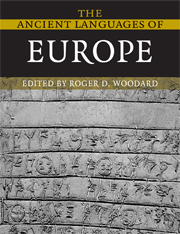
This book, derived from the acclaimed Cambridge Encyclopedia of the World's Ancient Languages, describes the ancient languages of Europe, for the convenience of students and specialists working in that area. Each chapter of the work focuses on an individual language or, in some instances, a set of closely related varieties of a language. Providing a full descriptive presentation, each of these chapters examines the writing system(s), phonology, morphology, syntax and lexicon of that language, and places the language within its proper linguistic and historical context. The volume brings together an international array of scholars, each a leading specialist in ancient language study. While designed primarily for scholars and students of linguistics, this work will prove invaluable to all whose studies take them into the realm of ancient language.
Antoine Meillet mentored a generation of influential twentieth-century linguists and philologists, including Émile Benveniste, Georges Dumézil, and André Martinet. One of the most influential comparative linguists of his time, he recognised that language is a social phenomenon, influenced by sociological factors. Originally published in 1933, this third edition of his 1928 history of Latin was the last to be published during his lifetime. In it, Meillet explores the historical context and significance of Latin. He describes how it developed from Indo-European and evolved according to the fluctuating fortunes of the Roman empire, imitating and borrowing from Greek in many ways but unified by the centralising influence of Rome. As the empire declined, the regional dialects of Latin began to develop into the modern Romance languages, with religion, philosophy and science ensuring the survival of Latin itself into the modern period.
Sabrinae Corolla, published in 1850, takes its name from a poem by John Milton. It is a collection of poems from a wide range of sources, mainly in English but also in German, Greek and Italian, with translations into Greek or Latin on the facing page. It was edited by the Victorian classicist Benjamin Hall Kennedy (1804–1889), most famous for his Latin primer (also available in this series), and the translations were made by some of Kennedy's former students at Shrewsbury School, who are named in a separate list. The book contains Latin versions of works including the eighteenth-century Scottish poet Tobias Smollett's My Native Stream, the German Friedrich Schiller's Hektors Abschied, and Greek renditions of Shelley's The World's Wanderers and Voltaire's Enigma. It also includes nine illustrations.
The eight volumes of the Grammatici Latini, published by Teubner between 1855 and 1880 under the general editorship of Heinrich Keil (1822–1894), are an outstanding monument of nineteenth-century German philology. Keil published editions of Propertius and of Pliny's letters before turning to the works of the Latin grammarians, whose attempts to define and describe their own language have influenced the way in which modern researchers in language and linguistics have approached their discipline. Keil's only predecessor in this field was Helias Putsch, who in 1605 published Grammaticae Latinae auctores antiqui; Keil uses the same order in which to present his versions of the texts. The second volume contains the first twelve books of Priscian's Institutiones Grammaticae.
The term colloquial has had a varied fortune in the history of linguistics. In works written in the nineteenth and the first half of the twentieth centuries it is possible to find references to the colloquial form of language, sometimes contrasted on the one hand with ‘formal’ or ‘literary’ language, and on the other hand with ‘vulgar’ or ‘illiterate’. Thus in 1920 the English scholar Henry Wyld could write a book entitled A History of Modern Colloquial English, and argue for a separation between the spoken and literary forms. It was clear that Wyld also separated out the colloquial from the vulgar in his later tract on ‘the best English’ (Wyld 1934: 605), which notoriously maintained that the language spoken by the ‘members of the great Public Schools and by those classes in society which normally frequent them’ was intrinsically superior to every other type of English speech. Other works on English written in the same period, often aimed at teachers of English or a wider non-specialist public, are more explicit in their classification of the language into three levels (see Kenyon 1948 for citation and discussion of these). Yet it is clear that the simple segregation of language into bands of formal, colloquial and vulgar was never a widely or deeply held view; Wyld himself acknowledges the fact that different varieties may interlock in speech and change takes place through mixture of different codes.
What do these investigations tell us about what colloquial Latin is and how to find it? Clackson tells us that there is no point looking to linguistics for an immediate solution to our problem: linguists avoid the term ‘colloquial’ because of its ambiguities and associated value judgements. Ferri and Probert tell us that the Roman rhetoricians and grammarians do not provide a full answer either: the way the Romans divided up language into registers is not fully understood and was fluid not only diachronically but also synchronically. Chahoud makes it clear that modern research on colloquial Latin is not much more help. For the past century most work on colloquial Latin has relied on stylistic criteria that are supposed to be characteristic of actual conversational usage but have never been clearly demonstrated to have a close connection with it, and there is widespread disagreement among commentators over whether individual passages are colloquial or not. Such disagreement cannot be resolved by any appeal to a generally accepted set of principles about colloquial Latin, for there are no such principles, nor any agreement about what it is.
On the basis of these investigations we can, however, state the range of things that colloquial language and colloquial Latin in particular has been said to be and therefore could be. Colloquial Latin could be the words and usages that Latin speakers (or just those Latin speakers who lived before or during the Augustan age) employed freely in conversation but avoided in their formal literary productions.
As a rule of thumb linguistic change typically starts in the colloquial registers of a given language and gradually spreads to other segments of language use. High-level literature and legal texts tend to be last to incorporate linguistic innovations. The shift from object-before-verb (OV) to verb-before-object (VO) structures, for example, was first manifest in the more colloquial Latin texts and only spread to other registers at a later stage. The honorand of this Festschrift has analysed this change on various occasions and already in 1977 stated that ‘in spoken Latin of the informal varieties VO was already established as the unmarked order, but…OV was preferred in literary Latin.… It is well-established that formal and informal codes in any language differ radically’ (Adams 1976b: 97). Similarly, other major linguistic changes first manifest themselves in our sources of colloquial Latin: case loss and the spread of prepositions, the loss of other inflected forms in favour of right-branching analytic forms, the spread of subordinate clauses with conjunctions and finite verbs replacing accusative with infinitive and participial constructions, and so forth.
The same pattern is found in other languages as well and at all times. The eventual morphological loss in today's French of the passé défini (passé simple), for example, which goes back to the Latin perfective paradigm (Fr. je louai < Lat. laudavi), is now almost complete and can be traced in the twentieth century in the various written registers.
Das ist das wahrste Denkmal der ganzen Merowingerzeit.
B. Krusch (Winterfeld 1905: 60)
ne respondeas stulto iuxta stultitiam suam ne efficiaris ei similis
responde stulto iuxta stultitiam suam ne sibi sapiens esse videatur
(Proverbs 26:4–5)
What is known about how a text is transmitted affects the evaluation of its content. And evaluation and classification of content in turn affect the interpretation of words and language. Literary historians must decide what it is they have in front of them using internal and, where available, external evidence too. Lexicon, syntax, metrics, topoi, generic markers, and more, all go into the taxonomic decision. And once a work has a place in some sort of scholarly taxonomy it may then be used (or abused). A text's nature and classification may also be interpreted in widely divergent ways by scholars who never engage each others' views. Near the end of the long period this volume covers (third century bc – eighth century ad) the Letters of Frodebert and Importunus, texts that some regard as serious documents and others as obvious parodies, provide a case study of such a problem. Commentary on them can easily expand to book-length. My concern here will be to pinpoint the nature of a late text of controversial content, genre and characteristics (learned/vulgar, literary/colloquial, ecclesiastical/secular, written/oral, Latin/Romance). My discussion will begin with the mise en scène and continue with series of limited textual and interpretative problems showing how arguments even about small philological points affect much broader assumptions about what these texts are.
Unlike some other authors of the sixth century ad, such as Cassiodorus, the historian Jordanes has received very little attention in modern scholarship. Besides, the evaluation of his language and style has been since Mommsen an unfavourable one, for two reasons. The first is that, since both his works are epitomes, Jordanes often employs large sections of previous authors – from the second to the sixth century ad – sometimes copying them word for word (Bergmüller 1903: 3 defines him a ‘Kompilator ersten Ranges’); the other reason is that his texts contain, at least in Mommsen's (1882) edition, several late and substandard features as compared to the ‘good’ classical Latin, that is ‘the standard language in the late Republic and early Empire’. The aim of this paper is to connect, in some way, these two aspects: on the one hand, I shall show how crucial an exact knowledge of the sources is to a precise understanding of Jordanes' language; on the other, I shall discuss some morphological and syntactic peculiarities of his works. Special attention will be given here to a few substandard usages that can be considered ‘colloquialisms’, that is to those features which are normally excluded from literary sources of the (post-) classical period and, on the ground of several parallels in authors of the same period and, especially, in non-literary and extra-literary sources, are likely to have been widespread in the spoken varieties of late Latin.