Refine search
Actions for selected content:
152072 results in Classical Studies
Part I - Descent and Fall
-
- Book:
- Plotinus on the Contemplation of the Intelligible World
- Published online:
- 03 September 2024
- Print publication:
- 21 November 2024, pp 21-88
-
- Chapter
- Export citation
Part I
-
- Book:
- The Cambridge Companion to Lucian
- Published online:
- 07 November 2024
- Print publication:
- 21 November 2024, pp 25-26
-
- Chapter
- Export citation
14 - Parnassian Divining Bee Nymphs and Lot-Divination
- from Part III - Anatolian and Aeolian Myth and Cult
-
- Book:
- Aeolic and Aeolians
- Published online:
- 21 November 2024
- Print publication:
- 21 November 2024, pp 410-449
-
- Chapter
- Export citation
Dedication
-
- Book:
- Plotinus on the Contemplation of the Intelligible World
- Published online:
- 03 September 2024
- Print publication:
- 21 November 2024, pp v-v
-
- Chapter
- Export citation
Chapter 7 - Moments of Glad Grace: Augustan Love Poetry
-
- Book:
- A History of Latin Literature From its Beginnings to the Age of Augustus
- Published online:
- 14 November 2024
- Print publication:
- 21 November 2024, pp 244-273
-
- Chapter
- Export citation
Index Nominum
-
- Book:
- A History of Latin Literature From its Beginnings to the Age of Augustus
- Published online:
- 14 November 2024
- Print publication:
- 21 November 2024, pp 372-379
-
- Chapter
- Export citation

Marginalised Populations in the Ancient Greek World
- The Bioarchaeology of the Other
-
- Published by:
- Edinburgh University Press
- Published online:
- 20 November 2024
- Print publication:
- 31 March 2022
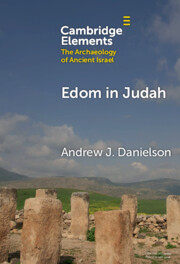
Edom in Judah
- Trade, Migration, and Kinship in the Late Iron Age Southern Levant
-
- Published online:
- 20 November 2024
- Print publication:
- 19 December 2024
-
- Element
- Export citation
RUSPINA-MONASTIR ROMAINE ET TARDO-ANTIQUE. UNE HISTOIRE NOUVELLE By Nabil Kallala. Institut National du Patrimoine – Agence de Mise en Valeur du Patrimoine et de Promotion Culturelle – Université de Tunis, Tunis, 2024. ISBN 9789938788051, pp. 421, 403 black-and-white and colour illustrations, 7 plates. Price: €35.00 (paperback)
-
- Journal:
- Libyan Studies / Volume 56 / November 2025
- Published online by Cambridge University Press:
- 20 November 2024, pp. 178-180
- Print publication:
- November 2025
-
- Article
- Export citation
The Odyssey of Women Writers in Antiquity: an example of coeducation and fostering vocational science
-
- Journal:
- Journal of Classics Teaching / Volume 26 / Issue 52 / Autumn 2025
- Published online by Cambridge University Press:
- 20 November 2024, pp. 181-190
-
- Article
-
- You have access
- Open access
- HTML
- Export citation
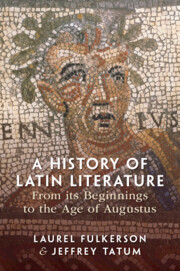
A History of Latin Literature From its Beginnings to the Age of Augustus
-
- Published online:
- 14 November 2024
- Print publication:
- 21 November 2024
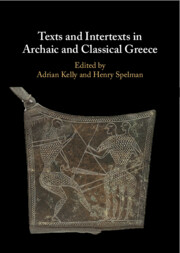
Texts and Intertexts in Archaic and Classical Greece
-
- Published online:
- 14 November 2024
- Print publication:
- 21 November 2024
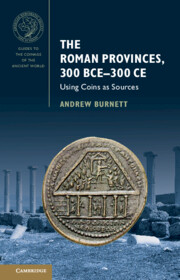
The Roman Provinces, 300 BCE–300 CE
- Using Coins as Sources
-
- Published online:
- 14 November 2024
- Print publication:
- 14 November 2024
-
- Textbook
- Export citation
Figures
-
- Book:
- The Roman Provinces, 300 BCE–300 CE
- Published online:
- 14 November 2024
- Print publication:
- 14 November 2024, pp ix-xxvii
-
- Chapter
- Export citation
Copyright page
-
- Book:
- The Roman Provinces, 300 BCE–300 CE
- Published online:
- 14 November 2024
- Print publication:
- 14 November 2024, pp vi-vi
-
- Chapter
- Export citation
Boxes
-
- Book:
- The Roman Provinces, 300 BCE–300 CE
- Published online:
- 14 November 2024
- Print publication:
- 14 November 2024, pp xxix-xxx
-
- Chapter
- Export citation
Appendices
-
- Book:
- The Roman Provinces, 300 BCE–300 CE
- Published online:
- 14 November 2024
- Print publication:
- 14 November 2024, pp 304-312
-
- Chapter
- Export citation
Index
-
- Book:
- The Roman Provinces, 300 BCE–300 CE
- Published online:
- 14 November 2024
- Print publication:
- 14 November 2024, pp 347-362
-
- Chapter
- Export citation
Maps
-
- Book:
- The Roman Provinces, 300 BCE–300 CE
- Published online:
- 14 November 2024
- Print publication:
- 14 November 2024, pp xxviii-xxviii
-
- Chapter
- Export citation
5 - The Revolution of Augustus – and Becoming More Roman in the First Century
-
- Book:
- The Roman Provinces, 300 BCE–300 CE
- Published online:
- 14 November 2024
- Print publication:
- 14 November 2024, pp 129-173
-
- Chapter
- Export citation
