Refine search
Actions for selected content:
7008 results in Algorithmics, Complexity, Computer Algebra, Computational Geometry
Multiway Trees of Maximum and Minimum Probability under the Random Permutation Model
-
- Journal:
- Combinatorics, Probability and Computing / Volume 5 / Issue 4 / December 1996
- Published online by Cambridge University Press:
- 12 September 2008, pp. 351-371
-
- Article
- Export citation
A Matroid Reconstruction Result
-
- Journal:
- Combinatorics, Probability and Computing / Volume 3 / Issue 3 / September 1994
- Published online by Cambridge University Press:
- 12 September 2008, pp. 371-373
-
- Article
- Export citation
Shortcutting Planar Digraphs*
-
- Journal:
- Combinatorics, Probability and Computing / Volume 4 / Issue 3 / September 1995
- Published online by Cambridge University Press:
- 12 September 2008, pp. 287-315
-
- Article
- Export citation
Precoloring Extension III: Classes of Perfect Graphs
-
- Journal:
- Combinatorics, Probability and Computing / Volume 5 / Issue 1 / March 1996
- Published online by Cambridge University Press:
- 12 September 2008, pp. 35-56
-
- Article
- Export citation
Small Submatroids in Random Matroids
-
- Journal:
- Combinatorics, Probability and Computing / Volume 5 / Issue 3 / September 1996
- Published online by Cambridge University Press:
- 12 September 2008, pp. 257-266
-
- Article
- Export citation
CPC volume 3 issue 3 Cover and Front matter
-
- Journal:
- Combinatorics, Probability and Computing / Volume 3 / Issue 3 / September 1994
- Published online by Cambridge University Press:
- 12 September 2008, pp. f1-f2
-
- Article
-
- You have access
- Export citation
A Probabilistic Analysis of a String Editing Problem and its Variations†
-
- Journal:
- Combinatorics, Probability and Computing / Volume 4 / Issue 2 / June 1995
- Published online by Cambridge University Press:
- 12 September 2008, pp. 143-166
-
- Article
- Export citation
On the Number of Convex Lattice Polygons
-
- Journal:
- Combinatorics, Probability and Computing / Volume 1 / Issue 4 / December 1992
- Published online by Cambridge University Press:
- 12 September 2008, pp. 295-302
-
- Article
- Export citation
On Subgraph Sizes in Random Graphs
-
- Journal:
- Combinatorics, Probability and Computing / Volume 1 / Issue 2 / June 1992
- Published online by Cambridge University Press:
- 12 September 2008, pp. 123-134
-
- Article
- Export citation
On a Random Instance of a ‘Stable Roommates’ Problem: Likely Behavior of the Proposal Algorithm
-
- Journal:
- Combinatorics, Probability and Computing / Volume 2 / Issue 1 / March 1993
- Published online by Cambridge University Press:
- 12 September 2008, pp. 53-92
-
- Article
- Export citation
On the Thickness of Sparse Random Graphs
-
- Journal:
- Combinatorics, Probability and Computing / Volume 1 / Issue 4 / December 1992
- Published online by Cambridge University Press:
- 12 September 2008, pp. 303-309
-
- Article
- Export citation
CPC volume 2 issue 1 Cover and Front matter
-
- Journal:
- Combinatorics, Probability and Computing / Volume 2 / Issue 1 / March 1993
- Published online by Cambridge University Press:
- 12 September 2008, pp. f1-f2
-
- Article
-
- You have access
- Export citation
Threshold Functions for H-factors
-
- Journal:
- Combinatorics, Probability and Computing / Volume 2 / Issue 2 / June 1993
- Published online by Cambridge University Press:
- 12 September 2008, pp. 137-144
-
- Article
- Export citation
-
Let H be a graph on h vertices, and G be a graph on n vertices. An H-factor of G is a spanning subgraph of G consisting of n/h vertex disjoint copies of H. The fractional arboricity of H is
 , where the maximum is taken over all subgraphs (V′, E′) of H with |V′| > 1. Let δ(H) denote the minimum degree of a vertex of H. It is shown that if δ(H) < a(H), then n−1/a(H) is a sharp threshold function for the property that the random graph G(n, p) contains an H-factor. That is, there are two positive constants c and C so that for p(n) = cn−1/a(H) almost surely G(n, p(n)) does not have an H-factor, whereas for p(n) = Cn−1/a(H), almost surely G(n, p(n)) contains an H-factor (provided h divides n). A special case of this answers a problem of Erdős.
 , where the maximum is taken over all subgraphs (
Turán-Ramsey Theorems and Kp-Independence Numbers
-
- Journal:
- Combinatorics, Probability and Computing / Volume 3 / Issue 3 / September 1994
- Published online by Cambridge University Press:
- 12 September 2008, pp. 297-325
-
- Article
- Export citation
-
Let the Kp-independence number αp (G) of a graph G be the maximum order of an induced subgraph in G that contains no Kp. (So K2-independence number is just the maximum size of an independent set.) For given integers r, p, m > 0 and graphs L1,…,Lr, we define the corresponding Turán-Ramsey function RTp(n, L1,…,Lr, m) to be the maximum number of edges in a graph Gn of order n such that αp(Gn) ≤ m and there is an edge-colouring of G with r colours such that the jth colour class contains no copy of Lj, for j = 1,…, r. In this continuation of [11] and [12], we will investigate the problem where, instead of α(Gn) = o(n), we assume (for some fixed p > 2) the stronger condition that αp(Gn) = o(n). The first part of the paper contains multicoloured Turán-Ramsey theorems for graphs Gn of order n with small Kp-independence number αp(Gn). Some structure theorems are given for the case αp(Gn) = o(n), showing that there are graphs with fairly simple structure that are within o(n2) of the extremal size; the structure is described in terms of the edge densities between certain sets of vertices.
The second part of the paper is devoted to the case r = 1, i.e., to the problem of determining the asymptotic value of
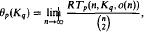
for p < q. Several results are proved, and some other problems and conjectures are stated.
CPC volume 4 issue 2 Cover and Front matter
-
- Journal:
- Combinatorics, Probability and Computing / Volume 4 / Issue 2 / June 1995
- Published online by Cambridge University Press:
- 12 September 2008, pp. f1-f2
-
- Article
-
- You have access
- Export citation
The Induced Size-Ramsey Number of Cycles
-
- Journal:
- Combinatorics, Probability and Computing / Volume 4 / Issue 3 / September 1995
- Published online by Cambridge University Press:
- 12 September 2008, pp. 217-239
-
- Article
- Export citation
Block Reduced Lattice Bases and Successive Minima
-
- Journal:
- Combinatorics, Probability and Computing / Volume 3 / Issue 4 / December 1994
- Published online by Cambridge University Press:
- 12 September 2008, pp. 507-522
-
- Article
- Export citation
-
A lattice basis bi,…,bm is called block reduced with block size β if for every β consecutive vectors bi,…,bi+β−1, the orthogonal projections of bi,…,bi+β−1 in span(bi,…,bi−1)⊥ are reduced in the sense of Hermite and Korkin–Zolotarev. Let λi denote the successive minima of lattice L, and let b1,…,bm be a basis of L that is block reduced with block size β. We prove that for i = 1,…, m

where γβ is the Hermite constant for dimension β. For block size β = 3 and odd rank m ≥ 3, we show that

where the maximum is taken over all block reduced bases of all lattices L. We present critical block reduced bases achieving this maximum. Using block reduced bases, we improve Babai's construction of a nearby lattice point. Given a block reduced basis with block size β of the lattice L, and given a point x in the span of L, a lattice point υ can be found in time βO(β) satisfying

These results also give improvements on the method of solving integer programming problems via basis reduction.
CPC volume 4 issue 4 Cover and Front matter
-
- Journal:
- Combinatorics, Probability and Computing / Volume 4 / Issue 4 / December 1995
- Published online by Cambridge University Press:
- 12 September 2008, pp. f1-f2
-
- Article
-
- You have access
- Export citation
Author Index to Volume 1
-
- Journal:
- Combinatorics, Probability and Computing / Volume 1 / Issue 4 / December 1992
- Published online by Cambridge University Press:
- 12 September 2008, pp. 383-384
-
- Article
- Export citation
A Characterisation of Strict Matching Matroids
-
- Journal:
- Combinatorics, Probability and Computing / Volume 1 / Issue 3 / September 1992
- Published online by Cambridge University Press:
- 12 September 2008, pp. 209-217
-
- Article
- Export citation
