To save content items to your account,
please confirm that you agree to abide by our usage policies.
If this is the first time you use this feature, you will be asked to authorise Cambridge Core to connect with your account.
Find out more about saving content to .
To save content items to your Kindle, first ensure no-reply@cambridge.org
is added to your Approved Personal Document E-mail List under your Personal Document Settings
on the Manage Your Content and Devices page of your Amazon account. Then enter the ‘name’ part
of your Kindle email address below.
Find out more about saving to your Kindle.
Note you can select to save to either the @free.kindle.com or @kindle.com variations.
‘@free.kindle.com’ emails are free but can only be saved to your device when it is connected to wi-fi.
‘@kindle.com’ emails can be delivered even when you are not connected to wi-fi, but note that service fees apply.
From its earliest days, the Fortran programming language has been designed with computing efficiency in mind. The latest standard, Fortran 2008, incorporates a host of modern features, including object-orientation, array operations, user-defined types, and provisions for parallel computing. This tutorial guide shows Fortran programmers how to apply these features in twenty-first-century style: modular, concise, object-oriented, and resource-efficient, using multiple processors. It offers practical real-world examples of interfacing to C, memory management, graphics and GUIs, and parallel computing using MPI, OpenMP, and coarrays. The author also analyzes several numerical algorithms and their implementations and illustrates the use of several open source libraries. Full source code for the examples is available on the book's website.
Bringing together experts in multimodal signal processing, this book provides a detailed introduction to the area, with a focus on the analysis, recognition and interpretation of human communication. The technology described has powerful applications. For instance, automatic analysis of the outputs of cameras and microphones in a meeting can make sense of what is happening – who spoke, what they said, whether there was an active discussion and who was dominant in it. These analyses are layered to move from basic interpretations of the signals to richer semantic information. The book covers the necessary analyses in a tutorial manner, going from basic ideas to recent research results. It includes chapters on advanced speech processing and computer vision technologies, language understanding, interaction modeling and abstraction, as well as meeting support technology. This guide connects fundamental research with a wide range of prototype applications to support and analyze group interactions in meetings.
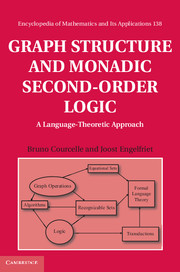
The study of graph structure has advanced in recent years with great strides: finite graphs can be described algebraically, enabling them to be constructed out of more basic elements. Separately the properties of graphs can be studied in a logical language called monadic second-order logic. In this book, these two features of graph structure are brought together for the first time in a presentation that unifies and synthesizes research over the last 25 years. The authors not only provide a thorough description of the theory, but also detail its applications, on the one hand to the construction of graph algorithms, and, on the other to the extension of formal language theory to finite graphs. Consequently the book will be of interest to graduate students and researchers in graph theory, finite model theory, formal language theory, and complexity theory.
What is knowledge and how is it represented? This book focuses on the idea of formalising knowledge as relations, interpreting knowledge represented in databases or logic programs as relational data and discovering new knowledge by identifying hidden and defining new relations. After a brief introduction to representational issues, the author develops a relational language for abstract machine learning problems. He then uses this language to discuss traditional methods such as clustering and decision tree induction, before moving onto two previously underestimated topics that are just coming to the fore: rough set data analysis and inductive logic programming. Its clear and precise presentation is ideal for undergraduate computer science students. The book will also interest those who study artificial intelligence or machine learning at the graduate level. Exercises are provided and each concept is introduced using the same example domain, making it easier to compare the individual properties of different approaches.
Systems of logico-probabilistic (LP) reasoning characterize inference from conditional assertions that express high conditional probabilities. In this paper we investigate four prominent LP systems, the systems O, P, Z, and QC. These systems differ in the number of inferences they licence (O ⊂ P ⊂ Z ⊂ QC). LP systems that license more inferences enjoy the possible reward of deriving more true and informative conclusions, but with this possible reward comes the risk of drawing more false or uninformative conclusions. In the first part of the paper, we present the four systems and extend each of them by theorems that allow one to compute almost-tight lower-probability-bounds for the conclusion of an inference, given lower-probability-bounds for its premises. In the second part of the paper, we investigate by means of computer simulations which of the four systems provides the best balance of reward versus risk. Our results suggest that system Z offers the best balance.
This paper deals with the partition function of the Ising model from statistical mechanics, which is used to study phase transitions in physical systems. A special case of interest is that of the Ising model with constant energies and external field. One may consider such an Ising system as a simple graph together with vertex and edge weights. When these weights are considered indeterminates, the partition function for the constant case is a trivariate polynomial Z(G;x,y,z). This polynomial was studied with respect to its approximability by Goldberg, Jerrum and Paterson. Z(G;x,y,z) generalizes a bivariate polynomial Z(G;t,y), which was studied in by Andrén and Markström.
We consider the complexity of Z(Gt,y) and Z(G;x,y,z) in comparison to that of the Tutte polynomial, which is well known to be closely related to the Potts model in the absence of an external field. We show that Z(G;x,y,z) is #P-hard to evaluate at all points in 3, except those in an exceptional set of low dimension, even when restricted to simple graphs which are bipartite and planar. A counting version of the Exponential Time Hypothesis, #ETH, was introduced by Dell, Husfeldt and Wahlén in order to study the complexity of the Tutte polynomial. In analogy to their results, we give under #ETH a dichotomy theorem stating that evaluations of Z(G;t,y) either take exponential time in the number of vertices of G to compute, or can be done in polynomial time. Finally, we give an algorithm for computing Z(G;x,y,z) in polynomial time on graphs of bounded clique-width, which is not known in the case of the Tutte polynomial.
We consider random permutations derived by sampling from stick-breaking partitions of the unit interval. The cycle structure of such a permutation can be associated with the path of a decreasing Markov chain on n integers. Under certain assumptions on the stick-breaking factor we prove a central limit theorem for the logarithm of the order of the permutation, thus extending the classical Erdős–Turán law for the uniform permutations and its generalization for Ewens' permutations associated with sampling from the PD/GEM(θ)-distribution. Our approach is based on using perturbed random walks to obtain the limit laws for the sum of logarithms of the cycle lengths.
We present a review of recent activities in swarm robotic research, and analyse existing literature in the field to determine how to get closer to a practical swarm robotic system for real world applications. We begin with a discussion of the importance of swarm robotics by illustrating the wide applicability of robot swarms in various tasks. Then a brief overview of various robotic devices that can be incorporated into swarm robotic systems is presented. We identify and describe the challenges that should be resolved when designing swarm robotic systems for real world applications. Finally, we provide a summary of a series of issues that should be addressed to overcome these challenges, and propose directions for future swarm robotic research based on our extensive analysis of the reviewed literature.
We study distance properties of a general class of random directed acyclic graphs (dags). In a dag, many natural notions of distance are possible, for there exist multiple paths between pairs of nodes. The distance of interest for circuits is the maximum length of a path between two nodes. We give laws of large numbers for the typical depth (distance to the root) and the minimum depth in a random dag. This completes the study of natural distances in random dags initiated (in the uniform case) by Devroye and Janson. We also obtain large deviation bounds for the minimum of a branching random walk with constant branching, which can be seen as a simplified version of our main result.
With this issue of the Journal of Functional Programming, we transition to a new leadership. Xavier Leroy, who has faithfully served as co-Editor in Chief since 2007, is stepping down. After a short apprenticeship over the past year, Benjamin Pierce is taking his place.
We introduce the notion of discrimination as a generalization of both sorting and partitioning, and show that discriminators (discrimination functions) can be defined generically, by structural recursion on representations of ordering and equivalence relations. Discriminators improve the asymptotic performance of generic comparison-based sorting and partitioning, and can be implemented not to expose more information than the underlying ordering, respectively equivalence relation. For a large class of order and equivalence representations, including all standard orders for regular recursive first-order types, the discriminators execute in the worst-case linear time. The generic discriminators can be coded compactly using list comprehensions, with order and equivalence representations specified using Generalized Algebraic Data Types. We give some examples of the uses of discriminators, including the most-significant digit lexicographic sorting, type isomorphism with an associative-commutative operator, and database joins. Source code of discriminators and their applications in Haskell is included. We argue that built-in primitive types, notably pointers (references), should come with efficient discriminators, not just equality tests, since they facilitate the construction of discriminators for abstract types that are both highly efficient and representation-independent.
Probabilistic operational semantics for a nondeterministic extension of pure λ-calculus is studied. In this semantics, a term evaluates to a (finite or infinite) distribution of values. Small-step and big-step semantics, inductively and coinductively defined, are given. Moreover, small-step and big-step semantics are shown to produce identical outcomes, both in call-by-value and in call-by-name. Plotkin’s CPS translation is extended to accommodate the choice operator and shown correct with respect to the operational semantics. Finally, the expressive power of the obtained system is studied: the calculus is shown to be sound and complete with respect to computable probability distributions.
The infinite Post Correspondence Problem (ωPCP) was shown to be undecidable by Ruohonen (1985) in general. Blondel and Canterini [Theory Comput. Syst. 36 (2003) 231–245] showed that ωPCP is undecidable for domain alphabets of size 105, Halava and Harju [RAIRO–Theor. Inf. Appl. 40 (2006) 551–557] showed that ωPCP is undecidable for domain alphabets of size 9. By designing a special coding, we delete a letter from Halava and Harju’s construction. So we prove that ωPCP is undecidable for domain alphabets of size 8.