To save content items to your account,
please confirm that you agree to abide by our usage policies.
If this is the first time you use this feature, you will be asked to authorise Cambridge Core to connect with your account.
Find out more about saving content to .
To save content items to your Kindle, first ensure no-reply@cambridge.org
is added to your Approved Personal Document E-mail List under your Personal Document Settings
on the Manage Your Content and Devices page of your Amazon account. Then enter the ‘name’ part
of your Kindle email address below.
Find out more about saving to your Kindle.
Note you can select to save to either the @free.kindle.com or @kindle.com variations.
‘@free.kindle.com’ emails are free but can only be saved to your device when it is connected to wi-fi.
‘@kindle.com’ emails can be delivered even when you are not connected to wi-fi, but note that service fees apply.
For obvious reasons, engine-control systems were among the first developed for vehicles: The engine is not only the most crucial component for automobile performance; its emission performance also significantly affects the environment. As discussed in Chapter 1, engine-control systems may include fuel-injection control (i.e., air–fuel ratio control), ignition or spark-timing control, antiknock-control systems, idle-speed control, EGR control, and transmission control. The goal of engine-control systems is to ensure that the engine operates at near-optimal conditions at all times in terms of drivability, fuel economy, and emissions.
Overall, engine-control systems are complex due to the nonlinearity of many of the components and the interactions among the several related control functions: air–fuel ratio control, idle-speed control, knock (or spark-timing) control, EGR control, and transmission control. In this chapter, each major phase of the operation of a spark-ignited gasoline engine and its dynamic modeling is discussed from the control perspective. Subsequent chapters consider specific engine-control problems (e.g., air–fuel ratio control, spark timing, EGR, and idle-speed control), as well as control problems associated with hybrid and fuel-cell vehicles.
This textbook is organized in four major parts as follows:
Introduction and Background is an introduction to the topic of automotive control systems and a review of background material on engine modeling, vehicle dynamics, and human factors.
Powertrain Control Systems includes topics such as air–fuel ratio control, idle-speed control, spark-timing control, control of transmissions, control of hybrid-electric vehicles, and fuel-cell vehicle control.
Vehicle Control Systems covers cruise control and headway-control systems, traction-control systems (including antilock brakes), active suspensions, vehicle-stability control, and four-wheel steering.
Intelligent Transportation Systems (ITS) includes an overview of ITS technologies, collision detection and avoidance systems, automated highways, platooning, and automated steering.
With multiple chapters in each part, this textbook contains sufficient material for a one-semester course on automotive control systems. The coverage of the material is at the first-year graduate or advanced undergraduate level in engineering. It is assumed that students have a basic undergraduate-level background in dynamics, automatic control, and automotive engineering.
The concept of vehicle stability control (VSC), variously known as vehicle dynamics control (VDC) and electronic stability program (ESP), was first introduced in 1995 and has been studied extensively as an active safety device to improve vehicle stability and handling. The concepts are natural extensions of the ABS and TCS discussed in Chapter 13. When “differential braking” is applied – that is, braking forces of the left- and right-hand-side tires are different – a yaw moment is generated. This yaw moment then slows down the vehicle and influences the vehicle lateral/yaw/roll motion. By taking advantage of the widely available and mature ABS hardware, this differential braking function is added on with minimal additional cost. Therefore, this vehicle control system has enjoyed rapid market acceptance.
The vehicle yaw moment also can be generated through the manipulation of tire-traction forces – for example, through the control of differentials or power-split devices in AWD vehicles (Piyabongkarn et al. 2010). In such systems, the objectives of VSC can be achieved without reducing the longitudinal velocity – but at the cost of additional hardware. Vehicle-handling performance can be influenced by many different actuations. In addition to differential braking and traction, all-wheel steering and active/semi-active suspensions (including antiroll systems) can be used. Hac and Bodie (2002) discussed methods for improving vehicle stability and emergency handling using electronically controlled chassis systems. Small changes in the balance of tire forces between the front and rear axles may affect vehicle yaw moment and stability. They discuss methods of affecting vehicle-yaw dynamics using controllable brakes, steering, and suspension. Brake-steering techniques are discussed in detail in Pilutti et al. (1998).
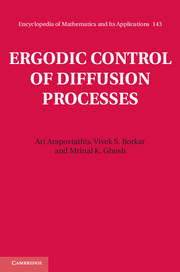
This comprehensive volume on ergodic control for diffusions highlights intuition alongside technical arguments. A concise account of Markov process theory is followed by a complete development of the fundamental issues and formalisms in control of diffusions. This then leads to a comprehensive treatment of ergodic control, a problem that straddles stochastic control and the ergodic theory of Markov processes. The interplay between the probabilistic and ergodic-theoretic aspects of the problem, notably the asymptotics of empirical measures on one hand, and the analytic aspects leading to a characterization of optimality via the associated Hamilton–Jacobi–Bellman equation on the other, is clearly revealed. The more abstract controlled martingale problem is also presented, in addition to many other related issues and models. Assuming only graduate-level probability and analysis, the authors develop the theory in a manner that makes it accessible to users in applied mathematics, engineering, finance and operations research.
In this chapter we turn to the study of degenerate controlled diffusions. For the nondegenerate case the theory is more or less complete. This is not the case if the uniform ellipticity hypothesis is dropped. Indeed, the differences between the nondegenerate and the degenerate cases are rather striking. In the nondegenerate case, the state process X is strong Feller under a Markov control. This, in turn, facilitates the study of the ergodic behavior of the process. In contrast, in the degenerate case, under a Markov control, the Itô stochastic differential equation (2.2.1) is not always well posed. From an analytical viewpoint, in the nondegenerate case, the HJB equation is uniformly elliptic and the associated regularity properties benefit its study. The degenerate case, on the other hand, is approached via a particular class of weak solutions known as viscosity solutions. This approach does not yield as satisfactory results as in the case of classical solutions. In fact ergodic control of degenerate diffusions should not be viewed as a single topic, but rather as a class of problems, which are studied under various hypotheses.We first formulate the problem as a special case of a controlled martingale problem and then summarize those results from Chapter 6 that are useful here. Next, in Section 7.3, we study the HJB equations in the context of viscosity solutions for a specific class of problems that bears the name of asymptotically flat diffusions.
We conclude by highlighting a string of issues that still remain open.
In the controlled martingale problem with ergodic cost, we obtained existence of an optimal ergodic process and optimal Markov process separately, but not of an optimal ergodic Markov process, as one would expect from one's experience with the nondegenerate case. This issue still remains open. In particular it is unclear whether the Krylov selection procedure of Section 6.7, which has been used to extract an optimal Markov family for the discounted cost problem under nondegeneracy, can be similarly employed for the ergodic problem. The work in Bhatt and Borkar [22] claims such a result under very restrictive conditions, but the proof has a serious flaw.
The HJB equation was analyzed in two special cases. The general case remains open. In particular, experience with discrete state space problems gives some pointers:
(a) In the multichain case for Markov chains with finite state space S and finite action space A, a very general dynamic programming equation is available due to Howard [53], viz.,
for i ∈ S. Here the unknowns are the value function V and the state dependent optimal cost ϱ. An analog of this for the degenerate diffusion case could formally be written down as