To save content items to your account,
please confirm that you agree to abide by our usage policies.
If this is the first time you use this feature, you will be asked to authorise Cambridge Core to connect with your account.
Find out more about saving content to .
To save content items to your Kindle, first ensure no-reply@cambridge.org
is added to your Approved Personal Document E-mail List under your Personal Document Settings
on the Manage Your Content and Devices page of your Amazon account. Then enter the ‘name’ part
of your Kindle email address below.
Find out more about saving to your Kindle.
Note you can select to save to either the @free.kindle.com or @kindle.com variations.
‘@free.kindle.com’ emails are free but can only be saved to your device when it is connected to wi-fi.
‘@kindle.com’ emails can be delivered even when you are not connected to wi-fi, but note that service fees apply.
Following his stint as the naturalist aboard the Endeavour on James Cook's pioneering voyage, Sir Joseph Banks (1743–1820) became a pre-eminent member of the scientific community in London. President of the Royal Society from 1778, and a friend and adviser to George III, Banks significantly strengthened the bonds between the practitioners and patrons of science. Between 1796 and 1800, the Swedish botanist and librarian Jonas Dryander (1748–1810) published this five-volume work recording the contents of Banks' extensive library. The catalogue was praised by many, including the distinguished botanist Sir James Edward Smith, who wrote that 'a work so ingenious in design and so perfect in execution can scarcely be produced in any science'. Volume 1 (1798) lists books pertaining to various branches of science, including accounts in a multitude of languages from scientific institutions all over the world.
Following his stint as the naturalist aboard the Endeavour on James Cook's pioneering voyage, Sir Joseph Banks (1743–1820) became a pre-eminent member of the scientific community in London. President of the Royal Society from 1778, and a friend and adviser to George III, Banks significantly strengthened the bonds between the practitioners and patrons of science. Between 1796 and 1800, the Swedish botanist and librarian Jonas Dryander (1748–1810) published this five-volume work recording the contents of Banks' extensive library. The catalogue was praised by many, including the distinguished botanist Sir James Edward Smith, who wrote that 'a work so ingenious in design and so perfect in execution can scarcely be produced in any science'. Volume 2 (1796) focuses on books relating to animals, including humans, particularly their physiology, maladies and economic functions.
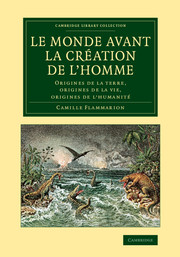
French astronomer Camille Flammarion (1842–1925) won acclaim for bringing science to a general readership. His Astronomie populaire (1880) and its translation into English as Popular Astronomy (1894) are both reissued in this series. The present work, on the origins of the Earth and humankind, sold tens of thousands of copies. Flammarion's original purpose was to update Zimmermann's Le monde avant la création de l'homme, published a quarter of a century earlier. However, scientific understanding had progressed so much that he decided to rewrite the work completely. First published in 1886, it contains some 400 wood engravings depicting dramatic landscapes, dinosaurs, fossils and much more. Ranging from early chapters on the universe and solar system, through to later discussion of the emergence of humankind after aeons of evolution, this book will prove an absorbing read for those interested in a nineteenth-century perspective on the origins of life.
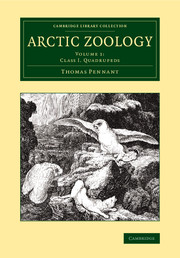
In the 'Advertisement' to this 1784 two-volume work, Thomas Pennant (1726–98), zoologist and traveller, explains that his original intention was to record the zoology of North America 'when the empire of Great Britain was entire'. After the War of Independence, he changed his focus to the zoology (and people, archaeology and geology) of the Arctic regions of America, Europe and Siberia. The content of the volumes, one of the earliest works of systematic zoology published in Britain, is based on the writings of earlier zoologists, information obtained by Pennant from his scientific correspondents all over Europe and America, and his studies in private museums and collections. It is embellished with engravings of animals, birds, landscapes and artefacts. Volume 1 begins with an account of the various Arctic habitats, and describes the quadrupeds of these regions. Other works by Thomas Pennant are also reissued in the Cambridge Library Collection.
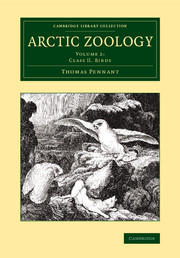
In the 'Advertisement' to this 1784 two-volume work, Thomas Pennant (1726–98), zoologist and traveller, explains that his original intention was to record the zoology of North America 'when the empire of Great Britain was entire'. After the War of Independence, he changed his focus to the zoology (and people, archaeology and geology) of the Arctic regions of America, Europe and Siberia. The content of the volumes, one of the earliest works of systematic zoology published in Britain, is based on the writings of earlier zoologists, information obtained by Pennant from his scientific correspondents all over Europe and America, and his studies in private museums and collections. It is embellished with engravings of animals, birds, landscapes and artefacts. Volume 2 deals with land and water birds, including some, such as the passenger pigeon, which are now extinct. Other works by Thomas Pennant are also reissued in the Cambridge Library Collection.
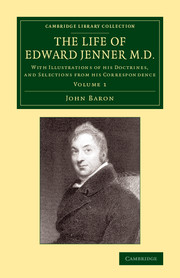
Written by his friend, the physician John Baron (1786–1851), this laudatory biography of the 'father of immunology' did much to enhance the reputation of Edward Jenner (1749–1823) upon its publication in two volumes between 1827 and 1838. The work covers Jenner's personal and professional life both before and after his development of the vaccine for smallpox, as well as touching on the vaccine's reception and use around the world. Thoroughly explaining the history and facts of vaccination, Baron established himself as an authority on the subject. Although criticised by some for its unquestioning praise of Jenner's genius, the work is valuable for its use of primary sources, drawing heavily on correspondence and personal notes, excerpts of which appear throughout the text. Volume 1, published in 1827, focuses on Jenner's early life and the history and science of vaccination.
Embracing Only Those Branches of Chemical Science which Are Calculated to Illustrate or Explain the Different Objects of Medicine, and to Furnish a Chemical Grammar to the Author's Pharmacologia
The physician and author John Ayrton Paris (1785–1856), several of whose other medical and popular works have been reissued in the Cambridge Library Collection, published the first edition of his Pharmacologia in 1812. It was immediately successful, and went into eight further editions until 1843. The third edition, of 1820, has been reissued in this series. This book, published in 1825, was intended as a companion volume, providing a 'grammar' of chemistry for the medical student. After an imaginary dialogue on the importance of chemistry, between a provincial physician and 'the author', to whom the former is entrusting his son for his medical education, the book moves systematically from the general application of chemistry to medicine, through topics such as gravity, crystallization and electricity, to the detail of the actions of specific elements, and tables of relevant weights and measures, providing fascinating insights into the history of medical education.
Having previously embarked on a collecting expedition to the Pyrenees, backed by Sir William Hooker and George Bentham, the botanist Richard Spruce (1817–93) travelled in 1849 to South America, where he carried out unprecedented exploration among the diverse flora across the northern part of the continent. After his death, Spruce's writings on fifteen fruitful years of discovery were edited as a labour of love by fellow naturalist Alfred Russel Wallace (1823–1913), whom Spruce had met in Santarém. This two-volume work, first published in 1908, includes many of the author's exquisite illustrations. Showing the determination to reach plants in almost inaccessible areas, Spruce collected hundreds of species, many with medicinal properties, notably the quinine-yielding cinchona tree, as well as the datura and coca plants. Featuring four maps, Volume 2 includes discussion of the Peruvian and Ecuadorian Andes and the cinchona forests of western Chimborazo.
The Scottish landscape gardener and prolific horticultural writer John Claudius Loudon (1783–1843) published this manual on the practice of greenhouse or conservatory gardening in 1824. In his preface he remarks on the rise of greenhouses, which have 'now become an appendage to every villa, and to many town residences'. The work is directed at professional gardeners (and their employers) who may not have the requisite knowledge and skills to make the best use of this exciting new space. The first part of the work describes the practicalities of siting and constructing the greenhouse, how it should be heated, with what plants it should be stocked and how these should be cultivated. The second part consists of a catalogue of 'all the green-house and frame plants hitherto in cultivation'. Still valuable, this substantial guide offers modern readers a record of the plants that were then available to the enthusiast.
Following his stint as the naturalist aboard the Endeavour on James Cook's pioneering voyage, Sir Joseph Banks (1743–1820) became a pre-eminent member of the scientific community in London. President of the Royal Society from 1778, and a friend and adviser to George III, Banks significantly strengthened the bonds between the practitioners and patrons of science. Between 1796 and 1800, the Swedish botanist and librarian Jonas Dryander (1748–1810) published this five-volume work recording the contents of Banks' extensive library. The catalogue was praised by many, including the distinguished botanist Sir James Edward Smith, who wrote that 'a work so ingenious in design and so perfect in execution can scarcely be produced in any science'. Volume 3 (1797) lists Banks' collection of books on botanical subjects, including works on the medical and economic applications of various plants.
With a View to Establish, on Practical Grounds, a System of Rules, for the Prevention and Cure of the Diseases Incident to a Disordered State of the Digestive Functions
The physician and author John Ayrton Paris (1785–1856), several of whose other medical and popular works have been reissued in the Cambridge Library Collection, published this book on the significance of diet to health in 1826. In the first part, Paris discusses the physiology of the digestive system, and the way that sensations of hunger, thirst and fullness are conveyed. In the second part, he considers types of food and drink, and methods of cookery. Paris suggests the times of day at which different meals should be taken, and the types and amounts of food and drink to be consumed. Part 3 deals with the problems of indigestion. A table of matters for investigation is given which covers the patient's lifestyle and habits as well as their immediate physical symptoms, and Paris firmly makes the point that changes of lifestyle are at least as important as medicine in effecting a cure.