To save content items to your account,
please confirm that you agree to abide by our usage policies.
If this is the first time you use this feature, you will be asked to authorise Cambridge Core to connect with your account.
Find out more about saving content to .
To save content items to your Kindle, first ensure no-reply@cambridge.org
is added to your Approved Personal Document E-mail List under your Personal Document Settings
on the Manage Your Content and Devices page of your Amazon account. Then enter the ‘name’ part
of your Kindle email address below.
Find out more about saving to your Kindle.
Note you can select to save to either the @free.kindle.com or @kindle.com variations.
‘@free.kindle.com’ emails are free but can only be saved to your device when it is connected to wi-fi.
‘@kindle.com’ emails can be delivered even when you are not connected to wi-fi, but note that service fees apply.
Written by his friend, the physician John Baron (1786–1851), this laudatory biography of the 'father of immunology' did much to enhance the reputation of Edward Jenner (1749–1823) upon its publication in two volumes between 1827 and 1838. The work covers Jenner's personal and professional life both before and after his development of the vaccine for smallpox, as well as touching on the vaccine's reception and use around the world. Thoroughly explaining the history and facts of vaccination, Baron established himself as an authority on the subject. Although criticised by some for its unquestioning praise of Jenner's genius, the work is valuable for its use of primary sources, drawing heavily on correspondence and personal notes, excerpts of which appear throughout the text. Volume 2, published in 1838, covers Jenner's later life and the global reception of vaccination. The appendix lists the various honours bestowed upon him.
Thoroughly revised and updated, the new edition of this acclaimed and best-selling guide offers a rich blend of practical advice and real-life examples. The authors draw on fifty years of experience, providing detailed step-by-step guidance designed to help students and researchers write and present scientific manuscripts more successfully through knowledge, practice, and an efficient approach. Retaining the user-friendly style of the previous editions, this fourth edition has been broadened to include detailed information relevant to today's digital world. It covers all aspects of the writing process, from first drafts, literature retrieval, and authorship to final drafts and electronic publication. A new section provides extensive coverage of ethical issues, from plagiarism and dual publication to honesty in reporting statistics. Both the text and 30 hands-on exercises include abundant examples applicable to a variety of writing contexts, making this a powerful tool for researchers and students across a range of disciplines.
Professor of natural philosophy for the Royal Institution between 1853 and 1887, the physicist John Tyndall (1820–93) passionately sought to share scientific understanding with the Victorian public. Reissued here is the collected research he contributed to the Philosophical Transactions of the Royal Society and other journals. Published in 1872, it complements Tyndall's Heat Considered as a Mode of Motion (1863), which is also reissued in this series. Here each memoir is preceded by a short summary, explaining what he discovered and his reasons for embarking on the investigations in question. Accompanying the detailed descriptions of experimental methods are illustrations of the scientific apparatus used. Tyndall also shows how his work built upon previous research, acknowledging the insights of distinguished scientists such as William Herschel and Macedonio Melloni. In particular, he discusses at length his academic debates with Heinrich Gustav Magnus.
Following his stint as the naturalist aboard the Endeavour on James Cook's pioneering voyage, Sir Joseph Banks (1743–1820) became a pre-eminent member of the scientific community in London. President of the Royal Society from 1778, and a friend and adviser to George III, Banks significantly strengthened the bonds between the practitioners and patrons of science. Between 1796 and 1800, the Swedish botanist and librarian Jonas Dryander (1748–1810) published this five-volume work recording the contents of Banks' extensive library. The catalogue was praised by many, including the distinguished botanist Sir James Edward Smith, who wrote that 'a work so ingenious in design and so perfect in execution can scarcely be produced in any science'. Volume 4 (1799) lists books pertaining to geology and mineralogy, including works on the medical and economic applications of minerals and metals.
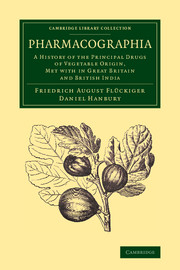
First published in 1874 and reissued here in its second edition of 1879, this substantial work provides information on the vegetable material medica used by Victorian pharmacists, principally in Britain but also in India. Arranging the entries according to the type of plant from which each drug is derived, Daniel Hanbury (1825–75) and Friedrich August Flückiger (1828–94) give a description of each drug as well as covering its botanical origin and history, including its first medicinal application. They also discuss chemical composition, referring to the investigations of other scientists as well as their own, and comment on microscopic structure. Intending to create a broad reference work rather than an encyclopaedia, the authors chose not to focus on the therapeutic applications of the drugs. In many instances, however, they give some information on how the plant products are used. The appendix provides short biographical and bibliographical notes.
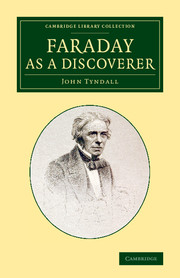
First published in 1868, soon after the death of Michael Faraday (1791–1867), this short work assesses the discoveries made by a humble bookbinder who became one of the foremost scientific investigators of the nineteenth century. Eminently qualified, John Tyndall (1820–93), who received Faraday's support in taking up the professorship of natural philosophy at the Royal Institution in 1853, gives an informed appraisal of a remarkable scientific career. The protégé of Sir Humphry Davy, Faraday went on to carry out pioneering work in the fields of electromagnetism, diamagnetism and electrolysis. Tyndall focuses here on Faraday's research, describing his influences and how he approached his investigations, although insights into his character are also incorporated: 'Underneath his sweetness and gentleness was the heat of a volcano.' Also reissued in this series are The Life and Letters of Faraday (1870), compiled by Henry Bence Jones, and John Hall Gladstone's Michael Faraday (1872).
Although devoted to his parish, Leonard Jenyns (1800–93) combined his clerical duties with keen research into the natural world around him. His numerous publications include A Manual of British Vertebrate Animals (1835) and Observations in Natural History (1846), both of which are reissued in this series. This 1858 work is based on nineteen years of meticulous observation of Cambridgeshire weather, including trends in atmospheric pressure and precipitation. Jenyns' careful recording of his surroundings supplies the raw data for the text and many informative tables. The geological position of Swaffam Bulbeck, where most of the observations were made, is briefly discussed along with other factors bearing upon the climate of Cambridgeshire more generally. Throwing light on how meteorological observation was conducted and interpreted, the work reflects a growing interest in the topic in Victorian Britain.
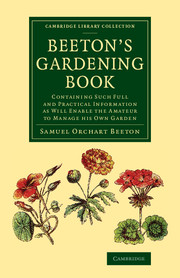
Samuel Orchart Beeton (1831–77), the publishing entrepreneur who made his wife's Book of Household Management one of the bestselling titles of the century, gave his name to many other books of domestic, medical and general information for the middle classes. (The 1871 Book of Garden Management, published and probably compiled by him, is also reissued in this series.) This work was published in 1874 by Ward Lock, to whom Beeton was forced to sell his own business after a financial collapse in 1866. The book contains 'such full and practical information as will enable the amateur to manage his own garden'. It covers flower, fruit and vegetable gardening, with a section on garden pests and a monthly calendar of tasks. It also contains advertisements for gardening and medicinal products, as well as for other books from the publishers, offering a fascinating insight into social as well as garden history.