To save content items to your account,
please confirm that you agree to abide by our usage policies.
If this is the first time you use this feature, you will be asked to authorise Cambridge Core to connect with your account.
Find out more about saving content to .
To save content items to your Kindle, first ensure no-reply@cambridge.org
is added to your Approved Personal Document E-mail List under your Personal Document Settings
on the Manage Your Content and Devices page of your Amazon account. Then enter the ‘name’ part
of your Kindle email address below.
Find out more about saving to your Kindle.
Note you can select to save to either the @free.kindle.com or @kindle.com variations.
‘@free.kindle.com’ emails are free but can only be saved to your device when it is connected to wi-fi.
‘@kindle.com’ emails can be delivered even when you are not connected to wi-fi, but note that service fees apply.
Originally apprenticed to a bookbinder, Michael Faraday (1791–1867) began to attend Sir Humphrey Davy's chemistry lectures purely out of interest. Although he soon recognised that science would be his vocation, there was no defined career path to follow, and when he applied to Davy for work he was gently told to 'attend to the bookbinding'. It was only after a laboratory explosion in which Davy partially lost his sight that Faraday was taken on as his amanuensis. From this difficult beginning stemmed perhaps the most famous scientific career of the nineteenth century. This three-volume collection of Faraday's papers provides a comprehensive record of a key branch of his work. Volume 1, reissued here in a second edition of 1849, covers his early work in electricity and magnetism, including papers on lightning, electric fish, and notes on the elaborate and often beautiful experiments conducted to investigate whether magnetism could produce electricity.
In 1816, Sir Francis Ronalds (1788–1873) became the first physicist to demonstrate the possibility of an electric telegraph. Previously, the only telegraphs were semaphores - cumbersome signal towers capable of sending only two or three words per minute. However, his idea was dismissed by the Admiralty, where senior officials deemed any new telegraphs 'unnecessary'. Although his designs were soon to be superseded by those of the more successful Samuel Morse, Ronalds' devotion to telegraphy never waned; he spent much of his life collecting books on the subject. Upon his death, his collection was left to the Society of Telegraph Engineers, where it would become available to those most in need of it. Covering more than 13,000 titles, and including a short memoir of Ronalds, this book, first published in 1880, is a catalogue of that collection and other relevant works. It remains an invaluable resource for students in the history of science.
Dreaming of a successful future in science? This practical guide for students, postdocs and professors offers a unique step-by-step approach to help you get the funding to start or consolidate your own research career. From preparing and writing effective career grant applications, to understanding how funding agencies will evaluate them, it provides guidance to enhance your skills and combine them with those of others who can support you on the road to success. Learn how to generate great original ideas for your application, strategically prepare and optimise your plan and résumé, develop a convincing title and abstract, convert reviewers' comments to your advantage, and succeed at a selection interview. With numerous valuable tips, real-life stories and novel practical exercises, this must-read guide provides everything you need to optimise your funding opportunities and take responsibility for your own career in science.
The mathematician Charles Babbage (1791–1871) was one of the most original thinkers of the nineteenth century. In this influential 1830 publication, he criticises the continued failure of government to support science and scientists. In addition, he identifies the weaknesses of the then existing scientific societies, saving his most caustic remarks for the Royal Society. Asserting that the societies were operated largely by small groups of amateurs possessing only superficial interest and knowledge of science, Babbage explores the importance of the relationships between science, technology and society. Exposing the absence of a true scientific culture, he states, 'The pursuit of science does not, in England, constitute a distinct profession, as it does in other countries.' These concerns found favour with many, influencing reforms of the Royal Society and leading to the founding of the British Association.
Georges Cuvier (1769–1832), made a peer of France in 1819 in recognition of his work, was perhaps the most important European scientist of his day. His most famous work, Le Règne Animal, was published in French in 1817; Edward Griffith (1790–1858), a solicitor and amateur naturalist, embarked on in 1824, with a team of colleagues, an English version which resulted in this illustrated sixteen-volume edition with additional material, published between 1827 and 1835. Cuvier was the first biologist to compare the anatomy of fossil animals with living species, and he named the now familiar 'mastodon' and 'megatherium'. However, his studies convinced him that the evolutionary theories of Lamarck and St Hilaire were wrong, and his influence on the scientific world was such that the possibility of evolution was widely discounted by many scholars both before and after Darwin. Volume 12 covers molluscs and radiata.
Georges Cuvier (1769–1832), made a peer of France in 1819 in recognition of his work, was perhaps the most important European scientist of his day. His most famous work, Le Règne Animal, was published in French in 1817; Edward Griffith (1790–1858), a solicitor and amateur naturalist, embarked on in 1824, with a team of colleagues, an English version which resulted in this illustrated sixteen-volume edition with additional material, published between 1827 and 1835. Cuvier was the first biologist to compare the anatomy of fossil animals with living species, and he named the now familiar 'mastodon' and 'megatherium'. However, his studies convinced him that the evolutionary theories of Lamarck and St Hilaire were wrong, and his influence on the scientific world was such that the possibility of evolution was widely discounted by many scholars both before and after Darwin. Volume 15 is the second of two covering insects.
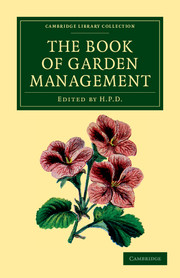
This anonymous work (the name of H. P. D., the author of the preface, is not known) was probably compiled by Samuel Orchart Beeton (1831–77), the publishing entrepreneur who made his wife's Book of Household Management one of the best-selling titles of the century. Published in 1871, it is a complete guide to gardening for the enthusiastic middle-class amateur, with instructions on everything from choosing the site to garden design, plants and cultivation, 'fountains, fish-ponds, and ornamental waters' to the use of colour, interspersed with a detailed calendar of tasks to be carried out each month. It is illustrated with line engravings and twelve plates (which can be viewed in colour online at http:www.cambridge.org/9781108049399), providing both practical information and a fascinating insight into the plants available to the Victorian gardener, the techniques for cultivating flowers, fruit and vegetables, and the then current trends in design and display.
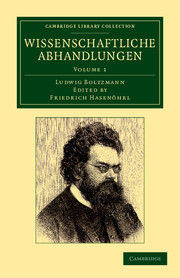
The Austrian physicist Ludwig Eduard Boltzmann (1844–1906), educated at the University of Vienna, was appointed professor of mathematical physics at the University of Graz in 1869 at the age of only twenty-five. Boltzmann did important work in the fields of statistical mechanics and statistical thermodynamics; for instance, he contributed to the kinetic theory concerned with molecular speeds in gas. Boltzmann also promoted atomic theory, which at the time was still highly controversial. He was a member of the Imperial Austrian Academy of Sciences from 1885 and became a member of the Royal Swedish Academy of Sciences in 1888. This three-volume work, prepared in 1909 by the physicist Fritz Hasenöhrl, one of Boltzmann's students, comprises all his academic publications from 1865 to 1905. Volume 1 contains papers from 1865 to 1874, including work on the movement of electricity, the theory of heat, and atoms in gases.
The Englefield mountain barometer was designed to calculate altitude and was so easy to use that a reading could be taken out of the window of a carriage – provided the horses stood still. Using a bar of mercury, which fell in the lower air pressure of higher altitudes, the barometer gave readings accurate to one thousandth of an inch. By taking a mercury reading at two locations, the owner could work out the difference in altitude between them. In this companion book, first published in 1817, the maker of the new barometer, Thomas Jones, provides tables listing the heights of objects measuring between fifteen and thirty-one inches of mercury. These measurements account for the heights of all mountains in England. He also includes tables that show how to allow for the expansion of both air and mercury. A fascinating book for historical researchers and experimenters in physics alike.
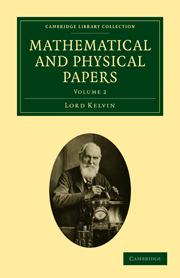
William Thomson, first Baron Kelvin (1824–1907), is best known for devising the Kelvin scale of absolute temperature and for his work on the first and second laws of thermodynamics, though throughout his 53-year career as a mathematical physicist and engineer at the University of Glasgow he investigated a wide range of scientific questions in areas ranging from geology to transatlantic telegraph cables. The extent of his work is revealed in the six volumes of his Mathematical and Physical Papers, published from 1882 until 1911, consisting of articles that appeared in scientific periodicals from 1841 onwards. Volume 2, published in 1884, includes articles from the period 1853–1856, and puts a special emphasis on the issue of the development of electric telegraphy. Also included is Thomson's Bakerian Lecture on the electro-dynamic qualities of metals.
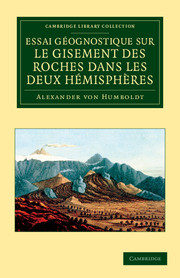
Prussian explorer and naturalist Alexander von Humboldt (1769–1859) was described by Darwin as 'the greatest scientific traveller who ever lived'. His boundless curiosity as well as his scientific and cultural knowledge helped lay the foundations of physical geography, climatology, ecology and oceanography. In 1799, Humboldt embarked on a five-year trip to explore Central and South America. He devoted a large amount of time to the study of géognosie, the science of the origin and distribution of minerals and rocks forming the earth, later known as geology. In 1805, Humboldt published his first impressions of volcanoes and earthquakes in the Americas in his Personal Narrative. In this 1826 work, he makes the first systematic attempt to compare the rocks of the Old and New Worlds. This groundbreaking analysis became one of the most important geological works of its time.
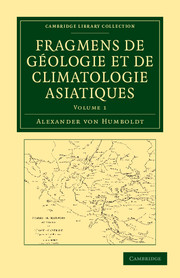
Prussian explorer Alexander von Humboldt (1769–1859) was one of the most respected scientists of his day, influencing the work of Darwin. He is considered the founder of physical geography, climatology, ecology and oceanography. In 1829, the Russian government invited Humboldt to visit the gold and platinum mines in the Urals. As he studied the mountains' mineral wealth, he was the first to predict the presence of diamonds. During six months, his epic 10,000-mile expedition took him as far as the Altai Mountains and the Chinese frontier. Humboldt's observations on the geography, volcanic geology and meteorology of Central Asia, being then a largely unexplored territory, were acknowledged as pioneering contributions. The results of his journey also provided much of the data used in part of his great work Kosmos. The first volume of this book, published in 1831, deals with the mountain chains and volcanoes of Central Asia.