To save content items to your account,
please confirm that you agree to abide by our usage policies.
If this is the first time you use this feature, you will be asked to authorise Cambridge Core to connect with your account.
Find out more about saving content to .
To save content items to your Kindle, first ensure no-reply@cambridge.org
is added to your Approved Personal Document E-mail List under your Personal Document Settings
on the Manage Your Content and Devices page of your Amazon account. Then enter the ‘name’ part
of your Kindle email address below.
Find out more about saving to your Kindle.
Note you can select to save to either the @free.kindle.com or @kindle.com variations.
‘@free.kindle.com’ emails are free but can only be saved to your device when it is connected to wi-fi.
‘@kindle.com’ emails can be delivered even when you are not connected to wi-fi, but note that service fees apply.
The discovery in 1897 of the electron, the first subatomic particle, led to rapid advances in our knowledge of atomic structure, the solid state, radioactivity and chemistry. It also raised major questions. Was the electron point-like or did it have structure? Was there a positive electron? What did the positive part of the atom look like? Did a hydrogen atom have one electron or a thousand? Published in 1906, this expository account by leading physicist Sir Oliver Lodge (1851–1940) examines the spectacular phenomena of cathode rays in evacuated tubes, the fixed units of charge observed in electrolysis, and the puzzling regularities in atomic spectra. Lodge knew most of the pioneers in the field, and his enthusiastic descriptions of their work and clear analyses of the problems as well as successes paint a vivid picture of the excitement of cutting-edge research and the scientific process in action.
Georges Cuvier (1769–1832), made a peer of France in 1819 in recognition of his work, was perhaps the most important European scientist of his day. His most famous work, Le Règne Animal, was published in French in 1817; Edward Griffith (1790–1858), a solicitor and amateur naturalist, embarked on in 1824, with a team of colleagues, an English version which resulted in this illustrated sixteen-volume edition with additional material, published between 1827 and 1835. Cuvier was the first biologist to compare the anatomy of fossil animals with living species, and he named the now familiar 'mastodon' and 'megatherium'. However, his studies convinced him that the evolutionary theories of Lamarck and St Hilaire were wrong, and his influence on the scientific world was such that the possibility of evolution was widely discounted by many scholars both before and after Darwin. Volume 10 covers the class of fish.
In 1889, a year after both he and Heinrich Hertz discovered electromagnetic waves and for the first time demonstrated the truth of Maxwell's great theory of the electromagnetic field, physicist Oliver Lodge (1851–1940) published his deepest reflections on the nature and meaning of electricity, how it originates, and its different manifestations. There had been great scientific advances - the work of Faraday and Maxwell, his own experiments and those of Hertz - and a revolution in technology. There were also puzzling questions. What is the connection between electricity and the ether that occupies space? How does electricity manifest itself in matter? Why does it come in fixed units? The discovery of the electron eight years later would offer crucial answers. Always lucid and direct, with a gift for making the difficult seem simple, Lodge engages the reader with his fascination for the subject, much as he did in his famous lectures.
Georges Cuvier (1769–1832), made a peer of France in 1819 in recognition of his work, was perhaps the most important European scientist of his day. His most famous work, Le Règne Animal, was published in French in 1817; Edward Griffith (1790–1858), a solicitor and amateur naturalist, embarked on in 1824, with a team of colleagues, an English version which resulted in this illustrated sixteen-volume edition with additional material, published between 1827 and 1835. Cuvier was the first biologist to compare the anatomy of fossil animals with living species, and he named the now familiar 'mastodon' and 'megatherium'. However, his studies convinced him that the evolutionary theories of Lamarck and St Hilaire were wrong, and his influence on the scientific world was such that the possibility of evolution was widely discounted by many scholars both before and after Darwin. Volume 14 is the first of two covering insects.
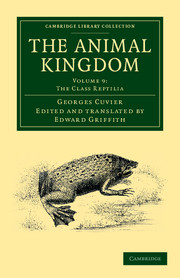
Georges Cuvier (1769–1832), made a peer of France in 1819 in recognition of his work, was perhaps the most important European scientist of his day. His most famous work, Le Règne Animal, was published in French in 1817; Edward Griffith (1790–1858), a solicitor and amateur naturalist, embarked on in 1824, with a team of colleagues, an English version which resulted in this illustrated sixteen-volume edition with additional material, published between 1827 and 1835. Cuvier was the first biologist to compare the anatomy of fossil animals with living species, and he named the now familiar 'mastodon' and 'megatherium'. However, his studies convinced him that the evolutionary theories of Lamarck and St Hilaire were wrong, and his influence on the scientific world was such that the possibility of evolution was widely discounted by many scholars both before and after Darwin. Volume 9 covers the class of reptiles.
Georges Cuvier (1769–1832), made a peer of France in 1819 in recognition of his work, was perhaps the most important European scientist of his day. His most famous work, Le Règne Animal, was published in French in 1817; Edward Griffith (1790–1858), a solicitor and amateur naturalist, embarked on in 1824, with a team of colleagues, an English version which resulted in this illustrated sixteen-volume edition with additional material, published between 1827 and 1835. Cuvier was the first biologist to compare the anatomy of fossil animals with living species, and he named the now familiar 'mastodon' and 'megatherium'. However, his studies convinced him that the evolutionary theories of Lamarck and St Hilaire were wrong, and his influence on the scientific world was such that the possibility of evolution was widely discounted by many scholars both before and after Darwin. Volume 16 is an index to the entire work.
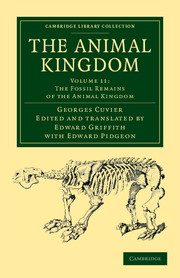
Georges Cuvier (1769–1832), made a peer of France in 1819 in recognition of his work, was perhaps the most important European scientist of his day. His most famous work, Le Règne Animal, was published in French in 1817; Edward Griffith (1790–1858), a solicitor and amateur naturalist, embarked on in 1824, with a team of colleagues, an English version which resulted in this illustrated sixteen-volume edition with additional material, published between 1827 and 1835. Cuvier was the first biologist to compare the anatomy of fossil animals with living species, and he named the now familiar 'mastodon' and 'megatherium'. However, his studies convinced him that the evolutionary theories of Lamarck and St Hilaire were wrong, and his influence on the scientific world was such that the possibility of evolution was widely discounted by many scholars both before and after Darwin. Volume 11 discusses the fossil remains of the animal kingdom.
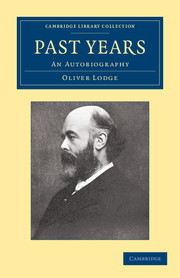
Sir Oliver Lodge (1851–1940) was a physicist instrumental in the discovery of electromagnetic waves: the basis of today's radio and X-ray technology. He came from humble beginnings. After suffering at the hands of violent masters and schoolmates during his childhood, Lodge went on to teach physics and chemistry to young women at Bedford College in London. Later, he was appointed professor of physics at the University of Liverpool, and became known for his public lectures on a vast range of topics, from the comic faults of phonographs to the medical applications of X-rays. Whether seeing the cells of a voltaic battery in a pile of plates or appreciating the enunciation of Alexander Graham Bell, Lodge had a warm enthusiasm that shines through in this touching autobiography, first published in 1931. It remains ideal for general readers as well as students in the history of science.
Published between 1839 and 1852, this two-volume work records the contribution of William Scoresby (1789–1857) to magnetic science, a field he considered one of 'grandeur'. The result of laborious investigations into magnetism and (with James Prescott Joule) electromagnetism, Scoresby's work was particularly concerned with improving the accuracy of ships' compasses. A whaler, scientist and clergyman, he epitomised the contribution which could be made to exploration and science by provincial merchant mariners - men often less celebrated than their counterparts in the Royal Navy or in metropolitan learned societies. In addition to his pioneering work on magnetic science, Scoresby furthered knowledge of Arctic meteorology, oceanography and geography. Volume 2 records Scoresby's investigations into the problem of navigating on iron-built ships, the section on shipwrecks proving just how pressing this was.