To save content items to your account,
please confirm that you agree to abide by our usage policies.
If this is the first time you use this feature, you will be asked to authorise Cambridge Core to connect with your account.
Find out more about saving content to .
To save content items to your Kindle, first ensure no-reply@cambridge.org
is added to your Approved Personal Document E-mail List under your Personal Document Settings
on the Manage Your Content and Devices page of your Amazon account. Then enter the ‘name’ part
of your Kindle email address below.
Find out more about saving to your Kindle.
Note you can select to save to either the @free.kindle.com or @kindle.com variations.
‘@free.kindle.com’ emails are free but can only be saved to your device when it is connected to wi-fi.
‘@kindle.com’ emails can be delivered even when you are not connected to wi-fi, but note that service fees apply.
Here we are in the shadows of speculation and must await the illumination of further discoveries.
Arthur Holmes
Margaret Howe was nearly thirty when she married Arthur Holmes at Gateshead United Methodist Church on Tuesday the 14th of July, 1914. The daughter of one of the famous Howe Brothers, a printing firm started very modestly by her grandfather in 1863 which had grown to be one of the biggest employers in Gateshead, Maggie was the youngest of three children. Her father, a master printer, was now comfortably retired but Maggie still lived with her parents in their fine Victorian house in Saltwell View, Gateshead, overlooking the park. Her brother and sister had both married and moved away so it fell to Maggie to stay at home and look after her parents.
It is unclear how the relationship arose, Arthur being five years Maggie's junior, but he wrote to her from Mozambique so they must have known each other for some time previously. Having been ‘squashed’ by Edie it appears Arthur's attentions turned to Maggie on his return from Mozambique. In a letter to Edward Wayland dated 8th October 1912, he shed some light on the subject:
I had, as a matter of fact, wanted a girl at home for a considerable time but … someone else appeared to be in the field. Fortunately he was unsuccessful, for the girl also wanted me but was under the impression that I was not available.
This book is for the general reader who wants to know how science really works and to know how much authority to grant to experts; it is for the student studying science at school or university; and it is for those at the very beginning of a course in the history, philosophy or sociology of science. In sum, the book is for the citizen living in a technological society. The book adapts the work of professional historians and sociologists for a more general audience. The chapters are of different origins. Some are based on our own work and some on our readings of a selection of the few books and papers in the history and sociology of science that adopt a non-retrospective approach. In these later cases we have relied on the original authors for additional information, and have had occasional resource to archival material. In choosing chapters to represent science we have been limited by the materials to hand. But, given this constraint, we have covered the ground in two ways. We have selected from the life sciences and the physical sciences and we have selected episodes of famous science alongside relatively mundane science and what some would call bad science. We have done this because we want to show that, in terms of our concerns, the science is the same whether it is famous or infamous, big or small, foundational or ephemeral.
Everyone is fascinated by memory and nearly everyone feels that they would prefer their memory to be a little better. Memorising lines in a play, or memorising multiplication tables, is the kind of hard work that people like to avoid. The slow growth of experience that counts as wisdom seems to be the gradual accumulation of memories over a lifetime. If only we could pass on our memories directly we could use our creative abilities from an early age without needing to spend years building the foundations first.
Between the late 1950s and the mid-1970s it began to look as though one day we might be able to build our memories without the usual effort. This was as a result of experiments done by James V. McConnell and, later, Georges Ungar, on the chemical transfer of memory in worms and rats. If memories are encoded in molecules then, in principle, it should be possible to transfer The Complete Works of Shakespeare to memory by ingesting a pill, to master the multiplication tables by injection into the bloodstream, or to become fluent in a foreign language by having it deposited under the skin; a whole new meaning would be given to the notion of ‘swallowing the dictionary’. McConnell and Ungar believed they had shown that memories were stored in chemicals that could be transferred from animal to animal.
Science seems to be either all good or all bad. For some, science is a crusading knight beset by simple-minded mystics while more sinister figures wait to found a new fascism on the victory of ignorance. For others it is science which is the enemy; our gentle planet, our feel for the just, the poetic and the beautiful, are assailed by a technological bureaucracy – the antithesis of culture – controlled by capitalists with no concern but profit. For some, science gives us agricultural self-sufficiency, cures for the crippled, and a global network of communication; for others it gives us weapons of war, a school teacher's fiery death as the space shuttle falls from grace, and the silent, deceiving, bone-poisoning, Chernobyl.
Both these ideas of science are wrong and dangerous. The personality of science is neither that of a chivalrous knight nor that of a pitiless juggernaut. What, then, is science? Science is a golem.
A golem is a creature of Jewish mythology. It is a humanoid made by man from clay and water, with incantations and spells. It is powerful. It grows a little more powerful every day. It will follow orders, do your work, and protect you from the ever threatening enemy. But it is clumsy and dangerous. Without control, a golem may destroy its masters with its flailing vigour.
Experience never misleads; what you are misled by is only your judgement.
Leonardo da Vinci
Progress on dating the age of the Earth was slow. Years, even decades went by without any significant advance being made. But science is like that. What is often not realised when the breakthrough finally occurs is that for years previously a few individuals had been diligently working in the background, thinking and writing about the problems, quietly and persistently pursuing their goal. Arthur Holmes was one. Every few years he took it upon himself to write an article summarising the current state of play with regard to the age of the Earth. In simple and lucid language he explained to the scientist and layman alike the history of radioactivity, its application to dating minerals and the age of the Earth, and included any recent developments. Year after year he said much the same thing: Kelvin's arguments were shot down in flames, the ‘hour-glass’ methods were swept aside, and radioactivity emerged victorious. Slowly, bit by bit, this one-man campaign spread the word about the great antiquity of the age of the Earth.
He also continued to build up the database. As early as 1923 a committee had been set up in America for ‘The Measurement of Geologic Time by Atomic Disintegration’, its objectives being to collate and monitor all the dating of rocks being done around the world.
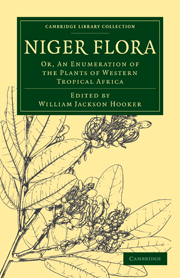
German scientist Theodore Vogel (1812–1841) joined an 1841 expedition to the Niger as its chief botanist. He died in the course of the journey, though not before taking extensive notes about the plants that he encountered. His botanical collection and diary were passed to the botanist William Jackson Hooker (1785–1865), who had been appointed as the first full-time director of Kew Gardens in the same year. Hooker edited Vogel's diary and observations and the resulting work, Niger Flora, was published in 1849. Because Vogel's period in West Africa was cut short by his untimely death, much of the work looks at the flora of the places the expedition stopped at along the way – Madeira, Tenerife and the Cape Verde islands, before giving details – including numerous illustrations – about west African plants. The works also includes observations on African flora by other botanists, including Joseph Dalton Hooker, William's son.
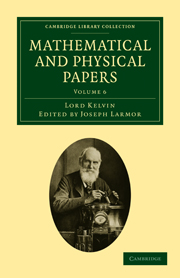
William Thomson, first Baron Kelvin (1824–1907), is best known for devising the Kelvin scale of absolute temperature and for his work on the first and second laws of thermodynamics, though throughout his 53-year career as a mathematical physicist and engineer at the University of Glasgow he investigated a wide range of scientific questions in areas ranging from geology to transatlantic telegraph cables. The extent of his work is revealed in the six volumes of his Mathematical and Physical Papers, published from 1882 until 1911, consisting of articles that appeared in scientific periodicals from 1841 onwards. Volume 6, published in 1911, includes articles from the period 1867–1907. The chapters in the first part of the work focus on voltaic theory and radioactivity, while later ones examine navigation and tides.
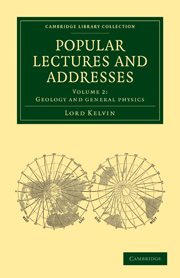
William Thomson, Baron Kelvin (1824–1907), was educated at Glasgow and Cambridge. While only in his twenties, he was awarded the University of Glasgow's chair in natural philosophy, which he was to hold for over fifty years. He is best known through the Kelvin, the unit of measurement of temperature named after him in consequence of his development of an absolute scale of temperature. These volumes collect together Kelvin's lectures for a wider audience. In a convivial but never condescending style, he outlines a range of scientific subjects to audiences of his fellow scientists. The range of topics covered reflects Kelvin's broad interests and his stature as one of the most eminent of Victorian scientists. Volume 2 is mainly concerned with geology and was actually published last, in 1894. It includes additional lectures given between 1866 and 1893 that were not included in the other two volumes.
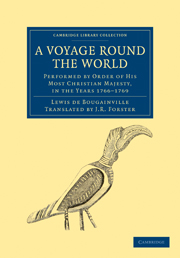
This is an English translation from 1772 of the famous Voyage Autour du Monde (1771) by Louis de Bougainville (1729–1811), French admiral and explorer. The contemporary fascination with global circumnavigation created demand for this translation by John Reinhold Forster (1729–98), which includes many annotations and comments from the translator himself on de Bougainville's observations. Describing all of de Bougainville's adventures on the voyage (which took place between 1766 and 1769) as well as his descriptions of local flora and fauna, the gripping tale includes such interesting passages as the unmasking of the botanist's valet as a woman (the first known to have circumnavigated the globe); de Bougainville's famous descriptions of Tahitian society; and graphic descriptions of the discomforts and perils of sea voyaging in the eighteenth century. It includes a copy of the original eighteenth-century plot of the route, and several plates representing original sketches from the trip.
William Thomson, Baron Kelvin (1824–1907), was educated at Glasgow and Cambridge. While only in his twenties, he was awarded the University of Glasgow's chair in natural philosophy, which he was to hold for over fifty years. He is best known through the Kelvin, the unit of measurement of temperature named after him in consequence of his development of an absolute scale of temperature. These volumes collect together Kelvin's lectures for a wider audience. In a convivial but never condescending style, he outlines a range of scientific subjects to audiences of his fellow scientists. The range of topics covered reflects Kelvin's broad interests and his stature as one of the most eminent of Victorian scientists. Volume 3, published in 1891, deals with the science of the seas and oceans, particularly as it relates to navigation, tides and magnetic forces.
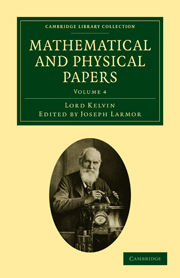
William Thomson, first Baron Kelvin (1824–1907), is best known for devising the Kelvin scale of absolute temperature and for his work on the first and second laws of thermodynamics, though throughout his 53-year career as a mathematical physicist and engineer at the University of Glasgow he investigated a wide range of scientific questions in areas ranging from geology to transatlantic telegraph cables. The extent of his work is revealed in the six volumes of his Mathematical and Physical Papers, published from 1882 until 1911, consisting of articles that appeared in scientific periodicals from 1841 onwards. Volume 4, published in 1910, includes articles from the period 1867–1906. Themes covered in this book examine issues relating to water, such as hydrodynamics, tidal theory and deep sea ship waves.
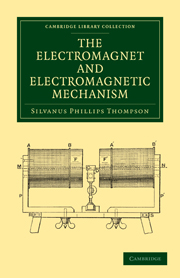
Silvanus P. Thompson (1851–1916) was an engineer and physicist who researched aspects of electricity, magnets and optics. He spent his career teaching, first as a professor in Bristol and later in London, at the City and Guilds Finsbury Technical College, and he was a frequent public speaker on scientific matters. Over the course of his career he became especially interested in technical education, and produced many books that explained complicated scientific concepts with clarity, including his most famous work Calculus Made Easy. In this work, published in 1891, Thompson explains the importance and function of the electromagnet. Starting with the history and development of electromagnets, the work looks at the principle of the magnetic current, and gives detailed descriptions – including numerous technical illustrations – of electromagnetic motors and machine tools, providing an engaging guide to the latest forms of scientific knowledge at the end of the nineteenth century.
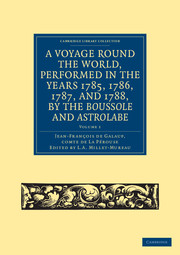
Jean François de Galaup, comte de La Pérouse (1741–88) was a French explorer appointed by Louis XVI to lead an expedition to explore the Pacific Ocean, which ended in disaster when in 1788 the ships left Botany Bay in Australia on course for the islands of Oceania, and were never heard from again. However, La Pérouse had sent back via a British ship letters, journals and charts which form the basis of these detailed volumes (first published in English translation in 1799), providing a fascinating account of the journey and the discoveries of the expedition. They provide valuable insights into the social and political context of contemporary scientific naval expeditions. Volume 1 contains a short biography of La Pérouse, copies of documents concerning the planning and provision of the expedition and a description of the voyage across the Pacific Ocean as far as Korea.
Sir David Brewster (1781–1868) was a Scottish physicist, mathematician, astronomer, inventor, and writer of international reputation. His biography of Sir Isaac Newton, published in 1855 and reissued in 1860, was the result of over twenty years' research, undertaken while publishing hundreds of scientific papers of his own. Brewster made use of previously unknown correspondence by Newton, and his own scientific interests, particularly in optics, meant that he was able to understand and explain Newton's work. It covered the many facets of Newton's personality and work, remaining the best available study of Newton for over a century. Brewster reveals much about the science of his own time in his handling of earlier centuries, and as a cleric was obviously uncomfortable about the evidence of Newton's unorthodox religious views and alchemical studies. Volume 2 covers the period from the dispute with Leibniz to Newton's death, and considers his posthumous reputation.
William Thomson, first Baron Kelvin (1824–1907), is best known for devising the Kelvin scale of absolute temperature and for his work on the first and second laws of thermodynamics, though throughout his 53-year career as a mathematical physicist and engineer at the University of Glasgow he investigated a wide range of scientific questions in areas ranging from geology to transatlantic telegraph cables. The extent of his work is revealed in the six volumes of his Mathematical and Physical Papers, published from 1882 until 1911, consisting of articles that appeared in scientific periodicals from 1841 onwards. Volume 5, published in 1911, includes articles from the period 1847–1908. Topics covered include thermodynamic and electrodynamic research, as well as some works on issues of geological physics such as the possible age of the sun's heat.
Jean François de Galaup, comte de La Pérouse (1741–88) was a French explorer appointed by Louis XVI to lead an expedition to explore the Pacific Ocean, which ended in disaster when in 1788 the ships left Botany Bay in Australia on course for the islands of Oceania, and were never heard from again. However, La Pérouse had sent back via a British ship letters, journals and charts which form the basis of these detailed volumes (first published in English translation in 1799), providing a fascinating account of the journey and the discoveries of the expedition. They provide valuable insights into the social and political context of contemporary scientific naval expeditions. Volume 2 contains a description of the remainder of the voyage to Botany Bay, navigational tables showing the route of the expedition and ethnological notes concerning the indigenous inhabitants of California and Easter Island.
First published in English in 1890, this book by Norwegian explorer and scientist Fridtjof Nansen (1861–1930) recounts the first crossing of the Greenland interior in 1888, an expedition that took two months. Learning from previous failed attempts, Nansen suggested crossing from the uninhabited east to the inhabited west of Greenland, an innovation that proved successful. Nansen's account was translated by Hubert Majendie Gepp and includes an introduction written by the secretary of the Royal Geographical Society. Volume 2 begins with the party setting out for the west, and includes lextensive descriptions of the climate and encounters with Inuit peoples. The book closes with the party reaching the west coast and journeying home. Volume 2 also includes an appendix of the scientific discoveries of the expedition. Nansen, who later served as delegate to the League of Nations, was awarded the 1922 Nobel Peace Prize for his humanitarian endeavours.