To save content items to your account,
please confirm that you agree to abide by our usage policies.
If this is the first time you use this feature, you will be asked to authorise Cambridge Core to connect with your account.
Find out more about saving content to .
To save content items to your Kindle, first ensure no-reply@cambridge.org
is added to your Approved Personal Document E-mail List under your Personal Document Settings
on the Manage Your Content and Devices page of your Amazon account. Then enter the ‘name’ part
of your Kindle email address below.
Find out more about saving to your Kindle.
Note you can select to save to either the @free.kindle.com or @kindle.com variations.
‘@free.kindle.com’ emails are free but can only be saved to your device when it is connected to wi-fi.
‘@kindle.com’ emails can be delivered even when you are not connected to wi-fi, but note that service fees apply.
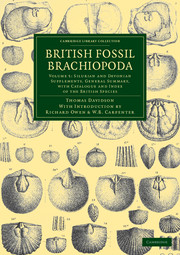
British palaeontologist Thomas Davidson (1817–85) was born in Edinburgh and began his studies at the city's university. Encouraged by German palaeontologist Leopold von Buch, he began to study brachiopod fossils at the age of twenty, and he quickly became the undisputed authority. He was elected fellow of the Geological Society of London in 1852, receiving the Wollaston medal in 1865. He became a Fellow of the Royal Society in 1857. Published between 1850 and 1886, this six-volume work became the definitive reference text on the subject. It includes more than two hundred hand-drawn plates and a comprehensive bibliography. This volume, the fifth of six, is the second of two supplements providing corrections to earlier volumes and detailing species discovered since the original volumes were published. It also features a general summary as well as a catalogue and index of British brachiopod species.
John D. Sedding (1838–91) was an English church architect and an influential figure in the Arts and Crafts movement. Having worked in Penzance and Bristol, he was elected a Fellow of the Royal Institute of British Architects in 1874 and set up a practice in London, eventually becoming a neighbour of William Morris. His designs included new churches such as Holy Trinity in Sloane Street (1888–90), Holy Redeemer in Clerkenwell (1887–95), and All Saints, Falmouth (1887–90), as well as restoration projects and decorative work. In 1888 he moved to Kent, and developed his interests in gardening and garden design. This book, completed in 1890 and published posthumously in 1891, sets out Sedding's vision for the landscaped garden. It helped to revive garden features such as terraces, covered walkways and topiary, and inspired generations of garden designers, particularly in the Arts and Crafts movement.
This biography of Swedish botanist Carl Linnaeus (1707–78) was originally published in 1903 by another Swedish botanist, Theodor Magnus Fries (1832–1913). This English version, published in 1923, was translated and edited by British botanist Benjamin Daydon Jackson (1846–1927). Jackson is best known for founding (with J. D. Hooker) the Index Kewensis, the register of all botanical names of seed plants; he also acted as Secretary of the Linnean Society for twenty-two years, becoming its General Secretary in 1902. This biography covers the early life of Linnaeus (including some family history), his student years at Uppsala, his travels, his years as a teacher, notes on his personality and his relationship with the wider scientific community. Jackson provides further information in the appendices, enhancing Fries' work with Linnaeus' genealogy, a list of his pupils, his private notes on 'Divine Punishment' and a brief history of Sweden during Linnaeus' lifetime.
Sir Charles James Fox Bunbury (1809–86), the distinguished botanist and geologist, corresponded regularly with Lyell, Horner, Darwin and Hooker among others, and helped them in identifying botanical fossils. He was active in the scientific societies of his time, becoming a Fellow of the Royal Society in 1851. This nine-volume edition of his letters and diaries was published privately by his wife Frances Horner and her sister Katherine Lyell between 1890 and 1893. His copious journal and letters give an unparalleled view of the scientific and cultural society of Victorian England, and of the impact of Darwin's theories on his contemporaries. Volume 3 covers the years from 1848 to 1856. In 1848 Bunbury published a well-received account of South Africa, and particularly its natural history: he had accompanied Sir George Napier, his step-mother's father, then governor general. Another notable event was a meeting in Berlin with Alexander von Humboldt.
Sir Humphry Davy (1778–1829) was a hugely influential chemist, inventor, and public lecturer who is recognised as one of the first professional scientists. His apprenticeship to an apothecary in 1795 led to his introduction to chemical experiments. A chance meeting with Davis Giddy in 1798 introduced Davy into the wider scientific community, and in 1800 he was invited to a post at the Royal Institution, where he lectured to great acclaim. This two-volume memoir was published by his brother, Dr John Davy, in 1836, in response to Paris' biography of 1831, authorised by Lady Davy (also reissued in this series). John Davy had additional papers in his possession, and felt that Paris had failed to convey Sir Humphry's character as a man and philosopher. Volume 2 concentrates on his researches (including on the safety lamp) and travels in Europe. It includes poetry, and also memorials of Davy by friends.
Sir Charles James Fox Bunbury (1809–86), the distinguished botanist and geologist, corresponded regularly with Lyell, Horner, Darwin and Hooker among others, and helped them in identifying botanical fossils. He was active in the scientific societies of his time, becoming a Fellow of the Royal Society in 1851. This nine-volume edition of his letters and diaries was published privately by his wife Frances Horner and her sister Katherine Lyell between 1890 and 1893. His copious journal and letters give an unparalleled view of the scientific and cultural society of Victorian England, and of the impact of Darwin's theories on his contemporaries. The final volume covers the years 1884–6. Bunbury's health was declining, but he kept up his journal- and letter-writing (although many of his contemporaries had predeceased him), and had many visitors. The volume ends with tributes written by his many friends.
John Stevens Henslow (1796–1861), professor of botany at Cambridge University and Anglican clergyman, is best remembered for his role as a mentor to Charles Darwin. First published in 1862, this biography by Henslow's colleague and brother-in-law, Leonard Jenyns, pays tribute to a man he describes as one of the most remarkable of his time. Through vivid accounts of times spent with Henslow both in the university and on travels around Britain, he paints a portrait of a modest and conscientious man, whose pursuits were intended solely for the benefit of others. Recounting Henslow's scientific work and religious endeavours, Jenyns also explores his pioneering contribution to botany and geology, his assistance to the farmers and the poor of his parish, and the role of his faith in his work. Compiled with help from Darwin and other colleagues, Jenyns' memoir provides a unique insight into an important figure in scientific history.
Originally published in 1832, this two-volume account of the life of Sir James Edward Smith (1759–1828) was posthumously compiled by his wife, Pleasance (1773–1877). Smith trained originally as a doctor, but his independent wealth enabled him to pursue botany. Hugely influenced by the work of Linnaeus, he benefited greatly from the purchase of the latter's library and herbarium in 1783, upon the advice of his friend, Sir Joseph Banks. He was highly regarded throughout Europe as a botanist, and in 1788 founded the Linnean Society. He published various botanical works, of which the most important was The English Flora (1824–8), and assisted in the publication of many more. His wife recounts his 'religious, social and scientific character' as well as his achievements, and Volume 2 includes correspondence from Alexander von Humboldt, and concludes with an appendix in which short papers by Smith present a variety of topics.
Charles Darwin (1809–82) was the English naturalist famous for the theory of evolution by natural selection. He began studying medicine at the University of Edinburgh, but developed a fascination for natural history and left Edinburgh to attend Christ's College, Cambridge, where he pursued his new interest while taking a Bachelor of Arts degree. After graduating, he had the opportunity to secure a position as ship's naturalist aboard H.M.S. Beagle for a five-year, round-the-world voyage which would make him famous. Published in 1845, this book is the second edition of Darwin's expedition journal, more popularly known as The Voyage of the Beagle. Throughout the journey he made observations and discoveries that would lead him to develop his revolutionary theory of evolution, which later appeared in On the Origin of Species and created a storm in the scientific and religious communities.
George John Romanes (1848–94), evolutionary biologist, was one of the most zealous supporters of Darwin's theory of evolution by natural selection in the nineteenth century. He met Darwin in 1874 and became a firm friend and follower, applying Darwinian theory to his work on animal intelligence and mental evolution. Romanes was elected to the Royal Society in 1879 at the age of 31, having produced his own influential research on the evolution of the nervous system. This three-volume study of Darwin's work and its implications was first developed as a series of lectures given in Edinburgh and London between 1886 and 1890. Controversially, Romanes deviates from Darwin's assertion of the significance of geographical isolation, contending that physiological differences among the same species were central to evolutionary change. First published in 1892, Volume 1 focuses on the Darwinian theory itself. This second edition appeared in 1893.
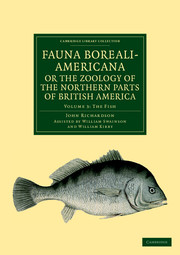
Containing Descriptions of the Objects of Natural History Collected on the Late Northern Land Expeditions under Command of Captain Sir John Franklin, R.N.
Sir John Richardson (1787–1865), surgeon, naturalist and Arctic explorer, went on Sir John Franklin's first two Arctic expeditions as ship's doctor and naturalist, and made observations and collected a large number of plant and animal specimens from the Canadian Arctic. On his return to England after the second expedition he began to write this four-volume work of natural history, first published between 1829 and 1837. A volume is dedicated to each of the classes of mammal, bird, fish and insect, which are found in the Canadian Arctic. This work is an interesting example of pre-Darwinian natural history, full of detailed descriptions of the appearance, anatomy and behaviour of the different species. Volume 3 was first published in 1836 and is devoted to the species of fish found in the Canadian Arctic. It contains many detailed illustrations, and discussions of the similarities between different species of fish.
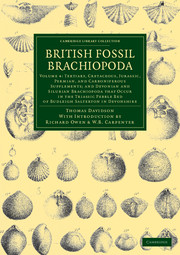
Volume 4, Tertiary, Cretaceous, Jurassic, Permian, and Carboniferous Supplements; and Devonian and Silurian Brachiopoda that Occur in the Triassic Pebble Bed of Budleigh Salterton in Devonshire
British palaeontologist Thomas Davidson (1817–85) was born in Edinburgh and began his studies at the city's university. Encouraged by German palaeontologist Leopold von Buch, he began to study brachiopod fossils at the age of twenty, and he quickly became the undisputed authority. He was elected fellow of the Geological Society of London in 1852, receiving the Wollaston medal in 1865. He became a Fellow of the Royal Society in 1857. Published between 1850 and 1886, this six-volume work became the definitive reference text on the subject. It includes more than two hundred hand-drawn plates and a comprehensive bibliography. This volume, the fourth of six, is the first of two supplements providing corrections to earlier volumes and detailing species discovered since the original volumes were published.
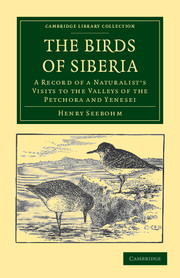
Henry Seebohm (1832–95) was a Yorkshire steel manufacturer and passionate amateur ornithologist. He travelled widely in Greece, Scandinavia, Turkey and South Africa studying birds in their native habitats. He served as secretary of the Royal Geological Society, was a fellow of the Linnean Society, and member of the British Ornithologists' Union and of the Zoological Society. This volume, published in 1901, contains two books recounting his travels in Siberia. Siberia in Europe (1880) was the result of an expedition to the lower Pechora River valley in 1875 with zoologist J. A. Harvie-Brown, and also his study of bird migrations in Heligoland with ornithologist Heinrich Gätke. He located the breeding grounds of several visitors to Britain, including the grey plover and Bewick's swan. Siberia in Asia (1882) was published after his 1877 journey with Arctic explorer Joseph Wiggins along the Yenisey River. There are numerous woodcuts illustrating birds and Siberian landscapes.
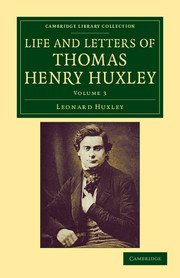
Thomas Henry Huxley (1825–95), the English biologist and naturalist, was known as 'Darwin's Bulldog', and is best remembered today for his vociferous support for Darwin's theory of evolution. He was, however, an influential naturalist, anatomist and religious thinker, who coined the term 'agnostic' to describe his own beliefs. Almost entirely self-educated, he became an authority in anatomy and palaeontology, and after the discovery of the archaeopteryx, he was the first to suggest that birds had evolved from dinosaurs. He was also a keen promoter of scientific education who strove to make science a paid profession, not dependent on patronage or wealth. Published in 1903, this three-volume work, edited by his son Leonard Huxley, is the second and most complete edition of Huxley's biography and selected letters. Volume 3 covers the period 1887–95, during which Huxley battled ill-health while continuing to defend his scientific ideals.
British palaeontologist Thomas Davidson (1817–85) was born in Edinburgh and began his studies at the city's university. Encouraged by German palaeontologist Leopold von Buch, he began to study brachiopod fossils at the age of twenty, and he quickly became the undisputed authority. He was elected fellow of the Geological Society of London in 1852, receiving the Wollaston medal in 1865. He became a Fellow of the Royal Society in 1857. Published between 1850 and 1886, this six-volume work became the definitive reference text on the subject. It includes more than two hundred hand-drawn plates and a comprehensive bibliography. This volume, the last of six, is a thorough bibliography of brachiopod research literature up to 1886.
George John Romanes (1848–94) was considered by The Times to be 'the biological investigator upon whom in England the mantle of Mr. Darwin has most conspicuously descended'. Incorporating some of Darwin's unpublished notes, this book explores the question of whether human intelligence evolved. In a stance still often considered controversial at the time of its first printing in 1888, the first half establishes a link between humans and animals, and introduces some of the most important issues of nineteenth-century evolutionary psychology: the impact of relative brain sizes of humans and primates, the origin of self-consciousness and the possible reasons behind the apparent mental stasis of what Romanes terms 'savage man'. Following the argument that one of the main factors to be considered is language, the second half focuses on philology. Romanes' earlier work, Mental Evolution in Animals (1883), is also reissued in this series.
Sir Charles James Fox Bunbury (1809–86), the distinguished botanist and geologist, corresponded regularly with Lyell, Horner, Darwin and Hooker among others, and helped them in identifying botanical fossils. He was active in the scientific societies of his time, becoming a Fellow of the Royal Society in 1851. This nine-volume edition of his letters and diaries was published privately by his wife Frances Horner and her sister Katherine Lyell between 1890 and 1893. His copious journal and letters give an unparalleled view of the scientific and cultural society of Victorian England, and of the impact of Darwin's theories on his contemporaries. Volume 5 covers the years 1865–8, and shows Bunbury's wide reading, from Latin poetry and military history to new books such as the latest edition of Lyell's Elements of Geology, as well as an interesting correspondence between Bunbury, Lyell, Hooker and Darwin about Agassiz's theories on glaciation.
In this work, first published in 1802 and followed by many subsequent editions, the famous horticulturalist William Forsyth (c. 1737–1804) gives an exhaustive guide to the cultivation of fruit trees and advises on pests and diseases. Forsyth was appointed superintendent of the Royal Gardens of St James and Kensington in 1784, and was also one of the founders of the (now Royal) Horticultural Society. The work is divided into two parts: in the first, various kinds of fruit trees, including soft fruit and nuts, are described in detail. Forsyth explains how to plant and prune them and gives advice on harvesting and storing the produce. In the short second part, Forsyth discusses the need for better care of both fruit and forest trees (good-quality timber being needed especially in time of war), and advocates a 'Composition' of his own invention for improving the health of diseased and damaged trees.
Containing Descriptions of the Objects of Natural History Collected on the Late Northern Land Expeditions under Command of Captain Sir John Franklin, R.N.
Sir John Richardson (1787–1865), surgeon, naturalist and Arctic explorer, went on Sir John Franklin's first two Arctic expeditions as ship's doctor and naturalist, and made observations and collected a large number of plant and animal specimens from the Canadian Arctic. On his return to England after the second expedition he began to write this four-volume work of natural history, first published between 1829 and 1837. A volume is dedicated to each of the classes of mammal, bird, fish and insect, which are found in the Canadian Arctic. This work is an interesting example of pre-Darwinian natural history, full of detailed descriptions of the appearance, anatomy and behaviour of the different species. Volume 2 was first published in 1831 and focuses on the species of birds found in the Canadian Arctic. It was co-authored with naturalist and illustrator William Swainson (1789–1855) and contains many illustrations.
In 1808, Napoleon I, Emperor of the French from 1804 to 1815, commissioned a series of official reports on the progress of scientific research since 1789. First published in 1810, this report on the current state of science was written by French naturalist and zoologist Georges Cuvier (1769–1832). One of the first scientists to establish the fields of comparative anatomy and palaeontology, Cuvier became permanent secretary of the Academy of Sciences in 1803. As such, he was charged with examining the state of science in higher educational establishments, and with presenting an overview of the progress accomplished during Napoleon's reign in the fields of chemistry, physics, biology, geology, and medicine. This report includes discoveries made by French scientists, such as the chemist Antoine Lavoisier (1743–94), as well as those made in the countries then under French occupation.