To save content items to your account,
please confirm that you agree to abide by our usage policies.
If this is the first time you use this feature, you will be asked to authorise Cambridge Core to connect with your account.
Find out more about saving content to .
To save content items to your Kindle, first ensure no-reply@cambridge.org
is added to your Approved Personal Document E-mail List under your Personal Document Settings
on the Manage Your Content and Devices page of your Amazon account. Then enter the ‘name’ part
of your Kindle email address below.
Find out more about saving to your Kindle.
Note you can select to save to either the @free.kindle.com or @kindle.com variations.
‘@free.kindle.com’ emails are free but can only be saved to your device when it is connected to wi-fi.
‘@kindle.com’ emails can be delivered even when you are not connected to wi-fi, but note that service fees apply.
George John Romanes (1848–94), evolutionary biologist, was one of the most zealous supporters of Darwin's theory of evolution by natural selection in the nineteenth century. He met Darwin in 1874 and became a firm friend and follower, applying Darwinian theory to his work on animal intelligence and mental evolution. Romanes was elected to the Royal Society in 1879 at the age of 31, having produced his own influential research on the evolution of the nervous system. This three-volume study of Darwin's work and its implications was first developed as a series of lectures given in Edinburgh and London between 1886 and 1890. Controversially, Romanes deviates from Darwin's assertion of the significance of geographical isolation, contending that physiological differences among the same species were central to evolutionary change. Published posthumously in 1897, Volume 3 considers the 'post-Darwinian question' of isolation, incorporating Romanes' own theories on physiological selection.
Alexander von Humboldt (1769–1859) was a naturalist, explorer and philanthropist now well known for his multidisciplinary approach to science. First published in English in 1873, this two-volume biography was translated from the German edition of 1872, edited by Karl Bruhns, which had been compiled in commemoration of the centenary of Humboldt's birth. Incorporating numerous extracts of Humboldt's own warmly written letters and anecdotes from his many acquaintances, it charts his travels in South America, Asia and Europe. Volume 2 covers his later life, exploring his impecunious period in Paris at the École Polytechnique, where he shared rooms with the famous French chemist Gay-Lussac, and later, his close association with King Frederick William IV of Prussia. Ideal for students and researchers in the history of science, this is a minutely detailed and compelling insight into the life of the man behind the scientist.
Sir Charles James Fox Bunbury (1809–86), the distinguished botanist and geologist, corresponded regularly with Lyell, Horner, Darwin and Hooker among others, and helped them in identifying botanical fossils. He was active in the scientific societies of his time, becoming a Fellow of the Royal Society in 1851. This nine-volume edition of his letters and diaries was published privately by his wife Frances Horner and her sister Katherine Lyell between 1890 and 1893. His copious journal and letters give an unparalleled view of the scientific and cultural society of Victorian England, and of the impact of Darwin's theories on his contemporaries. Volume 2 covers the years 1844–8, and shows how Bunbury's marriage brought him into close contact with the geologist Charles Lyell, whom he greatly admired, and who became his brother-in-law. His diaries mention attending lectures by Sedgwick and Owen, and socialising with Babbage and Henslow among others.
British palaeontologist Thomas Davidson (1817–85) was born in Edinburgh and began his studies at the city's university. Encouraged by German palaeontologist Leopold von Buch, he began to study brachiopod fossils at the age of twenty, and he quickly became the undisputed authority. He was elected fellow of the Geological Society of London in 1852, receiving the Wollaston medal in 1865. He became a Fellow of the Royal Society in 1857. Published between 1850 and 1886, this six-volume work became the definitive reference text on the subject. It includes more than two hundred hand-drawn plates and a comprehensive bibliography. This volume, the second of six, details the Permian and Carboniferous brachiopod species.
To Which is Annexed the Diary of Linnaeus, Written by Himself, and Now Translated into English, from the Swedish Manuscript in the Possession of the Editor
Carl Linnaeus (1707–88), father of modern taxonomy, was one of the most important scientists of the eighteenth century. This biography was written by Richard Pulteney (1730–1801), a physician and botanist who greatly admired Linnaeus' methods and aimed to promote them in England. The first edition was published in 1781 and contains a thorough account of the major works of Linnaeus and his unpublished papers. As well as details of his academic career, the work also gives insights into Linnaeus' character and personal life. The second edition, reissued here, was edited by William George Maton (1774–1835), a physician and member of the Linnean Society, and published in 1805. It contains in addition a memoir of Pulteney and a translation of a Swedish life of Linnaeus based on his own notes. The book is a rich source of information on a central figure in the history of botany.
Luke Howard (1772–1864) was a pharmacist and businessman, but is most famous for his contributions to meteorology. He classified clouds by their appearance and gave them their modern names of cumulus, cirrus, nimbus and stratus. He was educated at a Quaker school in Oxfordshire, then trained as a pharmacist, but was fascinated by weather throughout his life, and developed into a keen amateur meteorologist. He wrote several important texts on the subject including The Climate of London, an early study in urban climatology, and On the Modification of Clouds (both also reissued in this series). Published in 1837, Seven Lectures on Meteorology covers the components of the atmosphere, seasonal variation in winds and temperature, the use of barometers, cloud structure, and visual phenomena such as rainbows and the Aurora Borealis. This reissue also includes Howard's short 1842 book which details selected British weather data from 1824 to 1841.
With the Scientific Portions Revised by C. Davies Sherborn and an Essay on Owen's Position in Anatomical Science by the Right Hon. T. H. Huxley, F.R.S.
Richard Owen, F.R.S. (1804–92) was a controversial and influential palaeontologist and anatomist. Originally from Lancaster, he studied medicine at the University of Edinburgh and at London's St Bartholomew's Hospital. He grew interested in anatomical research and, after qualifying as a surgeon, became assistant conservator in the museum of the Royal College of Surgeons, and then superintendent of natural history in the British Museum. He became an authority on comparative anatomy and palaeontology, coining the term 'dinosaur' and founding the Natural History Museum. He was also a fierce critic of Darwin's theory of evolution by natural selection, and engaged in a long and bitter argument with Thomas Huxley, known as 'Darwin's bulldog' for his belligerent support of the theory. Published in 1894, this two-volume biography draws on Owen's diaries and a wealth of correspondence. Volume 1 covers Owen's life up to 1854, just before his appointment to the British Museum.
Gertrude Jekyll (1843–1932), the distinguished and influential garden designer of the late nineteenth and early twentieth centuries, originally trained as an artist but later turned her hand to craftwork, gardening, and plant collecting and breeding. During her career she collaborated with distinguished architects such as Sir Edwin Lutyens and reached a popular audience through the publication of articles in newspapers and magazines such as William Robinson's The Garden. Jekyll's second book, first published in 1890, is a collection of her advice and reflections on a range of topics, particularly those relating to her own home, Munstead Wood. It contains chapters on particular plants, and gives guidance on projects such as building rock gardens, as well as more idiosyncratic pieces on her cats, or the importance of one's own tools. Jekyll's informal tone and the range of topics discussed make this a fascinating work of social and gardening history.
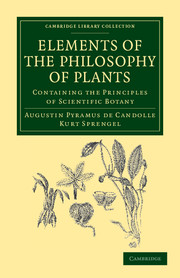
Containing the Principles of Scientific Botany; Nomenclature, Theory of Classification, Phythography; Anatomy, Chemistry, Physiology, Geography, and Diseases of Plants
This treatise on scientific botany brings together the works of two leading European scientists from the beginning of the nineteenth century, the Swiss botanist Augustin Pyramus de Candolle (1778–1841) and the German botanist and physicist Kurt Polycarp Joachim Sprengel (1766–1833). First published in German in 1820, it was almost immediately translated (anonymously) into English and published in Edinburgh by Blackwood in 1821. This collaborative volume includes three chapters from de Candolle's Théorie élémentaire de la botanique published in Paris in 1819, while the remaining texts and the preface were written by Sprengel; at the time, it provided significant advances on previous botanical theories such as the work of German botanist Carl Ludwig Willdenow (1765–1812). A fascinating document on the evolution of botanical science, the book contains a practical section detailing the characteristics of over forty plants, as well as eight illustrations.
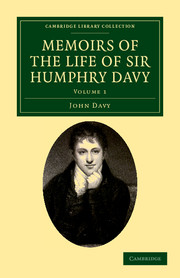
Sir Humphry Davy (1778–1829) was a hugely influential chemist, inventor, and public lecturer who is recognised as one of the first professional scientists. His apprenticeship to an apothecary in 1795 led to his introduction to chemical experiments. A chance meeting with Davis Giddy in 1798 introduced Davy into the wider scientific community, and in 1800 he was invited to a post at the Royal Institution, where he lectured to great acclaim. This two-volume memoir was published by his brother, Dr John Davy, in 1836, in response to Paris' biography of 1831, authorised by Lady Davy (also reissued in this series). John Davy had additional papers in his possession, and felt that Paris had failed to convey Sir Humphry's character as a man and philosopher. Volume 1 deals with his education and apprenticeship, work at the Royal Institution, and European travels. The author quotes extensively from his brother's writings.
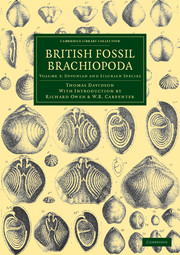
British palaeontologist Thomas Davidson (1817–85) was born in Edinburgh and began his studies at the city's university. Encouraged by German palaeontologist Leopold von Buch, he began to study brachiopod fossils at the age of twenty, and he quickly became the undisputed authority. He was elected fellow of the Geological Society of London in 1852, receiving the Wollaston medal in 1865. He became a Fellow of the Royal Society in 1857. Published between 1850 and 1886, this six-volume work became the definitive reference text on the subject. It includes more than two hundred hand-drawn plates and a comprehensive bibliography. This volume, the third of six, details the Devonian and Silurian brachiopod species, and features an essay by Roderick Impey Murchison on the classification of Silurian rocks.
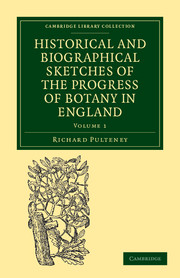
Richard Pulteney (1730–1801) was a Leicestershire physician whose medical career suffered both from a lack of aristocratic patronage and from his dissenting religious background. However, his lifelong interest in botany and natural history, and particularly his work on the new Linnaean system of botanical classification, led to publications in the Gentleman's Magazine and the Philosophical Transactions of the Royal Society. He was elected a Fellow of the Royal Society in 1762. His book on Linnaeus (also reissued in this series), first published in 1782, was later considered to be of great significance for the acceptance in England of the Linnaean system, and this two-volume work, published in 1790, is still relevant to the study of the history of botany. Volume 1 begins in 'primaeval' and 'druidical' times and continues to the seventeenth century, including the first printed herbals and the work of the great botanist John Ray.
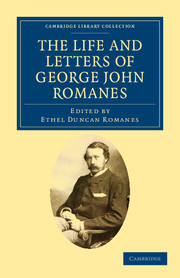
George John Romanes (1848–94) was an influential evolutionary biologist whose work focused on the evolution of mental faculties. Although criticised for his anecdotal method, he is credited as being one of the pioneers of comparative psychology for his work on animal intelligence, and he also contributed to the development of the theory of natural selection. Romanes and Charles Darwin (1809–82) were close friends, and Darwin gave Romanes his notes on psychology for use in his studies. First published in 1896, this biography was written by his wife Ethel (1856–1927), also an author on religious topics. This reissue is of the second printing (also 1896): including correspondence between Darwin and Romanes, it is a rich source of information on both men and the development of their work. This book is also fascinating for its account of Romanes' mental conflict between his Christian faith and belief in evolution.
Gertrude Jekyll (1843–1932) was one of the most influential garden designers of the late nineteenth and early twentieth centuries. Skilled as a painter and in many forms of handicrafts, she found her metier in the combination of her artistic skills with considerable botanical knowledge. Having been collecting and breeding plants, including Mediterranean natives, since the 1860s, she began writing for William Robinson's magazine, The Garden, in 1881, and together they are regarded as transforming English horticultural method and design: Jekyll herself received over 400 design commissions in Britain, and her few surviving gardens are treasured today. Like Robinson's, her designs were informal and more natural in style than earlier Victorian fashions. In this, the first of fourteen books, published in 1899, she stresses the importance of being inspired by nature, and sums up her philosophy of gardening: 'planting ground is painting a landscape with living things'.
Julius Sachs (1832–97) was an important and influential German botanist. He attended Charles University in Prague, gaining his doctorate in 1856. After appointments in Dresden, Chemnitz and Bonn, he took a professorship at the University of Freiburg in 1867. A year later he accepted a chair at Würzburg, where he stayed for the rest of his career. Sachs made important contributions across botanical science, notably in cytology and photosynthesis. He was also largely responsible for the leap in understanding of plant physiology that took place in the second half of the nineteenth century. His famous Textbook of Botany, published here in the 1875 English translation of the final German edition (1874), takes the physiological approach that he pioneered and features hundreds of instructive illustrations and a full index. It was the most influential botanical text of its day, and the standard textbook on the subject for many years.
Sir Charles James Fox Bunbury (1809–86), the distinguished botanist and geologist, corresponded regularly with Lyell, Horner, Darwin and Hooker among others, and helped them in identifying botanical fossils. He was active in the scientific societies of his time, becoming a Fellow of the Royal Society in 1851. This nine-volume edition of his letters and diaries was published privately by his wife Frances Horner and her sister Katherine Lyell between 1890 and 1893. His copious journal and letters give an unparalleled view of the scientific and cultural society of Victorian England, and of the impact of Darwin's theories on his contemporaries. Volume 1 begins with a short autobiographical memoir written by Bunbury towards the end of his life, and ends with his marriage to Frances Horner in 1844. It demonstrates his interest in science, encouraged by his parents and continued at Cambridge and during travels in Europe and South America.
Born in Leighlinbridge in Ireland, John Tyndall (1820–93) was a brilliant nineteenth-century experimental physicist and gifted science educator. He worked initially as a draughtsman, then spent a year teaching at an English school before attending the University of Marburg to study physics and chemistry. Tyndall carried out important research on magnetism, light and bacteriology. Among his many significant achievements, he demonstrated the greenhouse effect in Earth's atmospheric gases using absorption spectroscopy. He was a skilled and entertaining educator and as Professor of Natural Philosophy at the Royal Institution he gave many public lectures and demonstrations of science. Published in 1873, this book features six accessible lectures on light. They explore a wide range of ideas in a non-technical way, from basic scientific theories through magnetism and light scattering, to analytical spectroscopy. The book ends with a series of essays on special topics, and includes a detailed index.
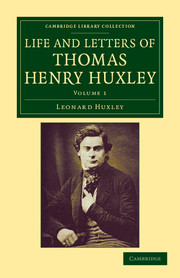
Thomas Henry Huxley (1825–95), the English biologist and naturalist, was known as 'Darwin's Bulldog', and is best remembered today for his vociferous support for Darwin's theory of evolution. He was, however, an influential naturalist, anatomist and religious thinker, who coined the term 'agnostic' to describe his own beliefs. Almost entirely self-educated, he became an authority in anatomy and palaeontology, and after the discovery of the archaeopteryx, he was the first to suggest that birds had evolved from dinosaurs. He was also a keen promoter of scientific education who strove to make science a paid profession, not dependent on patronage or wealth. Published in 1903, this three-volume work, edited by his son Leonard Huxley, is the second and most complete edition of Huxley's biography and selected letters. Volume 1 covers the period 1825–69, including his expedition to Australasia and the publication of the On the Origin of Species (1859).
Born in Leighlinbridge in Ireland, John Tyndall (1820–93) was a brilliant nineteenth-century experimental physicist and gifted science educator. He worked initially as a draughtsman, then spent a year teaching at an English school before attending the University of Marburg to study physics and chemistry. Tyndall carried out important research on magnetism, light and bacteriology. Among his many significant achievements, he demonstrated the greenhouse effect in Earth's atmospheric gases using absorption spectroscopy. He was a skilled and entertaining educator and as Professor of Natural Philosophy at the Royal Institution he gave many public lectures and demonstrations of science. In this engaging potpourri of essays published in 1893, Tyndall's prose enlivens subjects as diverse as the life of Louis Pasteur, observing the Sabbath, the prevention of phthisis (tuberculosis), personal experiences of Alpine mountaineering, and the science of rainbows.
Alphonse de Candolle (1806–93) was a French-Swiss botanist who was an important figure in the study of the origins of plants and the reasons for their geographic distribution. He also created the first Code of Botanical Nomenclature. Despite initially studying law, he took over both the chair of botany at the University of Geneva, and the directorship of Geneva's botanical gardens from his father Augustin de Candolle (1778–1841). He published numerous botanical books, and edited ten volumes of the Prodromus, a seventeen-volume reference text intended to cover the key properties of all known seed plants. This work, reissued in the second edition of the English translation of 1886, is his most famous and influential book, tracing the geographic origins of plants known to have been cultivated by humans. It is one of the earliest studies of the history of crop domestication, and an important contribution to phytogeography.