To save content items to your account,
please confirm that you agree to abide by our usage policies.
If this is the first time you use this feature, you will be asked to authorise Cambridge Core to connect with your account.
Find out more about saving content to .
To save content items to your Kindle, first ensure no-reply@cambridge.org
is added to your Approved Personal Document E-mail List under your Personal Document Settings
on the Manage Your Content and Devices page of your Amazon account. Then enter the ‘name’ part
of your Kindle email address below.
Find out more about saving to your Kindle.
Note you can select to save to either the @free.kindle.com or @kindle.com variations.
‘@free.kindle.com’ emails are free but can only be saved to your device when it is connected to wi-fi.
‘@kindle.com’ emails can be delivered even when you are not connected to wi-fi, but note that service fees apply.
This 1939 work gives deserved recognition to the achievements of the engineer and businessman Matthew Boulton. Boulton's importance has generally been overshadowed by that of his partner James Watt, but he was a significant figure in his own right, particularly in relation to the Soho Foundry and his production of coins and medals. He belonged to a network of highly significant men of the period, including Josiah Wedgwood, Erasmus Darwin and Benjamin Franklin, and was a founding member of the Lunar Society of Birmingham. An engineer by profession, H. W. Dickinson researched widely, and published highly readable works on the history of the steam engine, Watt, and Trevithick, also reissued in this series. He succeeds in producing a work which appeals to the scientist, the historian and the general reader, without feeling obliged to over-simplify the technical details.
C. E. Raven (1885–1964) was an academic theologian elected Regius Professor of Divinity at the University of Cambridge in 1932, who developed an interest in natural history and the history of scientific thought. First published in 1947, this volume demonstrates how changing attitudes to the natural world reflected and influenced the transformations in scientific thought between the medieval period and the eighteenth century. Raven's focus on the field of 'natural history' reveals how the scientific ideas behind modern biological studies developed from the richly illustrated and often fantastical bestiaries of the medieval world. The subjects of this volume are grouped chronologically into Pioneers, Explorers and Popularisers, with biographical details woven together with discussions of their academic work. The book provided a wealth of new information concerning the founders of natural history and remains a valuable contribution to this subject.
Agnes Arber (1879–1960) was a prominent British botanist specialising in plant morphology and the history of botany. In 1946 she became the first female botanist to be elected a Fellow of the Royal Society. First published in 1912 and issued in an expanded second edition in 1938, this volume traces the history and development of printed herbals between 1470 and 1670. This two-hundred-year period was the most prolific for the publication of herbals, and significantly saw the emergence of botany as a scientific discipline within the study of natural history. Although Arber mentions the medical aspects of the herbal, her analysis remains focused on investigating herbals from a botanical view, with chapters devoted to the evolution of plant descriptions, classifications and illustrations. Her book remains the standard work on this subject. The text of this volume is taken from a 1953 reissue of the 1938 second edition.
This 1936 book, published to celebrate the bicentenary of Watt's birth, examines his career as a craftsman and engineer, rather than offering a purely narrative biography. Watt began his life as a maker of mathematical instruments, and throughout his working life enjoyed the challenge of such skilled work. Watt's inventions did much to power the Industrial Revolution and its economic and social consequences. However, he owed much of his commercial success to his long partnership with Matthew Boulton, a far more astute businessman, and a considerable portion of the book is devoted to the achievements of this period. An engineer by profession, H. W. Dickinson researched widely, and published highly readable works on the steam engine, Watt, Boulton and Trevithick. He succeeds in producing a work which appeals to the scientist, the historian and the general reader, without feeling obliged to over-simplify the technical details.
Agnes Arber (1879–1960) was a prominent British botanist specialising in plant morphology and comparative anatomy. In 1946, she became the first female botanist to be elected a Fellow of the Royal Society. First published in 1920, this volume provides a detailed anatomical study of aquatic flowering plants, with a discussion of their evolutionary history. Arber describes the general anatomical and reproductive organs, life histories and physiological adaptations of aquatic plants in detail, with interpretations informed from her previous experimental work. The final section of this volume discusses the evolutionary history of aquatic plants in the light of affinities to terrestrial flowering plants. Arber's account of aquatic plants was the first general description of these plants published, and provides a classic example of the comparative anatomy studies which were central to botanical investigation during the early twentieth century. An extensive bibliography and over 170 illustrations are included in this volume.
These Memorials of Andrew Crosse (1784–1855), published by his wife after his death, include his experiments, and some of his poetry and prose. After graduating from Brasenose College, Oxford, in 1805 (described in this volume as 'a perfect hell on earth'), he returned to his family's manor house where he studied electricity, chemistry, and mineralogy, and installed a mile and a quarter of insulated copper wire in his grounds. A controversial figure, Crosse was thorough in his approach to his scientific work, if somewhat unusual in his practice. In 1836 he famously conducted a series of experiments on electro-crystallization in which he noted an appearance of life forms, named Acarus, seemingly created in the metallic solutions which should have been destructive to organic life. This book recounts these experiments, and the public sensation that they gave rise to by their apparent suggestion of life created by electricity.
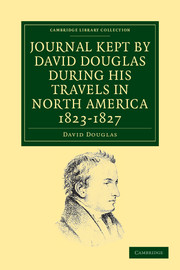
David Douglas (1799–1834), the influential Scottish botanist and plant collector, trained as a gardener before attending Perth College and Glasgow University. His genius for botany flourished and his talents came to the attention of the Royal Horticultural Society. With the society's backing he went to North America in 1823, beginning his life-long fascination with the region's flora. He discovered thousands of new species and introduced 240 of them to Britain, including the Douglas fir. Douglas continued to explore and discover plant species until his death in the Sandwich Islands (present-day Hawaii) in 1834. This remarkable journal, which remained unpublished until 1914, describes his adventures in North America during 1823–7. It also includes extracts from his journal of his explorations of Hawaii during 1833–4. The appendices include a listing of the plants Douglas introduced to Britain, and contemporary accounts of investigations into the mysterious circumstances of his death.
The Golem has attracted many reviews and much comment. In particular, the chapter on the foundation of relativity has given rise to a long debate which included a three-day workshop in which scientists, historians and sociologists met to discuss the history of relativity and its significance for The Golem. What we learned from the criticisms and the discussions has been incorporated in this new edition.
There is no doubt that, from the scientists' point of view, the original text had its faults. We have corrected these and all such changes are detailed at the end of the new Afterword. The main text has probably changed less than our scientist critics would have liked and the larger part of the Afterword is taken up with explaining why: We examine each serious criticism, either accepting it and making a change or putting the sociologist/historian's point of view. We have found the discussions enormously to our benefit even where the scientists and ourselves were unable to reach agreement.
From our point of view, one of the greatest benefits of writing The Golem has been the discovery that scientists and social scientists can discuss the issues in a register more familiar to academics than to religious zealots. As a result each of us has been able to learn from the other though this does not mean we agree about everything.
C. P. Snow, in his famous essay on the two cultures, set comprehension of the second law of thermodynamics as the standard for scientific literacy. The essays in The Golem represent a body of writing emerging from the humanities and the social sciences in which the authors have understood the second law of thermodynamics or its equivalent. Far from applauding, however, many scientists have reacted as though they would rather the scholars had stayed on their own side of the cultural divide. For these ‘science warriors’ the only acceptable way to talk about science is the scientists’ way.
The Golem became caught up in the ‘science wars’ because its authors, and those they represent, do not share the divisive model of the two cultures. We see it as a matter of building an island between the two territories on which species from both can flourish. Visitors to this new land do not have to agree about everything, they just have to know how to talk to each other and how to learn the customs and habits of their neighbours. Perhaps they will come to enjoy the strange fruits of the new territory even if they never become dietary staples.
How immeasurable would be the advance of our science could we but bring the chief events which it records into some relation with a standard of time!
William Sollas
Like most small boys brought up in a religious community, as would have existed in the Methodist enclaves of Gateshead at the turn of the twentieth century, Arthur Holmes and his friend Bob Lawson did not often find their favourite reading in the Bible. But in years to come Arthur well remembered his parent's Bible, and the magic fascination of the date of Creation, 4004 BC, which appeared in the margin of the first page. ‘I was puzzled by the odd “4”’, he wrote. ‘Why not a nice round 4000 years? And why such a recent date? And how could anyone know?’ But all he learnt from his parents was that to question the ‘Word of God’ was simply ‘not done’. This Biblical time barrier was further reinforced in Arthur's mind at Sunday School through the teachings of Philip Gosse, a Victorian naturalist who considered he had reconciled Hutton's geological findings with the Scriptures in his distinguished book Omphalos. In this work no compromise was called for. It was only necessary to believe that the Earth was created about 6000 years ago, in strict accordance with Biblical chronology, ‘exactly as it would have appeared at that moment of its history, if all the preceding eras of its history had been real’.
The Earth seems to have been born from the star spray of a stellar collision, but only in the realms of imagination can her destiny be foreshadowed.
Arthur Holmes
During the Second World War, as the Blitz raged over Britain, sixty thousand innocent civilians died and fifty thousand were injured, either caught under a direct hit or trapped in a burning building. Night after night the bombs rained down as more than a million homes were destroyed, an immense amount of damage was caused to industrial installations and many public institutions were ravaged or obliterated. Consequently, all over the country, teams of voluntary fire-fighters were set up to help in emergencies. These volunteers were risking their lives. In universities staff took it in turns to sit and ‘fire watch’ in case the building was bombed or set alight. Blackout instructions were rigorously adhered to and special permission had to be obtained before work in the laboratories could be continued after dark.
Holmes took his turn fire watching in the Durham Science Laboratories along with the other members of his staff, and during the day he lectured large batches of RAF cadets who now came through the department every six months as part of their course. Unfortunately, unlike during the First World War when the call to arms reduced student numbers and increased research time, the need to ‘cram’ these RAF cadets meant that the long vacations disappeared and precious research time was almost non-existent.
Einstein's theory of relativity became widely known in the early part of the twentieth century. One of the reasons for its success among scientists was that it made sense of a number of puzzling observations. For example, the theory accounted for the orbit of the planet Mercury departing slightly from its expected path, and it made sense of a slight shift towards the red end of the spectrum which some had claimed to detect in the light coming from the sun. But the theory of relativity also achieved a popular success; it became the subject of newspaper headlines. This had something to do with the ending of the Great War and the unifying effect of science on a fractured continent. It had something to do with the dramatic circumstances and the straightforward nature of the 1919 ‘proof’ of relativity. And it undoubtedly had something to do with the astonishing consequences of the theory for our common-sense understanding of the physical world. When the implications of Einstein's insight – that the velocity of light must be constant whatever the velocity of the source – were worked out, strange things were predicted.
It turned out that, if Einstein's ideas are correct, time, mass, and length are not fixed but are relative to the speed at which things move. Things that go very fast – at speeds near to the velocity of light – would get very heavy and very short. People who travelled this fast would seem to everyone else to age slowly; identical twins could grow old at different rates if one stayed still and one went on a very rapid journey.
When two chemists working at the University of Utah announced to the world's press on 23 March 1989 that they had discovered fusion, the controlled power of the hydrogen bomb, in a test tube, they launched the equivalent of a scientific gold rush. And the gold was to be found everywhere – at least in any well-equipped laboratory. The two scientists were Martin Fleischmann and Stanley Pons.
The apparatus was simple enough (see figure 3.1): a beaker of heavy water (like ordinary water but with the hydrogen atoms replaced by ‘heavy hydrogen’, otherwise known as deuterium); a palladium ‘electrode’ known as the cathode, and a platinum electrode, known as the anode. A small amount of the ‘salt’, lithium-deuteroxide, was added to the heavy water to serve as a conductor. Though these substances are not in everyday use, and are rather expensive, they are quite familiar to any modern scientist; there is nothing exotic about the apparatus. Put a low voltage across this ‘cell’ for a period of up to several hundred hours, and out should come the gold: fusion power. The heavy hydrogen atoms should fuse together into helium, releasing energy; this is the way the sun is powered. The telltale signs of fusion were heat and nuclear byproducts such as neutrons – sub-atomic particles – and traces of the super-heavy hydrogen atom, tritium.
The true men of action in our time, those who transform the world, are not the politicians and statesmen, but the scientists.
W.H. Auden
Once a year scientists of all disciplines came together to parade their most recent discoveries, their ‘wild miracles’. Held in a different place each year, meetings of the British Association for the Advancement of Science were a forum for hot debate on current controversies. Consequently, in the 1890s, as arguments raged about the age of the Earth, most BAAS meetings had an ‘Age’ discussion, and the Liverpool Meeting in 1896 was no exception. That year it was the turn of the biologists to defend their corner and Professor Poulton did this with fierce opposition to Kelvin and his meagre twenty million years. Responding to a challenge from Kelvin – ‘the burden of proof [falls] upon those who hold to the vaguely vast age derived from sedimentary geology’ – Poulton brilliantly put the case for an ancient planet, and suggested that for biological purposes the Earth must be more than one thousand million years old. He argued that in order for the oldest fossils then discovered to be as highly evolved as they were seen to be, inordinate amounts of time must have previously elapsed while life forms evolved to such a complex stage of development.
Unfortunately, Kelvin was not listening because he was attending the session held in the Physics and Mathematics Section where all the talk was of ‘mysterious rays’.
A dusky maiden had a fit at the sight of our faces!!!
Arthur Holmes diary
At Victoria station on Saturday 18th March, 1911, Holmes met up with Wayland and Wray and a fourth member of the Mozambique prospecting team, a mining engineer called Wilson; the two leaders of the group, Reid and Starey, having gone ahead a couple of days previously. Despite a rough crossing from Dover to Calais the team were in high spirits and managed a fine dinner in Paris where the train stopped for four hours before continuing on through France, over the Alps and down the length of Italy to breakfast in Rome. They disembarked in Naples where they had arranged to meet Starey and were to board their ship.
At every stop on the journey to Naples Holmes had sent his parents a postcard ‘to make the land part of my journey as real as possible to you’. None of the family had ever been abroad before, so even Europe seemed exotic and remote. As an only child Arthur was devoted to his parents, and they to him, and he was genuinely concerned for their worries about this trip to somewhere so distant as Mozambique. But he was an excellent and frequent letter writer, and almost everything that is known about this trip derives from the surviving letters he sent to his parents and to his friend Bob, as well as a diary that he kept for most of 1911.
Unfortunately I have so many irons in the fire at the moment that there is practically no fire.
Groucho Marx
Ardnamurchan, on the south west coast of Scotland, is the remains of an ancient volcano. Its unique rock formations open a window into the interior of the Earth and provide geologists with a singular opportunity to observe the processes, now frozen in time, that occur deep within the crust and which have been slowly brought to the surface over the last sixty million years. In 1930, when James Richey of the British Geological Survey published his completed geological map of Ardnamurchan confirming that it was an ancient volcano, it caused much interest amongst geologists. Consequently, the following year, Richey agreed to run a field trip so that those interested could look at the volcano in some detail and augment their understanding of the Earth's interior.
Kingsley Dunham drove his professor all the way from Durham to Ardnamurchan in his two-seater Morris Cowley. Maggie never accompanied Arthur on these trips because their son Geoffrey was still only small and needed someone at home to look after him, but as the new fashion of the time was to grow tomatoes, the students joked that the real reason she stayed behind was to water the precious tomato plants. The truth was that Maggie did not enjoy university life: the lunch parties, the afternoon calls, and the expectations of a professor's wife did not sit well with her.
The many stars we see burning in the night sky have one thing in common. They all convert matter into energy by a process known as nuclear fusion. This is the same process that occurs in hydrogen bombs. Because stars are continually eating up their own mass of hydrogen over time, they slowly change. The process of change or evolution is usually gradual, but can have dramatic moments such as the cataclysmic end of a star in a huge explosion, a supernova. The changing history of stars, including our own sun, is described by stellar evolution theory: one of the most fundamental theories in modern astrophysics. This theory successfully explains the different transitions undergone by most stars. For astronomers and astrophysicists, stellar evolution theory is taken for granted as much as Darwin's theory of evolution is for biologists.
Yet, despite the undoubted successes of the theory, its central assumption – that nuclear fusion is the source of a star's energy – has only recently been directly tested.
In 1967, Ray Davis, of the Brookhaven National Laboratory, tried to detect solar neutrinos: sub-nuclear particles produced by nuclear fusion in our own sun. This was the first direct experimental test of stellar evolution theory. All other radiation coming from the sun is the result of processes that took place millions of years earlier. For example, light rays take millions of years to escape from the sun's core as they work their way to the surface. Neutrinos, because they interact so little with matter, travel straight out of the sun.