To save content items to your account,
please confirm that you agree to abide by our usage policies.
If this is the first time you use this feature, you will be asked to authorise Cambridge Core to connect with your account.
Find out more about saving content to .
To save content items to your Kindle, first ensure no-reply@cambridge.org
is added to your Approved Personal Document E-mail List under your Personal Document Settings
on the Manage Your Content and Devices page of your Amazon account. Then enter the ‘name’ part
of your Kindle email address below.
Find out more about saving to your Kindle.
Note you can select to save to either the @free.kindle.com or @kindle.com variations.
‘@free.kindle.com’ emails are free but can only be saved to your device when it is connected to wi-fi.
‘@kindle.com’ emails can be delivered even when you are not connected to wi-fi, but note that service fees apply.
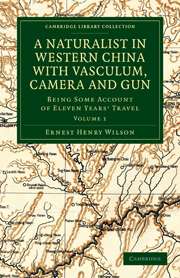
Ernest Henry Wilson (1876–1930) was introduced to China in 1899 when, as a promising young botanist, he was sent there by horticulturalist Henry Veitch (1840–1924) to collect the seed of the handkerchief tree, Davidia involucrata, for propagation in Britain. Subsequent trips saw Wilson bringing back hundreds of seed samples and plant collections, introducing many Chinese plants to Europe and North America. He wrote extensively about his travels in China: this two-volume work was published in 1913. Although much of the text is concerned with plant life, Wilson also gives a great deal of attention to the wider landscape around him. In addition, Wilson took a camera, and these volumes contain photographs of parts of China rarely seen by Europeans in the early twentieth century. Volume 1 covers his travels from Hupeh (Hubei) to Szechuan and into the Tibetan region before ending at Wa Wu Shan.
A controversial figure, Sir Francis Galton (1822–1911), biostatistician, human geneticist, eugenicist, and first cousin of Charles Darwin, is famed as the father of eugenics. Believing that selective breeding was the only hope for the human race, Galton undertook many investigations of human abilities and devoted the last few years of his life to promoting eugenics. Although he intended his studies to work positively, for eradicating hereditary diseases, his research had a hugely negative impact on the world which subsequently bestowed on Galton a rather sinister reputation. Written by Galton's colleague, eugenicist and statistician Karl Pearson (1857–1936), this four-volume biography pieces together a fascinating life. First published in 1930, this second part of Volume 3 includes records of Galton's travels and occupations, and recollections of friends and family. Pearson himself was later appointed the first Galton professor of eugenics at University College London.
A controversial figure, Sir Francis Galton (1822–1911), biostatistician, human geneticist, eugenicist, and first cousin of Charles Darwin, is famed as the father of eugenics. Believing that selective breeding was the only hope for the human race, Galton undertook many investigations of human abilities and devoted the last few years of his life to promoting eugenics. Although he intended his studies to work positively, for eradicating hereditary diseases, his research had a hugely negative impact on the world which subsequently bestowed on Galton a rather sinister reputation. Written by Galton's colleague, eugenicist and statistician Karl Pearson (1857–1936), this four-volume biography pieces together a fascinating life. First published in 1914, Volume 1 covers the years from Galton's birth in 1822 to his marriage to Louisa Jane Butler in 1853. Pearson himself was later appointed the first Galton professor of eugenics at University College London.
A controversial figure, Sir Francis Galton (1822–1911), biostatistician, human geneticist, eugenicist, and first cousin of Charles Darwin, is famed as the father of eugenics. Believing that selective breeding was the only hope for the human race, Galton undertook many investigations of human abilities and devoted the last few years of his life to promoting eugenics. Although he intended his studies to work positively, for eradicating hereditary diseases, his research had a hugely negative impact on the world which subsequently bestowed on Galton a rather sinister reputation. Written by Galton's colleague, eugenicist and statistician Karl Pearson (1857–1936), this four-volume biography pieces together a fascinating life. First published in 1930, the first part of Volume 3 focuses on Galton's later research on correlation, personal identification, and eugenics. Pearson himself was later appointed the first Galton professor of eugenics at University College London.
On the basis of extensive material in the form of letters, pamphlets and the recollections of friends and contemporaries, Jules Marcou (1824–1898) tells the story of the life and work of Louis Agassiz in this two-volume work of 1896. The Swiss-born palaeontologist, glaciologist and zoologist (1807–1873) is regarded as one of the founding fathers of the modern American scientific tradition. Marcou, a fellow countryman and collaborator of Agassiz, does not attempt to conceal his high regard for the subject of his biography but does have 'in view the truth'. In a chronological narrative, Volume 2 tells of Agassiz' professorship at Harvard and the founding in 1859 of the Museum of Contemporary Zoology, where he remained as director until his death. Although Darwin believed the Swiss scientist's theory on parallelisms provided evidence for evolution, Agassiz was no evolutionist but saw the plan of God everywhere in nature.
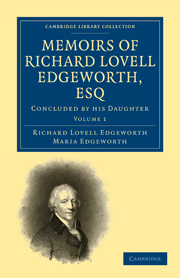
Richard Lovell Edgeworth (1744–1817) was a noted Irish educationalist, engineer and inventor. This two-volume autobiography, begun in 1808, was completed by his novelist daughter Maria, and published in 1820. Edgeworth's interest in education is evidenced by his reflections about how his childhood shaped his character and later life. Volume 1, written by Edgeworth himself and covering the period to 1781, reveals that his interest in science began early; he was shown an orrery (a moving model of the solar system) at the age of seven. As a young man, Edgeworth attended university in Dublin and Oxford, studied law, and eloped while still in his teens. He experimented with vehicle design, winning several awards, and was introduced by Erasmus Darwin to the circle of scientists, innovators and industrialists later known as the Lunar Society of Birmingham. In 1781 Sir Joseph Banks sponsored his election to the Royal Society.
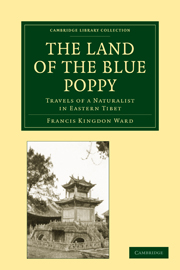
In 1911, Francis Kingdon Ward (1885–1958) set off on his first solo expedition and collected hundreds of plant species, many previously unknown. From Burma, he headed into the Hengduan Mountains of north-western Yunnan province, exploring along the Mekong, Yangtze and Salween rivers in the region between eastern Tibet and western Sichuan. In 2003, this area was designated a UNESCO World Heritage Site. One of the world's most biodiverse temperate zones, its extraordinary topography arises from its position at the collision point of tectonic plates. This fascinating book, first published in 1913, was one of the most popular by a prolific author. It is generously illustrated with Kingdon Ward's own photographs and maps from the trip. The blue poppy of the title is Meconopsis speciosa, which Kingdon Ward described as the 'Cambridge blue poppy'; rather than the famous 'Tibetan blue poppy' (Meconopsis betonicifolia) that he later brought to England.
First published in 1873, this co-authored biography of the Scottish physicist, Alpine explorer, and university leader James David Forbes (1809–1868) includes extracts from Forbes' letters. John Campbell Shairp, Forbes' successor as principal of the United College of the University of St Andrews, writes of Forbes' personal, family, and professional life, including his years at St Andrews. Forbes' student and his successor in the Natural Philosophy chair at the University of Edinburgh, Peter Guthrie Tait, himself an accomplished mathematical physicist who co-wrote, with Lord Kelvin, Treatise on Natural Philosophy (1867), discusses Forbes' scientific achievements and contributions. A. Adams-Reilly, a celebrated Irish mountaineer, cartographer, and friend of Forbes, writes of the latter's Alpine travels and his work and interest in glaciers. In Shairp's words, in addition to all of his academic accomplishments, Forbes was also Britain's 'father of Alpine adventure'.
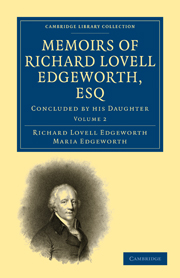
Richard Lovell Edgeworth (1744–1817) was a noted Irish educationalist, engineer and inventor. This two-volume autobiography, begun in 1808, was published in 1820. Edgeworth had abandoned the project in 1809, having covered the period to 1781, and it was completed after his death by his eldest daughter, a successful novelist. Maria Edgeworth and her father had co-authored educational works, and the experience of helping her father run their estate during her teens had provided material for her novels. Volume 2 of these memoirs was wholly written by her, though it contains excerpts from Richard's correspondence. It recounts how, after his third marriage, the growing family returned to Ireland, and focused first on domestic and educational concerns. Richard became involved in Irish politics and the newly founded Royal Irish Academy but continued to publish essays on scientific and mechanical topics, as well as influential (though controversial) works on education.
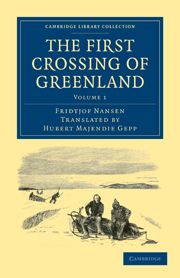
First published in English in 1890, this book by Norwegian explorer and scientist Fridtjof Nansen (1861–1930) recounts the first crossing of the Greenland interior in 1888, an expedition that took two months. Learning from previous failed attempts, Nansen suggested crossing from the uninhabited east to the inhabited west of Greenland, an innovation that proved successful. Nansen's account was translated by Hubert Majendie Gepp and includes an introduction written by the secretary of the Royal Geographical Society. Volume 1 describes the initial stages of the journey, including detailed accounts of the equipment, the methods used for crossing the ice and the arrival of the party on the east coast of Greenland. The volume ends with a description of previous attempts to cross the 'inland ice'. Nansen, who later served as delegate to the League of Nations, was awarded the Nobel Peace Prize in 1922 for his humanitarian endeavours.
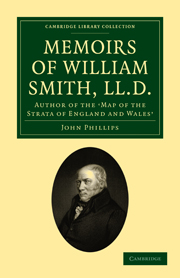
William Smith (1769–1839) was best known as the author of the Map of the Strata of England and Wales – indeed, he was known as 'Strata' Smith. His Memoirs, edited by his nephew John Phillips and published in 1844, tell the story of his life from his beginnings as a blacksmith's son in Oxfordshire to his geological work. Smith began as an assistant to a land surveyor and moved into mine-related projects, including excavations for canal-building. During the course of one such project he realised the significance of strata within layers of rock, and in subsequent surveys he could locate deposits of coal, iron and other minerals. Smith suffered throughout his life from financial problems which frustrated publication of his works; his map was published in 1815, but further works were never completed. Towards the end of his life, however, he finally received the scientific recognition that was his due.
On the basis of extensive material in the form of letters, pamphlets and the recollections of friends and contemporaries, Jules Marcou (1824–1898) tells the story of the life and work of Louis Agassiz in this two-volume work of 1896. The Swiss-born palaeontologist, glaciologist and zoologist (1807–1873) is regarded as one of the founding fathers of the modern American scientific tradition. Marcou, a fellow countryman and collaborator of Agassiz, does not attempt to conceal his high regard for the subject of his biography but does have 'in view the truth'. In a chronological narrative, Volume 1 traces the childhood and early professional success of Agassiz, including his charming of the great von Humboldt. It describes Agassiz' time as professor in Switzerland and his marriage, ending with the arrival of Agassiz in America and his first attempts at forging a university career there.
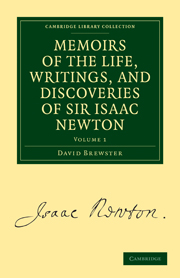
Sir David Brewster (1781–1868) was a Scottish physicist, mathematician, astronomer, inventor, and writer of international reputation. His biography of Sir Isaac Newton, published in 1855 and reissued in 1860, was the result of over twenty years' research, undertaken while publishing hundreds of scientific papers of his own. Brewster made use of previously unknown correspondence by Newton, and his own scientific interests, particularly in optics, meant that he was able to understand and explain Newton's work. It covered the many facets of Newton's personality and work, remaining the best available study of Newton for over a century. Brewster reveals much about the science of his own time in his handling of earlier centuries, and as a cleric was obviously uncomfortable about the evidence of Newton's unorthodox religious views and alchemical studies. Volume 1 covers the period up to about 1700, and includes disputes with Leibniz over the development of calculus.
In this investigation of orchids, first published in 1862, Darwin expands on a point made in On the Origin of Species that he felt required further explanation, namely that he believes it to be 'a universal law of nature that organic beings require an occasional cross with another individual'. Darwin explains the method by which orchids are fertilised by insects, and argues that the intricate structure of their flowers evolved to favour cross pollination because of its advantages to the species. The book is written in Darwin's usual precise and elegant style, accessible despite its intricate detail. It includes a brief explanation of botanical terms and is illustrated with 34 woodcuts.
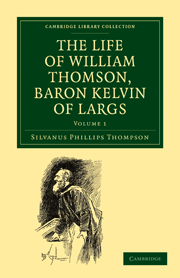
The mathematician and physicist William Thomson, 1st Baron Kelvin, (1824–1907) was one of Britain's most influential scientists, famous for his work on the first and second laws of thermodynamics and for devising the Kelvin scale of absolute temperature. Silvanus P. Thompson (1851–1916) began this biography with the co-operation of Kelvin in 1906, but the project was interrupted by Kelvin's death the following year. Thompson, himself a respected physics lecturer and scientific writer, decided that a more comprehensive biography would be needed and spent several years reading through Kelvin's papers in order to complete these two volumes, published in 1910. Volume 1 covers Kelvin's life to 1871, including his student days, his election (aged 22) as professor in Glasgow, his ground-breaking theoretical research on thermodynamics, his applied work on telegraphs including the Atlantic cable, and his involvement in a geological controversy about the age of the earth.
The mathematician and physicist William Thomson, 1st Baron Kelvin, (1824–1907) was one of Britain's most influential scientists, famous for his work on the first and second laws of thermodynamics and for devising the Kelvin scale of absolute temperature. Silvanus P. Thompson (1851–1916) began this biography with the co-operation of Kelvin in 1906, but the project was interrupted by Kelvin's death the following year. Thompson, himself a respected physics lecturer and scientific writer, decided that a more comprehensive biography would be needed and spent several years reading through Kelvin's papers in order to complete these two volumes, published in 1910. Volume 2, beginning in 1871, covers not only Kelvin's mature research, but also more personal aspects of his life, including his love of music and sailing, his experiments with compasses and navigation, and the relationship between his scientific discoveries and his religious beliefs.
Robert Willis (1800–1875) was a scientist, inventor and architectural historian of international repute. As Jacksonian Professor of Natural and Experimental Philosophy at Cambridge, he demonstrated specially made mechanical devices to huge audiences. First published in 1841, Principles of Mechanism provided the theory behind the demonstrations. He defined mechanism as the means by which any relations of motion could be realised. The book was extremely influential, with all books in English, French, and German on the subject for the next generation adopting Willis' classification and nomenclature. He worked closely with William Whewell, whose Mechanics of Engineering was published in the same year. These two books established the science of mechanism, and provided study materials for the rapidly growing engineering profession. The work became a standard textbook for engineering and mathematics students, with a second edition issued in 1870.
Joseph Priestley (1733–1804) was an eighteenth-century English polymath with accomplishments in the fields of science, pedagogy, philosophy and theology. Among his more notable achievements were the discovery of oxygen and his work in establishing Unitarianism. Often a controversialist, Priestley's efforts to develop a 'rational' Christianity and support for the French Revolution eventually made him unwelcome in his native land. His 1807 Memoirs relate the story of his life until the time of his 1794 emigration to America and include other biographical materials written by his son. This first volume also contains five appendices discussing his philosophy, scientific work and religious opinions. Priestley's memoirs are an important source for anyone interested in the state of epistemology, rationalism, and religious belief in the age of the Enlightenment, and in a man who, in the words of his son, 'gave unremitting exertions in the cause of truth'.
Agnes Arber (1879–1960) was a prominent British botanist specialising in plant morphology and comparative anatomy. In 1946 she became the first female botanist to be elected a Fellow of the Royal Society. First published in 1934, this volume provides a detailed comparative study of the Gramineae family of plants, which includes cereals, grasses and bamboos. Arber focuses on the general morphological features of these plants as shown by anatomical analysis, describing their life cycles, reproductive and vegetative phases, and embryology. The Gramineae family contains vitally important food plants such as wheat, millet and rice, leading Arber to begin her study with the history of human interaction with these plants. It was the first published general description of these important plants, and remains a classic example of comparative anatomical analysis. The book contains over 200 figures and an extensive bibliography.