To save content items to your account,
please confirm that you agree to abide by our usage policies.
If this is the first time you use this feature, you will be asked to authorise Cambridge Core to connect with your account.
Find out more about saving content to .
To save content items to your Kindle, first ensure no-reply@cambridge.org
is added to your Approved Personal Document E-mail List under your Personal Document Settings
on the Manage Your Content and Devices page of your Amazon account. Then enter the ‘name’ part
of your Kindle email address below.
Find out more about saving to your Kindle.
Note you can select to save to either the @free.kindle.com or @kindle.com variations.
‘@free.kindle.com’ emails are free but can only be saved to your device when it is connected to wi-fi.
‘@kindle.com’ emails can be delivered even when you are not connected to wi-fi, but note that service fees apply.
Natural catastrophes – rare, high-consequence events – present us with a unique conjunction of problems so far as risk is concerned. Firstly, they can have an extremely long recurrence interval – so long that the greatest may not have occurred within human memory. Secondly, the effects of events with which we are all too familiar, for example earthquakes, floods, volcanoes and storms, are easily trumped by the impacts of objects – comets and asteroids – that reach Earth from outer space; and thirdly, the largest of these events have a global reach, in principle threatening not just our way of life but perhaps life on Earth itself. However, recognising that such events occur very rarely, should we ‘make hay while the sun shines’ and ignore, ostrich-like, the significant actuarial risk; or should we seek to understand the underlying phenomena and develop strategies to mitigate the threat, and perhaps technologies to avert it? Our individual response often depends less on a purely rational assessment than on personal circumstances and how we have been brought up. In any case the nature of the risks, which are poorly understood, means that we must be prepared to handle the law of unintended consequences (that is, could our actions make things worse?). We must also be prepared to explore what happens if, perhaps inevitably, our current scientific understanding turns out to be less certain than many experts believe.
Introduction
Rare, high-consequence events present society with exceptional difficulties so far as risk assessment is concerned. The infrequency of the most extreme events means that their causes are often among the most poorly understood among environmental issues and their impacts are – fortunately – poorly known from direct experience. In addition, natural catastrophes may have an origin either entirely within the Earth-system or from outside: from the Sun, solar system or wider Universe of which the Earth is a part. It is widely accepted that the potentially devastating effects of cosmic phenomena are likely, in the long term, to far outweigh any purely Earth-based cataclysm.
In a series of paintings from the walls of a bar in Pompeii – painted sometime in the ten years before Vesuvius erupted in ad 79 – is a scene of two Roman men playing a game of chance (Figure 5.1). They have a board between them balanced on their knees, and we can just about make out some counters on it. The man on the left has just been shaking the dice in a shaker, and, in the ‘speech bubble’ above his head, he is claiming a winning throw. ‘I’ve won’, he shouts (‘Exsi’ in Latin). ‘No’, says his partner and opponent, ‘it's not a three, it's a two’ (‘Non tria, duas est’).
The other paintings in the series show other activities you might expect to find going on in a bar: drinking, brawling, sex and flirtation (Figure 5.2). In fact, it is a line-up of exactly the kind of things that Roman puritans (who saw an obvious connection between alcohol, sex and dice-games) were very keen on deploring. It is perhaps hardly surprising that in the next painting (and so in the final episode of this little visual narrative), the game is leading to blows. Although the panel is badly damaged, it is clear enough that the two men have left the table and are trading insults in some almost incomprehensible speech bubbles. What we can understand is predictably rude: ‘Look here cock-sucker (fellator) I was the winner.’ Almost completely lost is the figure of the long-suffering landlord (or alternatively the hard-nosed supremo of the gambling den, depending on how we choose to see him). But his speech bubble survives. He is saying, as landlords have said for thousands of years: ‘If you want to fight, get outside’ (‘itis foras rixsatis’).
Risk is a strange concept. Different disciplines have tried to define it precisely, but perhaps it is better to be informal and follow more popular usage. I shall take it as anything to do with situations where ‘bad’ (or ‘good’) things may, or may not, happen. The crucial elements are that there is uncertainty, and that the outcomes may be nice or nasty.
A wealth of recent psychological research has shown that we mainly use ‘gut feelings’ to deal with such situations, rather than carefully weighing up the consequences and assessing numerical probabilities, as more formal approaches would have us do. Our feelings are influenced by culture, our experiences and those of people close to us, media coverage, emotional feelings of dread, or hope, and so on, but we manage to get by most of the time, and it is noticeable how recently, in historical terms, the theory combining probability and ‘rational’ decision-making was developed. Even when evidence is available about the ‘size’ of a risk, in sufficiently stressful situations it may be ignored. Cass Sunstein, a senior adviser to Barack Obama, claims that people display ‘probability neglect’ when confronted with vivid images of terrorism, so that ‘when their emotions are intensely engaged, people's attention is focused on the bad outcome itself, and they are inattentive to the fact that it is unlikely to occur’. So the ‘true’ risks are ignored; it's been shown that people are, rather illogically, willing to pay more for insurance against terrorism than insurance against all risks (which implicitly include terrorism), just because the use of the word conjures up dread.
Puzzling over gaps between practice and declared principles in government and public services
It is often said that high officeholders in government, both elected and appointed, live chronically time-pressured lives with many urgent and competing claims crowding in on their limited time and attention. Such individuals often, indeed routinely, declare that they want to focus on the big picture and on the pursuit of their grand visions, and that they are mainly concerned with achieving results that bring substantive social value rather than with small-print details of process and structure or with the trivialities of day-to-day media gossip.
Yet careful analysis of how those high-level officeholders in government use their limited time often reveals that they spend a remarkably large proportion of it – 50 per cent or more, on some estimates – on matters of media presentation and that they often devote a surprising amount of their time as well to small-print details of legislation and government organisation.
Social scientists tell us we live in a ‘world risk society’. But what does this mean post 9/11? By any account the risk to our collective security and, no less importantly, our subjective sense of security, was altered radically by the tragic events of that day. Of course terrorism was far from unknown before 9/11, but it did not occupy the public imagination in the way it has done since. Risk commentators were quick to add terrorist threat to the catalogue of environmental, health and engineering risks, and natural catastrophes already said to characterise the world risk society. But the risks born of terrorism are very different from those posed by climate change and ’flu pandemics. If risk is to avoid becoming an undifferentiated amalgam of unnamed perils we need to think a little harder about what or who is at risk.
This is all the more important because seeking security from terrorism has the quality of a trump card. Play the security hand and countervailing interests, not least our civil liberties, lose out. Despite their rarity, acts of terrorism pose a risk of catastrophic harm that inclines us to accept whatever policies seem to offer some prospect of protection. Although counterterrorist measures may discriminate unfairly and erode civil liberties unwarrantedly, the urge to reduce risk prevails. Balancing liberty and security assumes a zero-sum game in which by eroding liberty we can reduce risk. In place of balancing we would do better to think about the whole range of risks associated with terrorism and consider how seeking to avert risk may have the effect of introducing new hazards. By focusing on the obvious risks – threats to life and property, and subjective insecurity or terror itself – we risk overlooking the fact that countering terrorism carries its own hazards: risks to political and economic life; risks to social cohesion, community and race relations; risks to rights (rights to freedom of speech, privacy and freedom of the person) and risks for the rule of law. Add to this the risk of marginalising and alienating those we target and we arrive at the paradoxical situation that counterterrorism policies may make further attack more, not less, likely. So we need to consider what risks are really at stake when we seek to counter terrorist risk.
The ability to make good decisions about future courses of action under conditions of uncertainty is essential for the survival of most animals, including humans. Whether it is deciding which item to choose from a restaurant menu, when to cross a busy road or what career path to follow, we are constantly faced with the need to make decisions of varying degrees of importance in terms of their implications for our future well-being. Often the outcomes of such decisions are highly uncertain, and we must therefore take into account not only the pros and cons of the outcomes associated with different courses of action but also the uncertainties or ‘risk’ attached to such outcomes. On the whole, humans are rather good at making decisions, as exemplified by our incredible success as a species. The root of that success necessarily lies in the machinery contained in our brain, a highly efficient computer weighing approximately 1.36 kg that has been shaped by evolution to allow us the flexibility to make good decisions in diverse and rapidly changing environments. In this chapter, I will give a broad introduction to a new interdisciplinary field of study called ‘neuroeconomics’, which is concerned with elucidating how the brain is capable of enabling us to make such good decisions. I will outline our current understanding about how decisions are made by the brain, and I will highlight some of the outstanding questions for future research in this still nascent field of study.
Neuroeconomics
The field of neuroeconomics has emerged through a fusion of approaches found in more traditional disciplines. These include not only neuroscience and economics, as one might have guessed from the perhaps clumsily put-together title, but also cognitive and behavioural psychology, computer science and artificial intelligence, engineering, robotics and behavioural ecology, among others (Glimcher et al., 2009). A core assumption behind neuroeconomics is (in common with much if not all contemporary neuroscience) that the brain can be treated as a computational device transforming input in the form of information reaching our sense organs (vision, touch, audition, smell and taste), into output in the form of the generation of behaviour. This transformation is mediated by the billions of highly interconnected neurons (nerve cells) contained in our brains. The main goal of neuroscience is to describe precisely how these neurons act on the incoming sensory information in order to produce a particular output, or, to return to the brain-as-computer analogy, to resolve the algorithms (or mathematical functions) used by the brain to achieve such transformations.
Most countries are attempting to achieve environmentally and socially sustainable economic growth, coupled with food, water and energy security at a time of enormous global changes, including environmental degradation at the local, regional and global scale. Key issues include climate change, loss of biodiversity and ecosystem services (provisioning, regulating, cultural and supporting), local and regional air pollution, and land and water degradation.
There is no doubt that the Earth's climate is changing and it is very likely that most of the observed changes in the last fifty years are due to human activities. Cost-effective and equitable approaches to address climate change exist or can be developed, but will require political will and moral leadership. A combination of technological and behavioural changes, coupled with pricing and effective policies (including regulatory policies), are needed to address this global challenge at all spatial scales, that is, local, national and international, and across sectors.
The chapters in this book originate from lectures given as part of the 2010 Darwin College Lecture Series on the subject of risk. This series constitutes one of Cambridge University's largest and longest-running set of public lectures. Begun in 1986, the Darwin College Lecture Series has, each year, focused on a single theme and invited eminent speakers from around the world to reflect on what that theme means in their field. Over the last twenty-five years the chosen themes have ranged from survival to serendipity, conflict, power, structure, sound, evidence, evolution, the fragile environment, predicting the future, time and identity, reflecting many of the key issues that affect our local and global societies, as well as celebrating important milestones in our history. ‘Origins’ was the subject of the first Darwin College Lecture Series in 1986. ‘Time’ was chosen to commemorate the 2000 millennium series, and in 2009, the title of the series was ‘Darwin’, celebrating the anniversary of Charles Darwin by looking at his ideas and influence.
The cornerstones of the Darwin College Lecture Series, and the books which accompany them, are their interdisciplinary approach and target audience. In the book following the first Darwin College Lecture Series in 1986, D. H. Mellor, Vice-Master of Darwin College, put it like this:
University research covers a great range of subjects. To try to comprehend all of them would be foolish: life is too short, and anyway no one is good at everything. But most subjects are to some extent spectator sports. You needn't be a musician to appreciate some modern music – though no doubt it helps – nor a cosmologist to appreciate some modern cosmology. And many spectators have common interests in very different subjects…there is, therefore, a predictable demand for a series of public lectures by leading authorities in interdisciplinary topics…and not only for lectures: such interests are not confined to Cambridge, nor to any one year.
Vestiges of the Natural History of Creation was published anonymously in 1844. Starting with the genesis of the solar system, it progresses systematically through such topics as the formation of the earth, the origins of marine life, the emergence of reptiles, birds and other life forms, and the evolution of human life. Drawing widely upon contemporary ideas from astronomy, biology, geology, linguistics, and anthropology, it seeks to establish the 'hypothesis of an organic creation by natural law'. Preceding Darwin's Origin of Species by fifteen years, Vestiges ignited a storm of controversy by pitting natural law and its role in what would soon come to be known as 'evolution' against the generally accepted Victorian belief that the universe was created by God. In 1884, it was revealed that the author was the British publisher Robert Chambers. This fifth edition of the work also contains its 1845 sequel, Explanations.
Erasmus Darwin (1731–1802) is remembered not only as the grandfather of Charles but as a pioneering scientist in his own right. A friend and correspondent of Josiah Wedgwood, Joseph Priestley and Matthew Boulton, he practised medicine in Lichfield, but also wrote prolifically on scientific subjects. He organised the translation of Linnaeus from Latin into English prose, coining many plant names in the process, and also wrote a version in verse, The Loves of Plants. The aim of his Zoonomia, published in two volumes (1794–6), is to 'reduce the facts belonging to animal life into classes, orders, genera, and species; and by comparing them with each other, to unravel the theory of diseases'. The first volume describes human physiology, especially importance of motion, both voluntary and involuntary; the second is a detailed description of the symptoms of, and the cures for, diseases, categorised according to his physiological classes.
From plague to AIDS, epidemics have been the most spectacular diseases to afflict human societies. This volume examines the way in which these great crises have influenced ideas, how they have helped to shape theological, political and social thought, and how they have been interpreted and understood in the intellectual context of their time.
After the publication of On the Origin of Species in 1859 Darwin became fascinated with the potential for botanical experiments to provide evidence for the process of evolution. First published in 1877, this volume is based on a series of papers concerning heterostylous plants (species which produce different types of flowers) originally published in the Journal of the Proceedings of the Linnaen Society in 1862. Linnaeus had divided the sexual relations of flowers into four groups, which Darwin uses as the structure for this volume. Darwin examines in detail plants which produce different flower forms, presenting his conclusions in terms of adaptive evolution and so providing the first functional interpretation of heterostyly. He demonstrates that these plants are adapted for cross-fertilisation, not self-fertilisation as was widely believed. The concepts which Darwin introduces in this volume continue to provide the basis for research into plant reproductive biology.
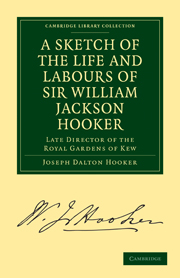
Sir William Jackson Hooker (1785–1865) was an eminent British botanist who is best known for expanding and developing the Royal Botanic Gardens at Kew into a leading centre of botanic research and conservation. After undertaking botanical expeditions to Iceland and across Europe, he was appointed Regius Professor of Botany at Glasgow University in 1820, where he proved to be a popular lecturer and established the Royal Botanical Institution of Glasgow. In 1841 Hooker was appointed the first Director of the Royal Gardens at Kew, a position he held until his death. This volume, written by his son, the equally renowned botanist Sir Joseph Hooker (1817–1911) and first published in 1903, provides an intimate biography of his life. Hooker's botanic expeditions, his experiences at Glasgow, and relations between leading members of the scientific community are recounted, together with vivid descriptions of his labours and improvements at Kew.
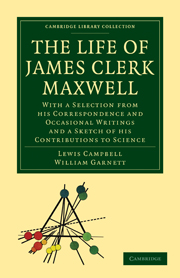
James Clerk Maxwell (1831–1879) was a Scottish physicist well-known for his extensive work with electromagnetism, colour analysis, and kinetic theory. Considered by many to be a giant in his field with significant influence on the physicists who would follow, Maxwell spent time as a professor at Aberdeen University, King's College, London, and Cambridge. This 1882 Life by his friend Lewis Campbell and natural philosopher William Garnett represents an important – and lengthy – investigation into Maxwell's life and thought. Part I is concerned with biographical matters while the second section focuses upon his scientific mind. A third part contains Maxwell's poetry, so included because the poems are 'characteristic of him' and have 'curious biographical interest'. At nearly 700 pages, the Life represents an important starting point for those curious about the state of theoretical physics and the person in whom it reached its culmination in the nineteenth century.