To save content items to your account,
please confirm that you agree to abide by our usage policies.
If this is the first time you use this feature, you will be asked to authorise Cambridge Core to connect with your account.
Find out more about saving content to .
To save content items to your Kindle, first ensure no-reply@cambridge.org
is added to your Approved Personal Document E-mail List under your Personal Document Settings
on the Manage Your Content and Devices page of your Amazon account. Then enter the ‘name’ part
of your Kindle email address below.
Find out more about saving to your Kindle.
Note you can select to save to either the @free.kindle.com or @kindle.com variations.
‘@free.kindle.com’ emails are free but can only be saved to your device when it is connected to wi-fi.
‘@kindle.com’ emails can be delivered even when you are not connected to wi-fi, but note that service fees apply.
Nineteenth and twentieth-century West African writer-intellectuals harnessed their Atlantic networks to explore ideas of race, regeneration, and nation-building. Yet, the ultimately cosmopolitan nature of these political and intellectual pursuits has been overlooked by dominant narratives of anti-colonial history. In contrast, Cosmopolitan Nationalism in Ghana uses cosmopolitanism as a primary theoretical tool, interrogating the anti-colonial writings that prop up Ghana's nationalist history under a new light. Mary A. Seiwaa Owusu highlights the limitations of accepted labels of nationalist scholarship and confirms that these writer-intellectuals instead engaged with ideas around the globe. This study offers a more complex account of the nation-building project, arguing for the pivotal role of other groups and factors in addition to Kwame Nkrumah's leadership. In turn, it proposes a historical account which assumes a cosmopolitan setting, highlights the centrality of debate, and opens a vista for richer understandings of Ghanaians' longstanding questions about thriving in the world.
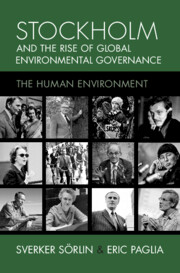
This unique history examines global environmental governance through the lens of Stockholm, which has played an outsized role in shaping its development. Fifty years before Greta Thunberg started her School Strike for Climate, Swedish diplomats initiated the seminal 1972 U.N. Conference on the Human Environment that propelled Stockholm to the forefront of international environmental affairs. Stockholm has since become a hub for scientific and political approaches to managing the environmental and climate crisis. Utilizing archival materials and oral histories, Sörlin and Paglia recount how, over seventy years, Stockholm-based actors helped construct the architecture of environmental governance through convening decisive meetings, developing scientific concepts and establishing influential institutions at the intersection of science and politics. Focusing on this specific yet crucial location, the authors provide a broad overview of global events and detailed account of Stockholm's extraordinary impact. This title is also available as Open Access on Cambridge Core.
Debunking the so-called apotheosis myth, Nicholas Griffiths argues that Indigenous peoples in North America, Mexico, the Andes, and Hawaii during the early modern period (1492–1789) did not believe invading Europeans were gods. Instead, many perceived them as 'more-than-human' intruders of considerable spiritual power. By exploring the Indigenous context and terminology, using published primary and secondary sources, the book investigates what natives meant when they used words that Europeans translated as 'gods.' In contrast to traditional accounts, Griffiths centers native points of view and the dynamic interactions between European and Indigenous perspectives. Ultimately, both groups were fundamentally comparable since both interpreted their mutual contact in terms of their pre-existing mythology. The traditional contrast between the scientific, rational, and modern Europeans on the one hand, and the myth-bound, irrational, pre-modern Indigenous peoples on the other, is entirely misleading. The first book-length synthesis of this myth, Griffiths reinterprets ideas that have long been debated in various regional literatures.
Joshua K. Leon explores 6,000 years of urban networks and the politics that drove them, from Uruk in the fourth millennium BCE to Amsterdam's seventeenth-century 'golden age.' He provides a fresh, interdisciplinary reading of significant periods in history, showing how global networks have shaped everyday life. Alongside grand architecture, art and literature, these extraordinary places also innovated ways to exert control over far-flung hinterlands, the labor of their citizens, and rigid class, race and gender divides. Asking what it meant for ordinary people to live in Athens, Rome, Chang'an, or Baghdad - those who built and fed these cities, not just their rulers - he offers one of the few fully rendered applications of world cities theory to historical cases. The result is not only vividly detailed and accessible, but an intriguing and theoretically original contribution to urban history.
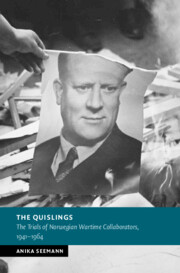
The Norwegian 'treason trials' were the most extensive post–Second World War 'reckoning' with wartime collaboration in all of Europe. Following the war, tens of thousands of Norwegians were sentenced for their wartime actions, including the notorious leader of Norway's collaborationist party Nasjonal Samling, Vidkun Quisling. And yet many wartime actions also went unpunished, including, in the vast majority of cases, violence perpetrated against Norway's Jewish minority. The Quislings examines how the Norwegian authorities planned, implemented and interpreted this reckoning between 1941 and 1964. In doing so, it looks at the broader political purposes the treason trials served, how these changed over time and the mechanisms that brought these changes about. This wide-ranging study argues that the trials were not driven by the agenda of any one institution or group. Instead, their final shape was the result of a complex process of weighing up demands for legal form and consistency against a fast-changing political and social environment.
By constructing the first transnational and interlingual conceptual history of ethnicity, Ethnos of the Earth reveals the pivotal role this concept played in the making of the international order. Rather than being a primordial or natural phenomenon, ethnicity is a contingent product of the twentieth-century transition from a world of empires to a world of nation-states. As nineteenth-century concepts such as 'race' and 'civilisation' were repurposed for twentieth-century ends, ethnicity emerged as a 'filler' category that was plugged into the gaps created in our conceptual organisation of the world. Through this comprehensive conceptual reshuffling, the governance of human cultural diversity was recast as an essentially domestic matter, while global racial and civilisational hierarchies were pushed out of sight. A massive amount of conceptual labour has gone into the 'flattening' of the global sociopolitical order, and the concept of ethnicity has been at the very heart of this endeavour.
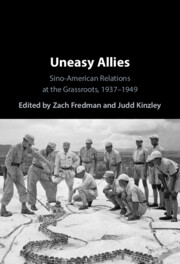
This timely collection of essays examines Sino-American relations during the Second World War, the Chinese Civil War and the opening of the Cold War. Drawing on new sources uncovered in China, Taiwan, the UK and the US, the authors demonstrate how 'grassroots' engagements - not just elite diplomacy - established the trans-Pacific networks that both shaped the postwar order in Asia, and continue to influence Sino-US relations today. In these crucial years, servicemen, scientists, students, businesspeople, activists, bureaucrats and many others travelled between the US and China. In every chapter, this innovative volume's approach uncovers their stories using both Chinese and English language sources. By examining interactions among various Chinese and American actors in the dynamic wartime environment, Uneasy Allies reveals a new perspective on the foundations of American power, the brittle nature of the Sino-American relationship, and the early formation of the institutions that shaped the Cold War Pacific.
Ecological and political instability have time and again emerged as catalysts for risky development projects along India's south-west coastline. Devika Shankar probes this complicated relationship between crisis and development through a focus on a port development project executed in Cochin in the first quarter of the twentieth century amidst significant political and ecological uncertainty. While ecological concerns were triggered by increasing coastal erosion, a political crisis was precipitated by a neighbouring princely state's unprecedented attempt to extend its sovereignty over the British port. This integrative environmental, legal, and political history brings together the history of British India and the princely states to show how these anxieties ultimately paved the way for an ambitious port development project in the final years of colonial rule. In the process it deepens our understanding of environmental transformations and development in modern South Asia and the uneven nature of colonial sovereignty.
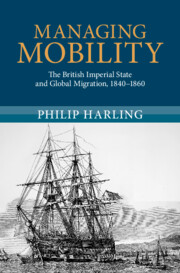
Between 1840 and 1860 the British Empire expanded rapidly in scale, with rampant annexation of territory and ruthless suppression of rebellion. These decades also witnessed an unprecedented movement of people across the Empire and around the world, with over 2.6 million emigrants leaving Britain in the 1850s alone. Managing Mobility examines how the British imperial state facilitated the mass migration of its impoverished subjects as labor assets, shipped across vast expanses of ocean to contribute to the economy of the Empire. Philip Harling analyzes the ideological framework which underpinned these interventions and discusses the journeys taken by emigrants across four continents, considering the varied outcomes of these significant projects of social engineering. In doing so, this study demonstrates how the British imperial state harnessed migration to ensure and maintain a racialised global economic order in the decades after Emancipation.
This Element examines the life and legacy of the sixteenth-century Ethiopian intellectual Täsfa Ṣeyon. It reconstructs his formative years in the Horn of Africa and his diasporic life in the Holy Land and Italian peninsula, where he emerged as a prominent intermediary figure at Santo Stefano degli Abissini, an Ethiopian monastery within the Vatican. He became a librarian, copyist, teacher, translator, author, and community leader, as well as a prominent advisor to European humanist scholars and Tridentine Church authorities concerned with the emerging field of philologia sacra as it pertained to Ethiopian Orthodox (täwaḥedo) Christianity. The Element reconstructs his wide-ranging contacts with the Roman Curia and emerging orientalist academy, and then scrutinizes his editio princeps of the Ge'ez Gospels. A final section traces his modern influence, erasure, and rediscovery by later generations of European, Ethiopian, and Eritrean intellectuals.
Jean Calvin was a French theologian and minister and one of the most important and influential advocates for Reformation in the generation after Martin Luther. Calvin was not trained as a theologian or minister. His initial publications were philological and reflect his legal education as well as the influence of Desiderius Erasmus and other humanists who imagined their work in opposition to the “scholasticism” of the universities and the innovations and corruptions of the Roman Catholic Church. Calvin made his most thorough and enduring contributions to Reformation at Geneva, where he lived (save for an exile in Strasbourg from 1538 to 1541) from 1536 until his death in 1564. And while his 1559 Institutio Christianae Religionis may serve as the most complete introduction to his theology, he often offers his most detailed treatments of topics in his commentaries, sermons, responses to adversaries, and local interventions in Geneva. For instance, in Geneva Calvin backed the creation of a consistory of ministers and elders that would mete out discipline in ecclesiastical matters. Depending upon the scope and definition of “ecclesiastical matters,” such a consistory could readily challenge the authority of civil magistrates or competing congregations.
Chapter 6 traces how, in the aftermath of these reforms, the Neogranadian church, at the parish level, became an Indigenous and grassroots organisation. One aspect of this transformation was institutional, as it came to be better staffed, organised, and equipped. Another was ideological, as the lessons of the Jesuit experiments with missionary methods were extended across the archdiocese, centring everyday practice, popular devotion, and social institutions. But the most significant aspect was led by Indigenous people themselves, as the shift away from punitive policies and towards a more inclusive Christianisation, coupled with the implementation of a more effective language policy, created space and opportunities for people in rural parishes to interact with Christianity in new ways. This went much further than the authorities had intended, as they learned when they sought to rein in some of these changes, and it transformed the New Kingdom of Granada forever.
Fortitude (fortitudo) is the affective disposition that accompanies virtue. Spinoza defines affects as “affections of the body by which the body’s power of acting is increased or diminished, aided or restrained, and at the same time, ideas of these affections” (E3def3). Affects express changes, for better or for worse, in our body’s power.
Panpsychism is the view that mentality is pervasive: each thing exhibits psychological features. On some versions of panpsychism, each thing has perceptions; on other versions, each thing has experiences or is conscious. In seeing mentality as extending much more broadly than we might ordinarily think, the panpsychist needs to provide a powerful argument for this position, and throughout the history of philosophy up to the present day, certain philosophers – no doubt, a minority – have tried to do precisely that. Among Spinoza’s rough contemporaries, Cavendish, Conway, and Leibniz among others belong to this minority. Spinoza is often regarded – though, as we will see, not without controversy – as falling into this category too, and the arguments for panpsychism that have been attributed to him are continuous with some of the most important arguments that philosophers nowadays employ to support panpsychist views.
The Principle of Sufficient Reason (hereafter: the PSR) is the principle according to which each thing that exists – or each fact that obtains – has an explanation. A commitment to some form of the PSR is one way to define what it is to be a rationalist.
In his Physics, Aristotle distinguishes between four different kinds of causes (aitia): material, formal, efficient, and final. Especially as articulated in later commentary, paradigmatic examples of material and formal causality include the contributions of “prime matter” and “substantial form” to the composition of a hylomorphic material substance. The efficient cause is something distinct in reality from the effect it produces, whereas the final cause is that for the sake of which the effect is produced.
Aleksandr Pushkin (1799–1837) was a poet firmly embedded in tradition, not a radical innovator but always aware of his predecessors and alert to ways of adapting and improving the models they provided. The exception that proves the rule is the Onegin stanza, the only instance in all of Pushkin’s oeuvre where he created his own stanzaic form. He did so for his unprecedented ‘novel in verse’ Eugene Onegin (Evgenii Onegin), widely considered the cornerstone of the Russian literary tradition. Composed from 1823 to 1831 and published serially between 1825 and 1832, the work is marked by sudden shifts in theme, character, setting, and mood.
Translated Byzantine lives of saints occupied considerable space in the hagiographic corpus of Rus and medieval Russia. But original (non-translated) vitae differ significantly from their Greek models in several respects: the very causes of their subjects’ sanctity (the Rus corpus emphasises saintly princes and founders of monasteries); their extremes of self-mortification (as in the case of Varlaam of Keret); and the extravagance of their feats (such as those of Andrew of Crete, or Petr and Fevroniia). Compared to Byzantine hagiography, the Lives of holy fools are overrepresented in the repertoire of medieval Rus, while female saints are underrepresented in it. In the modern era, Russian literature has drawn heavily on the medieval vitae. This tradition became pronounced in the mid-nineteenth century, but communist writers of the twentieth century also fashioned their heroes in the hagiographic mould.