To save content items to your account,
please confirm that you agree to abide by our usage policies.
If this is the first time you use this feature, you will be asked to authorise Cambridge Core to connect with your account.
Find out more about saving content to .
To save content items to your Kindle, first ensure no-reply@cambridge.org
is added to your Approved Personal Document E-mail List under your Personal Document Settings
on the Manage Your Content and Devices page of your Amazon account. Then enter the ‘name’ part
of your Kindle email address below.
Find out more about saving to your Kindle.
Note you can select to save to either the @free.kindle.com or @kindle.com variations.
‘@free.kindle.com’ emails are free but can only be saved to your device when it is connected to wi-fi.
‘@kindle.com’ emails can be delivered even when you are not connected to wi-fi, but note that service fees apply.
In an advertisement for ‘light’ cigarettes, Dr Smith was quoted as saying: ‘Light cigarettes reduce the risk of cancer by up to 50%.’ The doctor's opinion was authentic; he had uttered these words at a scientific conference. But Dr Smith had always been a fierce opponent of smoking in general. Does the doctor have any claim against the tobacco company?
Discussions
Austria
Operative rules
Dr Smith can claim damages for economic and, in the case of gross negligence or intent, non-economic loss.
Descriptive formants
According to prevailing opinion, mentioning someone's name in a commercial is not an arrogation of the name under § 43 ABGB (protection of the name) because the producer of the commercial actually intended the product to be associated with this particular person and so the name is used as a mark of that person in a correct manner. However, another personality right, derived from § 16 together with § 43 and § 1330 ABGB, called the ‘right to not be mentioned by name’ (Recht auf Namensanonymität), is applicable in such a constellation.
By stating a person's name in a commercial, the audience could be under the impression that the name has been made available to the concerned company for such purposes. The right to decide if the name of a person should be used in a commercial has to be strictly reserved to that particular person.
In an interview about environmental protection, Howard, the president of a chemical company, accused the association ‘World Animal Fund’ (WAF) of being a ‘gang of incompetents who were taking advantage of people's credulity and using member contributions for mysterious purposes’. Can the WAF sue Howard for damages?
Discussions
Austria
Operative rules
The legal entity WAF has the legal standing to sue. Compensation would only be awarded for economic loss.
Descriptive formants
The crucial point in this case is the question whether a legal entity can be defamed in the sense of § 1330 ABGB, subs. 1. According to the OGH and to some legal writers, the ‘insultability’ (‘Beleidigungsfähigkeit’), and thus the right of action, stems from § 26 ABGB which sets out that legal persons have the same rights as natural ones. Comparable things should be dealt with comparably; consequently, a legal person unjustly labelled a ‘gang of incompetents’ suffers harm to its reputation since its social standing is tarnished by such an ‘attack’. Korn and Neumayer are the foremost critics of such a right, but fail to state a basis for their opinion.
If, on the other hand, the claim is based on § 1330, subs. 2 ABGB – under which ‘economic reputation’ (reflected in one's creditworthiness, earnings and advancement in profession) is protected against the dissemination of facts which do not correspond to the truth – the standing to sue is not questioned as the business reputation of legal entities must be protected in any event.
Both the introductory essays and the national reports with their accompanying comparative remarks have made it clear that the protection of personality in European private law is a diverse field. The legal bases – constitutions, codes, statutes, case law, codes of conduct – as well as the perimeter of the scope of protection and the remedies are each exhibited very differently. However, the project has shown that there are still commonalities in all of this legal diversity. It must be stressed again that we are not concerned with one (general) personality right or one comprehensive aspect of personality such as privacy. Such expressions merely serve as umbrella terms. They have no specific content; they constitute the parameters of law-making through the courts. Instead, there is an array of personality interests, which have been developed at different times in certain social contexts and which are legally protected nowadays. Their borders cannot be defined exactly. Moreover, their legal treatment can differ within an individual legal system. Due to the limited space available to us, we were unable to include all relevant personality interests in the questionnaire. Yet, within this plurality of legally protected personality interests we display six representative aspects here, and will examine whether and how much there is agreement in respect of their legal protection. The six aspects are: (1) dignity and honour/reputation; (2) privacy; (3) the right to one's image; (4) the commercial appropriation of personality; (5) the right to personal identity; and (6) self-determination.
Sally took a snapshot of person X in a market place without asking this person's permission. Does X have a claim against Sally? Does it make a difference, if:
(a) X is famous or not;
(b) X is at work/is attending to his private affairs;
(c) the picture is published or not.
Discussions
Austria
Operative rules
X is not granted a claim in both situations (a) and (b). If, as suggested under hypothesis (c), the picture is published, X only has a claim for forbearance, publication of the judgment, abatement and restitution of both pecuniary and non-pecuniary loss under certain circumstances. A claim of unjust enrichment, however, appears highly improbable.
Descriptive formants
With regard to situation (a), it appears rather unlikely that X has any remedy against the mere taking of the picture irrespective of whether he is famous or not. The present case deals with the protection of privacy which can, in principle, be realised through the right to image according to § 78 UrhG (Urheberechtsgesetz, Copyright Act). However, this provision only awards a claim if the picture is published; the mere taking of the picture is not sufficient to merit a claim.
Other provisions aimed at preventing the violation of privacy which could be applicable are § 1328a ABGB and § 16 ABGB, together with Art. 8 ECHR.
Bridget was pregnant. She was under the treatment of a doctor who did not inform her that her foetus had a genetic anomaly, which was likely to cause brain damage. Her child was born mentally disabled. If Bridget had known about the anomaly she would have preferred to have undergone a (legal) abortion. Can Bridget sue the doctor for damages for non-economic loss, because he deprived her of the chance to decide whether or not to have the child?
Discussions
Austria
Operative rules
Damages in respect of economic loss (additional maintenance costs), as well as in respect of non-economic loss (shock) could be awarded here. However, Bridget will not be compensated for non-economic harm resulting from the mere loss of autonomy.
Descriptive formants
Under Austrian law it is unclear whether there is a personal right to family planning the infringement of which gives rise to a claim for damages in tort. As far as the rights to self-determination and free will are concerned, claims in tort for compensation are only granted where there is intentional infringement.
In the present case, however, there is a contractual relationship between Bridget and the doctor. The contract of medical treatment means that there is a duty on the doctor to inform the patient of any health risks (to either the mother or the foetus); this is, of course, true with respect to genetic anomalies and risks derived therefrom. Failure to inform, therefore, is a breach of contract.
A popular TV presenter with a very distinctive voice once did a voiceover on some adverts for a coffee company. After he had made it clear that he did not want to do any more of these adverts, the company produced a radio commercial in which his voice had been imitated by another person. Can the TV presenter sue the company for an injunction and compensation?
Discussions
Austria
Operative rules
The presenter can claim for forbearance and for compensation under the law of unjust enrichment. He also might have a claim for noneconomic damages. Economic damages are probably not recoverable in this case.
Descriptive formants
A right to one's own spoken words and to the protection of one's characteristic voice against imitation can be established on the basis of a consideration of other personality rights and constitutional aspects (above all Art. 10 ECHR) and a general weighing of interests, combined with § 16 ABGB.
In 2001, the OLG Wien (Higher Regional Court of Vienna) passed judgment on a similar case, tackling the same problems as the case at hand. The court had to decide whether to issue a preliminary injunction in relation to a radio commercial for a political campaign in which the voices of actors from a well-known television series were imitated. In another decision addressing the same legal dispute, the OGH approved the protection of someone's characteristic voice against exploitation through use in a commercial.
By
Mauro Bussani, University of Trieste,
Ugo Mattei, University of Turin and University of California, Hastings College of Law,
Rudolfo Sacco, University of Turin,
Rudolf B. Schlesinger, Cornell University – University of California, Hastings
This is the twelfth book in the series The Common Core of European Private Law published within the Cambridge Studies in International and Comparative Law. The project was launched in 1993 under the auspices of the late Professor Rudolf B. Schlesinger.
The methodology used in the project is still unparalleled. By making use of case studies it goes beyond mere description to detailed inquiry into how most European Union legal systems resolve specific legal questions in practice, and to thorough comparison between those systems. It is our hope that these volumes will provide scholars with a valuable tool for research in comparative law and in their own national legal systems. The collection of materials that the Common Core Project is offering to the scholarly community is already quite extensive and will become even more so when more volumes are published. The availability of materials attempting a genuine analysis of how things are is, in our opinion, a prerequisite for a fully-fledged and critical discussion on how they should be. Perhaps in the future European private law will be authoritatively restated or even codified. The analytical work carried on today by the almost 200 scholars involved in the Common Core Project is a precious asset of knowledge and legitimisation for any such normative enterprise.
We must thank the editors and contributors to the already published volumes, and those who are working hard to achieve future results.
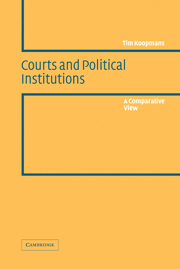
The frontier between 'law' and 'politics' is not always clear-cut. A large area exists where courts operate, but where governments and parliaments also make decisions. Tim Koopmans compares the way American, British, French and German law and politics deal with different issues: in many instances subjects which are highly 'political' in one country constitute legal issues in another. Is there, for example a 'sovereign Parliament' (as there is in Britain), or will courts control the compatibility of statutes with the Constitution (as in the United States and Germany)? How far can courts go in controlling the legality of administrative action? Are there general legal theories about the frontier between what courts and what politics can do? Koopmans considers case law on a range of issues, including human rights protection, federalism, separation of powers, equal protection and the impact of European and international law.
This book examines how national law is treated in WTO law, both in the WTO treaty and dispute settlement cases. The WTO treaty contains a set of far-reaching obligations establishing a systemic and constitutional framework of interaction between WTO law and national law. WTO dispute settlement operates as an international layer of judicial review of national laws and administrative, judicial or quasi-judicial measures. Consequently, much of the WTO dispute settlement decisions and rulings relate in different ways to Members' national laws. Yet, up until the publication of this book, there was no systematic analysis of this vastly important subject. This book provides a thorough map of an increasingly complex field. In doing so, it extends the enquiry beyond well-known formulas and combines practical analysis with principled discussion of how the treatment of national law in international law can and should ensure effectiveness of international rules and promote good governance within nation-states.
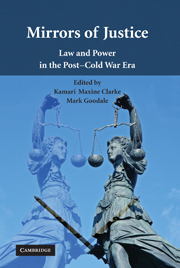
Mirrors of Justice is a groundbreaking study of the meanings of and possibilities for justice in the contemporary world. The book brings together a group of both prominent and emerging scholars to reconsider the relationships between justice, international law, culture, power, and history through case studies of a wide range of justice processes. The book's eighteen authors examine the ambiguities of justice in Europe, Africa, Latin America, Asia, the Middle East, and Melanesia through critical empirical and historical chapters. The introduction makes an important contribution to our understanding of the multiplicity of justice in the twenty-first century by providing an interdisciplinary theoretical framework that synthesizes the book's chapters with leading-edge literatures on human rights, legal pluralism, and international law.
This is the first comprehensive study of the life and works of Muhammad Baqer as-Sadr - an Iraqi scholar who made an important contribution to the renewal of Islamic law and politics in the contemporary Middle East. Executed in 1980, Sadr was the most articulate thinker and a major political actor in the revival of Shi'i learning, which placed Najaf in Southern Iraq at its centre. Dr Chibli Mallat examines the intellectual development of Sadr and his companions who included Ruhullah al-Khumaini and assesses Sadr's innovative approaches to the study of law, economics and banking. The author convincingly demonstrates how Sadr's ideas and activities were influential in the rise of political Islam across the Middle East and played an important part in the Iranian revolution of 1979.
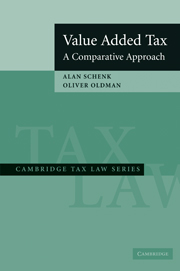
This book integrates legal, economic, and administrative materials about value added tax. Its principal purpose is to provide comprehensive teaching tools - laws, cases, analytical exercises, and questions drawn from the experience of countries and organizations from all areas of the world. It also serves as a resource for tax practitioners and government officials that must grapple with issues under their VAT or their prospective VAT. The comparative presentation of this volume offers an analysis of policy issues relating to tax structure and tax base as well as insights into how cases arising out of VAT disputes have been resolved. The authors have expanded the coverage to include new VAT related developments in Europe, Asia, Africa and Australia. A chapter on financial services has been added as well as an analysis of significant new cases.
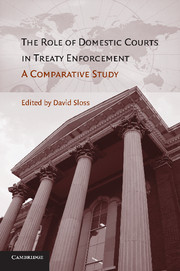
This book examines the application of treaties by domestic courts in twelve countries. The central question is whether domestic courts actually provide remedies to private parties who are harmed by a violation of their treaty-based rights. The analysis shows that domestic courts in eight of the twelve countries - Australia, Canada, Germany, India, the Netherlands, Poland, South Africa, and the United Kingdom - generally do enforce treaty-based rights on behalf of private parties. On the other hand, the evidence is mixed for the other four countries: China, Israel, Russia, and the United States. In China, Israel, and Russia, the trends are moving in the direction of greater judicial enforcement of treaties on behalf of private parties. The United States is the only country surveyed where the trend is moving in the opposite direction. US courts' reluctance to enforce treaty-based rights undermines efforts to develop a more cooperative global order.
For every transnational lawyer, it is vital to know the differences between national secured transactions laws. Since the applicable law is determined by the place where the collateral is situated, it may change when movables are brought from one state to another. Introductory essays from comparative lawyers set the scene. The book then presents a survey of the law relating to secured transactions in the member states of the European Union. Following the Common Core approach, the national reports are centred around fifteen hypothetical cases dealing with the most important issues of secured transactions law, such as the creation of security rights in different business situations, the relationship between debtor and secured creditor, the nature of the creditor's rights and their enforcement as against third parties. each case is followed by a comparative summary. A general report evaluates the possibilities of European harmonisation in the field of secured transactions law.
The 14 essays that make up this 2003 volume are written by leading international scholars to provide an authoritative survey of the state of comparative legal studies. Representing such varied disciplines as the law, political science, sociology, history and anthropology, the contributors review the intellectual traditions that have evolved within the discipline of comparative legal studies, explore the strengths and failings of the various methodologies that comparatists adopt and, significantly, explore the directions that the subject is likely to take in the future. No previous work had examined so comprehensively the philosophical and methodological foundations of comparative law. This is quite simply a book with which anyone embarking on comparative legal studies will have to engage.
Professor Jolowicz's comparative analysis of civil procedure concentrates on the purposes served by the institution of litigation rather than on the intentions of those who litigate. Stressing that those purposes go beyond mere dispute resolution by non-violent means, Jolowicz surveys a variety of topics of procedural law, making substantial use of the comparative method, in the attempt to examine and explain the ideas which underlie some of the most important of its constituent elements. In the final section, he deals with the reform of English law and ventures a prediction of the consequences that the new Civil Procedure Rules, together with the reforms which more or less immediately preceded them, will have on the character of English procedural law.
In this book one of the world's foremost legal historians attempts to explain what produced the private law of the western world as we know it today. Professor van Caenegem pays particular attention to the origins of the common law - civil law dichotomy, and how it arose that England and the continent of Europe, although sharing the same civilisation and values, live under two different legal systems. The chronological coverage extends from the Germanic invasion in the early Middle Ages to the present day, incorporating analysis of the medieval Roman and canon law (both products of the law schools), and that of the School of Natural Law which inspired the great national codifications of the modern age. Professor van Caenegem evaluates the role of the lawgivers - emperors, kings and parliaments - and that of the judges, particularly, of course, in the lands of the English common law. He deals with the great phases of legal development and the main bodies of doctrine and legislation (rather than offer an analysis of the legal norms themselves); with substantive private law - family and status, property, contract, inheritance, trade - and with the organisation of the courts and the forms of process. An Historical Introduction to Private Law is based on both an extensive secondary literature in several languages, and on evidence accumulated by Professor van Caenegem over the past forty years.