To save content items to your account,
please confirm that you agree to abide by our usage policies.
If this is the first time you use this feature, you will be asked to authorise Cambridge Core to connect with your account.
Find out more about saving content to .
To save content items to your Kindle, first ensure no-reply@cambridge.org
is added to your Approved Personal Document E-mail List under your Personal Document Settings
on the Manage Your Content and Devices page of your Amazon account. Then enter the ‘name’ part
of your Kindle email address below.
Find out more about saving to your Kindle.
Note you can select to save to either the @free.kindle.com or @kindle.com variations.
‘@free.kindle.com’ emails are free but can only be saved to your device when it is connected to wi-fi.
‘@kindle.com’ emails can be delivered even when you are not connected to wi-fi, but note that service fees apply.
While the United States is fighting a rearguard action to limit the jurisdiction of the new International Criminal Court over American citizens, it is bankrolling a Special Court to deal with atrocities in Sierra Leone which is far from universally popular there…So far there has been little public enthusiasm for the Court. The Sierra Leonean people have shown themselves to be amazingly forgiving, but they are also very fatalistic…They undoubtedly feel that there should be some accounting for these terrible tragedies, but in the spirit of peace and reconciliation many feel that it is for God or Allah to determine retribution.…The Court has been set up with the best of intentions. But is it right to pursue the prosecutions in Sierra Leone at this time, when the wounds of the conflict are still so raw and the peace so fragile?…Do those involved realise that this is not just the exercise of justice, but something which has profound political and security implications? If the Special Court goes ahead it must be managed most carefully by officials, the government and the international community, otherwise the peace could be seriously undermined and even broken.
(Peter Penfold, Guardian Unlimited, October 20, 2002)
Are Sierra Leoneans so fatalistic as to believe that justice for those responsible for the violence that they have lived with for the last decade can only be administered by God?…What kind of restitution does someone who has had their hands chopped off hope for and expect? What justice is there for children who have watched their parents and siblings being mutilated and killed or, worse still, who themselves were forced to participate? […]
In the final third of the twentieth century, a host of social movements challenged the ostensible neutrality of liberal conceptions of equality enshrined in the modern, liberal state, demanding a recognition and valorization of difference. These movements – feminism, gay and lesbian activism, ethnic identity movements, disability rights movements, to name but a few – challenged hegemonic conceptions of justice as difference-blind. They provoked a tidal wave of theoretical work in the areas of multiculturalism and the politics of difference, all of which tried to grapple with the implications that recognizing differences within the citizenry might have for justice. One could be forgiven for thinking that states had never before faced the challenges of difference or attempted to address difference politically and legally.
In fact, in the period immediately following the First World War, fifteen states, most of them located on the eastern periphery of Europe, legally committed themselves to doing precisely this. Along with the postwar peace treaties, they signed what became known as “minorities treaties.” These treaties required treaty-bound states – caustically dubbed “minority states” by international relations scholar Inis Claude (1955) – explicitly to grant equal civil and political rights to members of “racial, religious and linguistic minorities,” but also certain special rights that arose from their differences, such as free use of their maternal language, the right to set up charitable institutions at their own expense, and the right to primary education in the maternal language if the minority made up a “considerable proportion” of a district's residents.
INTRODUCTION: JUSTICE, PATERNALISM, AND LEGITIMACY
In Côte d'Ivoire, between 2002 and 2006, diplomats and international jurists tried to use the threat of international prosecution in a politically instrumental manner. Attempts to lessen the abuse of civilians were at least partially successful. Although it is difficult to give a definitive explanation for such success, I argue in this essay that the main causes can be located in Ivorian conceptions of justice and their ability to influence political actors' behavior, rather than the external threats brought to bear on those same actors. This is not to say that external and internal logics have not influenced each other, engaging in a kind of lengthy conversation. The commitment of Ivorians on both sides of the civil conflict to see themselves and be seen as legitimate political actors has helped to condition the forms of violence that have emerged in the Ivorian conflict at the same time that they have added to the efficacy of the threat of international prosecution for war crimes/crimes against humanity. The fact that blame for war crimes or atrocities could serve as one means of stripping political actors of local legitimacy increased the leverage such threats enjoyed, which raises the question of whether levels of violence might have been self-regulating even without external intervention.
From 1960 to 1985, Côte d'Ivoire was West Africa's economic Eldorado, rivaled only by Nigeria after it began producing oil.
In a highly critical article, Naz K. Modirzadeh (2006) challenges the international human rights community's refusal to address Shari'ah, or Islamic law, when it appears to foster violations of international human rights norms. According to her, this strategy is characterized by a caveat fidelis in almost all Human Rights Watch and Amnesty International reports focusing on Muslim societies, stating that international human rights NGOs (INGOs) take no position on religious law in the region and, for the most part, avoid the fact that many human rights violations in the region are rooted in some form or interpretation of Shari'ah. For most Muslims, she argues, “The question of ‘Islam and human rights’ is not, in fact, whether or not there is a conflict but, rather, how such a conflict is to be addressed”; the fact that INGOs refuse to address this conflict between two competing legal regimes is “bad for activists, bad for Islamic law, and bad for human rights” (2–3).
In an equally persuasive manner, Anthony Chase (2006) argues for the necessity of pursuing human rights in Muslim-majority Arab states outside of the framework of Islam: “[P]laying on Islamic turf is not only a transparent, losing strategy,…but, more dangerously, it also de-legitimizes non-Islamic norms in predominantly Muslim societies and implicitly accepts their marginalization” (Chase, 2006: 22). For him, human rights violations grow out of political, economic, and social phenomena rather than out of Islam; therefore, addressing and preventing violations must involve political, economic, and social solutions rather than reference to religion.
The persistence of violent conflicts in Africa and the world in general have resulted not only in untold human and material losses but also in egregious human rights abuses. The need to bring the perpetrators to account led to the establishment of several international tribunals to prosecute those persons and groups accused of committing gross human rights abuses. The employment of the ICC as an international justice mechanism in achieving peace, ensuring justice, and ending ongoing conflicts in Africa is now a reality. However, there is also tension between international justice mechanisms and local means of resolving ongoing and protracted conflicts in relation to the activities of the ICC in its first four investigations on the continent.
The ICC has jurisdiction to indict people accused of such international crimes as genocide, crimes against humanity, and war crimes. The Court has power to provide redress to victims and survivors of these crimes, and some argue that the mere presence of the ICC has a deterrent effect on future dictators and their collaborators. However, questions are being asked about whether the ICC alone can effectively end the conflicts or if other forms of transitional or restorative justice can be employed in achieving lasting peace and justice on the continent.
The emergence of international criminal justice regimes in Africa marks a clear departure from the past when leaders on the continent were immune from prosecution or criminal responsibility.
Historical narratives play important roles in institutions designed to address the legacies of mass violence. Truth commissions are explicitly designed to provide public and official contexts for narrating the unspeakable and locating responsibility for crimes against humanity. The assumption that “revealing is healing” (Adam and Adam, 2001) underlies many strategies for addressing the legacies of massive violence: Expressing or exposing previously denied, secreted, or silenced truths about state violence is said to provide victims with dignity and closure (du Toit, 2000; Hayner, 2001; Minow, 1998; Popkin and Rhot–Arriaza, 1995), as well as to reconcile former enemies and resolve the lingering community-level conflicts that follow violent regimes and armed resistance movements. Trials and international tribunals that identify perpetrators and hold them judicially accountable also produce and authorize new narratives about past atrocities, assigning responsibility for creating conditions that made massive violations of human rights possible. Providing a secure foundation for the rule of law, many advocates agree, requires a comprehensive accounting for the past. Lively legal and academic debate has turned on the role of war crimes trials in documenting systematic atrocities, creating historical memory, and raising public awareness of offenses against human rights (Douglas 2001; Osiel 1997), as distinct from adhering strictly to the requirements of the judicial process for determining culpability (Arendt, 1964; Buruma, 1994). Both tasks are essential, but it is difficult to accomplish both in a single body while upholding notions of historical documentation and institutional responsibility, on the one hand, and standards of due process and individual rights, on the other (Landsman, 2005).
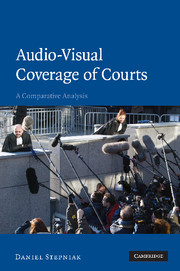
Researched over a period of 15 years by an author who has personally participated in the debate internationally, Audio-Visual Coverage of Courts was the first book to undertake a comprehensive comparative study of televised court proceedings in Great Britain, the United States, Canada, Australia and New Zealand. Exhaustive in his identification and analysis of relevant law and key developments, Daniel Stepniak draws on hitherto unpublished primary sources to undertake a largely unprecedented examination of the experiences of non-US courts. Through analysis of the regulation of audio-visual reporting, the author outlines a theoretical framework and proven action plan for the attainment of the potential benefits of audio-visual coverage, arguing that technological advances, acknowledgement of legally enforceable rights and, above all, judicial recognition of courts' vested interest in facilitating coverage in order to promote greater public access and understanding of judicial proceedings, have led audio-visual coverage to be increasingly perceived as desirable.
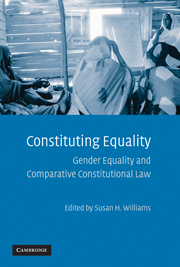
Constituting Equality addresses the question, how would you write a constitution if you really cared about gender equality? The book takes a design-oriented approach to the broad range of issues that arise in constitutional drafting concerning gender equality. Each section of the book examines a particular set of constitutional issues or doctrines across a range of different countries to explore what works, where, and why. Topics include: governmental structure (particularly electoral gender quotas); rights provisions; constitutional recognition of cultural or religious practices that discriminate against women; domestic incorporation of international law; and the role of women in the process of constitution making. Interdisciplinary in orientation and global in scope, the book provides a menu for constitutional designers and others interested in how the fundamental legal order might more effectively promote gender equality.
In Judges, legislators and professors one of the world's foremost legal historians shows how and why continental and common law have come to diverge so sharply. Using ten specific examples he investigates the development of European law, not as the manifestation of certain ideological and intellectual trends, but as largely the result of power struggles between the judiciary, the legislators, and legal scholars, each representing certain political and social ambitions. Now available in paperback, Judges, legislators and professors provides an historical introduction to continental law which is readily accessible to readers familiar with the common law tradition and vice-versa.
In 1980, the United Nations Convention for the International Sale of Goods (CISG) came into being as an attempt to create a uniform commercial sales law. This book, first published in 2007, compares two major restatements - the UNIDROIT Principles and the Principles of European Contract Law (PECL) - with CISG articles. This work has gathered scholars and legal practitioners from twenty countries who contribute analysis on the various issues covered in the articles of the CISG comparing them with how the issue is treated in the UNIDROIT and PECL restatements.The introductory section of the book addresses theoretical and practical issues of the appropriate interpretive methodology as mandated in CISG Article 7 and it is followed by individual analyses of the Convention's provisions.
This book examines the cultural origins of Islamic law. Some authorities stress the importance of the contribution of Roman law; others that of Arabian law. Most are agreed that Jewish law contributed, but not explained further. Dr Crone tests the Roman hypothesis with reference to one institution, the patronate, which does indeed appear to owe something to Roman law. He concludes that Roman law contributed only in so far as it was part and parcel of the rather different legal practice of the Near Eastern provinces, and that provincial law would repay further consideration by legal historians.
Every civilised system of government requires that the state should make available to all its citizens a means for the just and peaceful settlement of disputes between them as to their respective legal rights. The means provided are courts of justice to which every citizen has a constitutional right of access. Lord Diplock in Bremer Vulkan Schiffbau and Maschinenfabrik v South India Shipping Corp. [1981] AC 909, HL, p. 976.
The justification of a legal system and procedures must be one of lesser evils, that legal resolution of disputes is preferable to blood feuds, rampant crime and violence. M. Bayles, ‘Principles for legal procedure’, Law and Philosophy, 5:1 (1986), 33–57, 57.
The first impulse of a rudimentary soul is to do justice by his own hand. Only at the cost of mighty historical efforts has it been possible to supplant in the human soul the idea of self-obtained justice by the idea of justice entrusted to authorities. Eduardo J. Couture, ‘The nature of the judicial process’, Tulane Law Review, 25 (1950), 1–28, 7.
The last fifteen years has been a period of significant change within civil justice systems around the globe and the fundamental reform of English civil justice which was part of that movement is now a decade old. This therefore seems an opportune moment for reflection. In choosing civil justice as my topic for the Hamlyn Lectures 2008, I am straying into territory well marked out by experts such as Sir Jack Jacob, Michael Zander, J.A. Jolowicz, Adrian Zuckerman and, of course, in his own time, Jeremy Bentham. But my ambition in these lectures is to offer a somewhat different perspective on civil justice. I am interested in theoretical questions about the social purpose and function of civil justice (in particular in common law systems) and empirical questions about how the civil justice system works in light of those purposes. My perspective on civil justice is shaped by the experience of nearly three decades spent studying how the civil justice system operates in practice. I have sat in people’s homes talking about civil justice problems and why they do or don’t want to litigate or wish they had or hadn’t.
Few questions are as central to the study of the legal process as that of how legal decisions are made. It is of transcendent practical significance, because a favourable decision is the presumed goal of every litigant. The question also is an essential jurisprudential one, because any theory of the nature of law necessarily embodies a judgment about how law is made.
Introduction
In this chapter I propose to continue the focus on the social and economic significance of civil justice, but to look more closely at adjudication or judicial determination within that system. This has presented something of a challenge because of the scarcity of UK research on judicial behaviour. While there is scholarly writing on civil procedure and research on legal services and advocacy, there is little written on the role of the judge in civil justice, except as an adjunct to the post-Woolf philosophy of adjudication – which required the judiciary to change their culture, be less passive, roll up their sleeves and get stuck into becoming case managers.
My interest in the judicial role and judicial decision making arises from a number of sources. First, from having observed judges in courts and tribunal hearings during various research projects – often from the perspective of litigants, but also sitting with judges on the other side of the bench or table. This has given me a vivid sense of the expectations, fears and competence of litigants in court. It has also given me an insight into the day-to-day work of judges and, in particular, those below the waterline of the High Court.
My starting point for this chapter is essentially the conclusion of the previous chapter: that the civil justice system has a significant social purpose and that the fundamental challenge for reformers is how to provide a modern, efficient system that delivers just outcomes by means of procedures that are fair and that are perceived to be so by litigants and other court users – a system that delivers justice and enjoys public confidence. Most importantly, the question is how the public purpose of the civil justice system – in supporting social and economic stability – is achieved in a climate of strained resources and when the demands of criminal justice seem to be unstoppable. I argued that we have been presented with two competing narratives about civil justice: that there is not enough access to justice and that there is too much litigation. As far as the government and some sections of the judiciary are concerned, the answer to both arguments seems to be diverting cases away from the courts and into private dispute resolution processes and in particular mediation. This trend is true of policy in relation to family disputes, civil and commercial disputes and, more recently, administrative justice disputes involving citizen and State. In this context I am interested in reflecting on who and what is driving ADR policy, and why.
My focus is principally on the promotion of ADR for non-family civil disputes and, in particular, judicial and government policy on mediation. While my interest in civil justice reform has inevitably led to engagement with ADR policy, I have also developed a good ground-floor feel for what mediation offers and for its limitations as a result of having undertaken a number of evaluations of court-annexed mediation schemes in England over the last decade. These evaluations involved talking to litigants who had chosen to mediate, those who had rejected the opportunity to mediate, those who felt they had been forced to mediate and those who would have liked the opportunity to mediate. I have watched mediations. I have talked to lawyers about mediation and to mediators about mediation.
Having drawn attention to the social and economic importance of civil justice, this chapter considers the surprising coincidence during the past decade of worldwide ‘crises’ in civil justice. It examines the reform programmes put in place around the world – in response to these perceived crises and access to justice concerns – and discusses the interesting disconnection of these reviews and reforms from any empirical understanding about access to justice. The chapter concludes with a discussion of recent comparative evidence about the responsiveness of the civil justice system to the needs of the public and a reflection on the question of how much civil justice we need and how much we can afford to forego in light of the purposes of civil justice.
Civil justice in crisis around the world
If the significance of civil justice to governments around the world were to be judged merely by the number and tonnage of review reports, then clearly it is very significant indeed. The last decade has seen a global explosion of reviews, analyses and reforms of civil justice systems. Although the English civil justice system has been the subject of complaint and report at least since the middle of the nineteenth century, the fundamental review of English civil justice undertaken by Lord Woolf during 1994–6 has to be viewed in that wider context. It was only one of a number of similar reviews and reform programmes that started in California and Australia, were repeated in several Australian states and then seemed to spread around the world to New Zealand, several provinces in Canada, Hong Kong and Scotland. All were apparently undertaken in response to existing or impending crises in civil justice. Indeed, a collection of scholarly papers published in 1999 edited by Adrian Zuckerman was dramatically entitled Civil Justice in Crisis.