To save content items to your account,
please confirm that you agree to abide by our usage policies.
If this is the first time you use this feature, you will be asked to authorise Cambridge Core to connect with your account.
Find out more about saving content to .
To save content items to your Kindle, first ensure no-reply@cambridge.org
is added to your Approved Personal Document E-mail List under your Personal Document Settings
on the Manage Your Content and Devices page of your Amazon account. Then enter the ‘name’ part
of your Kindle email address below.
Find out more about saving to your Kindle.
Note you can select to save to either the @free.kindle.com or @kindle.com variations.
‘@free.kindle.com’ emails are free but can only be saved to your device when it is connected to wi-fi.
‘@kindle.com’ emails can be delivered even when you are not connected to wi-fi, but note that service fees apply.
Now in its second edition, this textbook presents a critical rethinking of the study of comparative law and legal theory in a globalising world, and proposes an alternative model. It highlights the inadequacies of current Western theoretical approaches in comparative law, international law, legal theory and jurisprudence, especially for studying Asian and African laws, arguing that they are too parochial and eurocentric to meet global challenges. Menski argues for combining modern natural law theories with positivist and socio-legal traditions, building an interactive, triangular concept of legal pluralism. Advocated as the fourth major approach to legal theory, this model is applied in analysing the historical and conceptual development of Hindu law, Muslim law, African laws and Chinese law.
Pure economic loss is one of the most discussed and controversial legal issues in Europe today, raising complex questions which affect the law of tort and contract. How far can tort liability expand without imposing excessive burdens upon individual activity? Should the recovery of pure economic loss be the domain principally of the law of contract? And is there a common core of principles, policies and rules governing tortious liability for pure economic loss in Europe? Originally published in 2003, this is a comprehensive study of the subject, using a fact-based comparative method and in-depth research into the laws of thirteen European countries. Following a historical and analytical introduction to economic loss, experts from most European countries consider how their national systems would deal with the same practical problem, highlighting similarities and differences in a range of comprehensive issues. This is the third publication of the Common Core of European Private Law.
“There is no reconciliation possible with the assassins of Shining Path.”
– Alan García, Correo, August 14, 2003
“With Shining Path there can be no pact, no political solution and no form of reconciliation.”
– Congresswoman and former presidential candidate Lourdes Flores Nano, La República, August 10, 2003
“The government never resolved the problems that caused the war. They should solve them! The same motives for waging war are still there. The strategies may change, but the motives are still present. It's not about giving alms to the poor or asking people to give their leftovers to them. The poor are also Peruvians! It's an obligation of the state to watch out for the well being of the population.”
– Shining Path militant, Interview, Chorillos Prison, June 23, 2007
INTRODUCTION
On August 28, 2003, the Commissioners of the Peruvian Truth and Reconciliation Commission (PTRC) submitted their Final Report to President Alejandro Toledo and the nation. After two years of work and some 17,000 testimonies, the Commissioners had completed their task of examining the causes and consequences of the twenty-year internal armed conflict (1980–2000) between the Peruvian armed forces and two armed rebel groups, Sendero Luminoso (SL) and the Movimiento Revolucionario Túpac Amaru (MRTA). Peru thus joined the growing list of countries that have implemented truth commissions as a means of transitioning from a period of armed conflict and authoritarian rule toward the founding of a procedural democracy and the rule of law.
The Allied victory in 1945 produced two innovative but not necessarily compatible constructions of justice. The first was the agreement among the Allies (United States, Great Britain, the Soviet Union, and France) to jointly prosecute the individual leaders of the defeated Axis powers for waging aggressive war and committing crimes against humanity, particularly the mass murder and torture of civilians. This consensus generated the initial Nuremberg trial (1945–1946) and then the International Military Tribunal for the Far East (IMTFE), also known as the Tokyo war crimes trial.
The second Allied consensus was that Germany and Japan had to be militarily occupied, purged of fascism (which was already defeated in Italy), and made incapable of threatening world peace. As early as 1946, as part of its grand strategy, the United States envisioned the reinvention of both these defeated enemies as bulwarks of free-market democracy against the geopolitical threat of the Soviet Union, west and east. For Japan, the postwar nation-building project entailed radical constitutional reform and cultural change. Less attention has been paid to how the U.S. Cold War national security objectives – founded on the legitimacy of its weapons of mass destruction (WMD) – ultimately corrupted the IMTFE by excluding evidence of mass murder with germ weapons and by failing to indict the responsible Japanese leaders for these crimes.
In contemporary times, American political indifference to genocide and torture in the Balkans and Africa has been analyzed as part of its historical reluctance to intervene in international conflict.
How can we measure justice? Are there tensions between an instrumental and an intrinsic conception of justice? These questions are currently being debated within the World Bank, an international development agency founded in 1946 under a mandate of poverty reduction. On May 15–16, 2006, members of the Bank's Legal Department led a workshop on developing justice indicators that examined these questions. The participants included thirty Bank employees, the Nordic-Baltic Foreign Ministries, and experts from four continents. The Bank organized the workshop in preparation for a new trust fund on justice and human rights, aimed at the “practical” promotion of human rights considerations at the institution. One of the objectives of the workshop was to “consider ‘what measuring justice means,’ including both the objective of and methodologies for doing so.”
The Measuring Justice Initiative, which attempts to quantify the performance of the justice sector in developing countries, is part of a larger trend in the Bank to empirically measure normative concepts. My research focuses on the institution's empirical treatment of human rights and its support for an instrumentalist interpretation of the concept. One example of this recent approach is the Bank's Human Rights Indicators Project, a parallel initiative to Measuring Justice, which began in 2005 and is also based in the Legal Department. This project aims to develop a methodology and operational tools to measure and assess human rights and integrate them into development processes.
In this volume, Mark Goodale and Kamari Clarke courageously tackle the question of the meanings of justice in a world that is exploding with interest in human rights and transitional justice. These initiatives are powered by the idea of justice, and compliance is deeply dependent on the normative support that the evocation of justice provides. Yet, as they point out, justice is an extremely vague and unspecified concept, however powerful. Most people agree that they want justice but have far greater difficulty deciding which dictator of what country should be tried and whether he should be killed for which offenses. It is, as Goodale and Clarke say, the very aspirational quality and substantive openness of the concept of justice that gives it its power. In this regard, the idea of justice differs sharply from that of human rights, which has an elaborate set of legal texts and procedures such as conventions, treaty bodies, complaint mechanisms, and civil society organizations that ferret out abuses and translate them into human rights terms that are recognizable to these international institutions. Human rights specify relatively clearly what justice is and what procedures will produce it.
If we ponder the sources of ideas of justice, however, we realize that they are multiple and hardly all grounded in human rights. Responding to the challenge that Goodale and Clarke pose in the introduction, it seems that we are able to identify at least four discrete sources of justice ideas.
Were there no injustice, men would never have known the name of justice.
– Heraclitus nearly 2,500 years ago
INTRODUCTION
In this epilogue, my interests lie in the taken-for-granted uses made of words to describe law-related phenomena – justice, injustice, human rights. In national and transnational contexts of power, the ambiguities embraced by words like justice, injustice, or human rights are often there for a purpose – the masking of imperial intent or power disparities that some might call recycled indirect rule. A favored concept may be selected as a distancing mechanism, or the use of a certain word may be the result of confusions. Others may select words to provoke debate in reference to concrete instances or to avoid confrontation by keeping the conversation abstract enough to keep within boundaries. In addition, words like justice may be used to differentiate between us and them, the virtuous and the wild animal, or good and bad scholarship. My professional interest in cultural anthropology lies in understanding the eye that sees, the mind that makes sense of ethnographic findings, and the controlling processes that mediate word use more generally. Simply put, the words we use to discuss law in the making of history often color the content of what we write while also shaping the possibilities for global research efforts to transform human relationships. The process by which words can be made to convey thought is far more complex than is ordinarily understood.
Since the end of the Cold War twenty years ago, there has been a dramatic increase in the number of international and transnational institutions for which “justice” has become a central ideological ordering principle, an implicit goal, or, in the case of the International Criminal Court (ICC), a formal basis for institutional action. At the same time, there has been a corresponding rise in the prevalence and cross-cultural resonance of justice as a framing discourse, a transnational normativity that gives shape to, but is not coextensive with, the modalities of international law, human rights, and preexisting cultural and moral imperatives. The problem, we might say, of justice is of course an old one indeed: Its complexities have formed the staple of debates within political philosophy for centuries if not millennia; within both theology and international law the centrality of justice has made it an iconic, if shifting, symbol that has at times come to represent the particular system itself. Justice has served as the illusive endpoint of any number of political and social teleologies, the utopian goal toward which movements of ideas and people have been hurled with sometimes tragic, sometimes heroic, consequences.
More recently, however, the withering away of the logics of the bipolar postwar system provided an opening for the actual building and implementation of both international and transnational systems that had existed as either idea or unrealized possibility, including the international human rights system, the interrelated system of international criminal law, and the more diffuse networks of transnational actors that came to constitute what Eleanor Roosevelt, the chair of the commission that produced the 1948 Universal Declaration of Human Rights, called the “curious grapevine.
In 52 b.c., Cicero proclaimed that “those who share Law must also share Justice; and those who share these are to be regarded as members of the same commonwealth” (1997: 24). This statement will form the backdrop to my presentation, which deals with international conventions about children and their rights and, more specifically, how they relate to the recent and burgeoning practice of transnational adoption from countries in the South to mainly involuntarily childless people in the North. To what extent these “global laws” can be said to represent the sense of justice of the citizens of the various signatory nation-states will be my overriding concern; how far and according to what principles can the boundaries of “the same commonwealth” be stretched? My argument will be that the values of these conventions reflect contemporary Western values and that this raises important questions about a globalization of Western rationality and morality, about legal pluralism, and about the meaning of justice. I shall consider if, in the application of the normative discourse of these conventions, we can witness what the editors of this volume call “circumscribed pluralism”; namely, a middle space between the local and the global, circumscribed by the demands of local moral agents as well as the global norms in relation to which they position themselves.
The relationship between local and (posited) universal ideas and values is an old anthropological problem.
The European Convention on Human Rights (hereafter, Convention) was signed in 1950 by Western European governments committed to prevent the repetition of the horrors and atrocities of World War II – not to mention the erection of a bulwark against communist Eastern Europe. Admittedly, justice was not originally at the forefront, and has indeed very much remained in the background, of discussions about the Convention system. Nonetheless an implicit narrative has always suggested that the protection of human rights is conducive to the realization of justice. This is clear, for example, in the Convention's Preamble which specifically “reaffirmed” a “profound belief in those fundamental freedoms which are the foundation of justice and peace in the world.” The Preamble referred to “like-minded” governments that shared “a common heritage of political traditions, ideals, freedom and the rule of law.” Not wanting the Convention to be mere words, the members established a system of judicial protection, which was a first in international law. The European Court of Human Rights (hereafter, Court) soon “earned a world-wide reputation for fairness, balance and intellectual rigour” (Harris et al., 1995: vii). This chapter challenges the implicit making of an equation between human rights law and justice by examining a specific area where the record of the Court is anything but strong, that of racial discrimination. In this area, those who have arguably been victims of human rights violations have not met justice at Strasbourg.
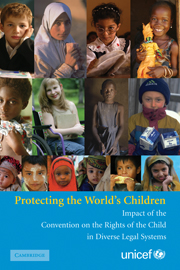
The book contains four studies that compare experiences from countries with similar legal traditions and examine how the Convention on the Rights of the Child has been integrated and harmonized with national legislation in specific countries. The book demonstrates how the CRC can be implemented in different country contexts in an effort to achieve children's rights uniformly across widely divergent legal traditions. It highlights key developments, identifies trends, and draws general conclusions that provide insight into the legal traditions at issue for advocacy in relationship to the implementation of the CRC, as well as to encourage practical actions. The book proposes a framework for enhancing compatibility of national legislation with human rights instruments and with the CRC in particular. The book endeavors to emphasize the CRC's ideology of indivisibility of rights, solidarity, and partnership in realizing children's rights. The book is a powerful advocacy tool for supporting the implementation of the CRC and Convention on the Elimination of all Forms of Discrimination Against Women (CEDAW).
I have not in the past had any impulse to take up issues of justice or rights in my anthropological work. My lack of interest on this score did not follow from an absence of personal concern about these matters, but was rather rooted in my sense that it is difficult if not impossible to talk about universally binding norms of justice without losing the distinctive tenor of the specifically anthropological voice. That voice, traditionally attuned to cultural differences and the integrity of local standards, tends to abandon what I take to be its better self in conversations on universal values. This need not always be the case. Indeed, I take the controversial American Anthropological Association Executive Board Statement on Human Rights to be an admirable attempt to speak to the issue of universal human rights in a uniquely anthropological way (Executive Board, 1947). The fact that this statement is held in little esteem today by anthropologists, however, and that it is held in even lesser regard by individuals outside the discipline, indicates that its confident, even brave (given the immediate postwar context of its composition), relativism has had little positive impact on broad discussions of the nature of justice and rights in the academy or beyond (cf. Goodale, 2006: 1–2; Merry, 2003). It appears, then, that the kind of openness to the value of relativism as a position from which to think about social possibilities and to keep a critical eye on our own settled pieties that stands at the foundation of my understanding of anthropology as a discipline has proven a nonstarter in the world of justice and rights – and this is why I have until this point shied away from addressing these topics.
Since the late 1990s, victims of mass atrocity have been led to believe that they can expect to be included to a greater extent than previously in international criminal prosecutions of those accused of harming them through genocide, crimes against humanity, and war crimes. Most notably, the new International Criminal Court (ICC), established by the Rome Statute in 1998, is mandated to address victims' interests in ways that go beyond previous responses to the world's gravest crimes, such as those undertaken through the ad hoc tribunals after the conflicts in the former Yugoslavia (International Criminal Tribunal for the former Yugoslavia; ICTY) and Rwanda (International Criminal Tribunal for Rwanda; ICTR). The ICC's approach to victims has been labeled “innovative,” and a New York Times Magazine cover story touted Luis Moreno-Ocampo, the ICC's first Chief Prosecutor, as a beacon of hope for victims in the Darfur region of Sudan and of other conflicts involving mass violence. In public presentations, the ICC Chief Prosecutor routinely includes pictures of victims (e.g., a maimed child lying in a hospital bed in northern Uganda) to make the point that certain individuals deserve justice from the global community. By drawing on such images, he and other supporters of the ICC highlight the significance of his decision to bring what he refers to as “global justice” into this particular conflict and also the assumption that the ICC is obligated and committed to delivering justice to victims.