To save content items to your account,
please confirm that you agree to abide by our usage policies.
If this is the first time you use this feature, you will be asked to authorise Cambridge Core to connect with your account.
Find out more about saving content to .
To save content items to your Kindle, first ensure no-reply@cambridge.org
is added to your Approved Personal Document E-mail List under your Personal Document Settings
on the Manage Your Content and Devices page of your Amazon account. Then enter the ‘name’ part
of your Kindle email address below.
Find out more about saving to your Kindle.
Note you can select to save to either the @free.kindle.com or @kindle.com variations.
‘@free.kindle.com’ emails are free but can only be saved to your device when it is connected to wi-fi.
‘@kindle.com’ emails can be delivered even when you are not connected to wi-fi, but note that service fees apply.
The herbicides Bentazone and Phenmedipharm kill the leaves of intact tobacco plants but do not affect callus cultures. Tolerant mutants were isolated by treating leaves of previously γ-irradiated haploid plants with herbicide then excising and culturing the green herbicide-resistant cell clones on the otherwise yellowed leaves. Among plants subsequently regenerated were a total of ten stable independently isolated mutants. Sexual crosses show these ten represent four Bentazone and two Phenmedipharm loci; all mutants were recessive to wild type.
Artificially selected diploids of Coprinus lagopus when mated in compatible combinations, either together or with haploids, produce dikaryotic mycelia which are typical of normal haploid-haploid dikaryons. In a diploid-haploid dikaryon, the diploid nucleus is not as stable as when alone in a monokaryon but it can persist through repeated sub-culturing into a fruiting body and eventually through meiosis into the basidiospores. In a diploid–diploid dikaryon either one or the other nucleus becomes haploid so that fruiting bodies with two diploid nuclei are never formed. This fact constitutes a restriction on diploidy in nature and a useful method of reducing diploids to the haploid state.
Matings that might be considered to be incompatible at the B mating gene show a significant difference which is related to the number of B alleles common to the mating colonies. Matings with one B allele in common, e.g. B3B6+B2B3 produce fully compatible and normal dikaryons. Matings with two B alleles in common, e.g. B3B6+B3B6 have, at first while the diploid nuclei still persist, the appearance of an incompatible common B haploid heterokaryon. This indicates that the B incompatibility system is based not on a complementary action between different B alleles but on an oppositional action between the same alleles neutralizing the B gene product which is necessary for dikaryon formation.
Destabilization in somatic cells of P-element insertions in the X-linked singed gene of Drosophila melanogaster has been studied. We have shown that some but not all unstable P-element insertions in singed can form mosaics. The cause of this variation is not clear from studies of the restriction maps of the mutations tested. The transposable element movements occur early in development and require, in addition to an appropriate P-element insertion in singed, a trans-acting maternal effect component. Movements appear to occur preferentially in attached-X stocks. However, the maternal effect component maps to the central region of chromosome 2.
Rifampicin-resistant mutants have been isolated from a Micromonospora sp. In one of these, rifampicin failed to inhibit [3H]UTP incorporation in osmotically shocked cells; consequently, resistance was probably not due to the alteration of rifampicin permeability. Parallel to the rifampicin resistance there was a substantial increase in the novobiocin sensitivity of the mutants. Rifampicin-sensitive revertants exhibited their original novobiocin sensitivity. At the same time there was no increase in their sensitivity towards coumermycin A1, an agent of related structure and activity. The possible mechanism for this pleiotropy is discussed.
Normalizing selection with a moving optimum can result in strong selection for increased recombination. This conclusion is based on computer simulation of an infinite, random-mating diploid population with additive, polygenic determination of the selected phenotype. There can also be selection for increased recombination with a fluctuating optimum, and with directional selection. These effects which arise in an infinite population appear to be large compared to the additional effects arising in a finite population because of the random generation of linkage disequilibrium.
Additional data are presented on the maintenance of kappa particles in cells of P. aurelia (stock 51) after removal of the gene K. It is shown that kappa particles may be maintained for as long as twenty-seven fissions in the absence of K, or may disappear before eight fissions. Slight retardation in fission rate of paramecia quickly eliminates kappa particles. The bearing of these results on the metagon theory is discussed.
As part of a study to identify dosage-sensitive modifiers of the white eye colour locus and the retrotransposon, copia, a segmental aneuploid screen was conducted. It surveys the autosomal complement of the genome for dosage dependent modifiers of white, including ones effective upon retrotransposon insertion-induced alleles. Several regions were found which, when present as a segmental trisomy, affected one or more of the alleles tested in a strong and consistent fashion. Two of these regions have been identified as containing previously described modifiers, Darkener of-apricot and Inverse regulator-a. The remainder identify new white allele modifiers. Selected segmental monosomics were also tested where possible for regions exhibiting a trisomic effect. At least three regions were found to have a dosage-dependent effect in one, two and three copies.
We study the transient dynamics of the genotypic variance of an additive trait under stabilizing selection, recombination and random drift. We show how interaction of these factors determines the form and the rates of change of different components of the genotypic variance. Let Vg be the genie variance of the trait and CL be the contribution of linkage disequilibrium to the genotypic variance. We demonstrate that the dynamics of the system on the plane (Vg, CL) are typically characterized by a quick approach to a straight line with slow evolution along this line afterwards. We show that the number of loci, n, and the population size, N, affect the expected dynamics of Vg mainly through the ratio N/n. We use our analytical and numerical results in interpreting the published results of artificial stabilizing selection experiments. The analysis suggests that it is drift and not selection that most likely led to the reduction of genetic variability in most of these experiments. Even very strong stabilizing selection only slowly removes polygenic variability from populations.
Chloramphenicol (CM), Aureomycin (AM) and Puromycin (PM) induce RNA synthesis in RC-stringent Escherichia coli starved of a required amino acid. This fact has been used to develop a method for comparing the levels of resistance of single-step CM-r mutants to the three antibiotics. Three levels of resistance to each antibiotic were found among four mutants selected in a single CM-s strain. The mutant with the highest CM resistance has the lowest AM resistance, and vice versa, while the level of PM resistance was not correlated with that of either CM or AM. The four mutants all differed from each other in their patterns of resistance to the three antibiotics.
We have developed a recombination test in Bacillus subtilis that provides a tool for rapid genetic classification of mutants of identical phenotype. The test has been used to classify 25 ts mutants in nine recombination classes that have been proved by independent evidence to correspond to nine genetic loci.
When T6/+ female mice were mated to non-translocation-bearing males, the relative viability of the embryos at 13·5–14·5 days gestation was about 39%. About 36% of the oocytes ovulated by T6/+ females were aneuploid, as a result of non-disjunction at meiosis, the majority having either 19 or 21 chromosomes. However, aneuploidy only accounts for a proportion of the embryonic loss in T6/+ × +/+ matings, as many of the embryos with 41 chromosomes survive postnatally. The present findings indicate that approximately 50% of the oocytes ovulated with the normal haploid number of chromosomes (n = 20) were genetically unbalanced as a result of adjacent segregation, and that a high proportion of the resultant embryos die in the early postimplantation period. In the present study non-translocation-bearing mice which were genotypically similar to the T6/+ females acted as controls.
A mutant, YS17, at the buff spore colour locus in Sordaria brevicollis has previously been described. It shows conversion with high frequency, predominantly to wild type, and is believed to act as a recognition site for an endonuclease that initiates recombination at the YS17 site. The discovery is now reported of a gene that causes loss of the high-frequency conversion shown by the YS17 mutant. The gene was present in existing stocks of the fungus. It reduces the conversion frequency of YS17 to a level similar to that of other buff mutants, from which it is inferred that the YS17 mutant no longer acts as an initiation site for recombination. When the conversion frequency of YS17 is low the bias in conversion to wild type rather than to mutant is lost, suggesting that this bias may relate to the initiation of recombination at the site. The loss of high frequency conversion of YS17 appears to be determined by a single recessive gene linked to mating type and unlinked to buff. It is suggested that the dominant allele induces recombination at the site of YS17 by controlling either the synthesis or the activity of an endonuclease that is capable of recognising the nucleotide sequence at the YS17 site. Some anomalous results point to the existence of modifiers of the action of the gene.
Twenty-four lines were bred from a base population of outbred Q mice by continued full-sib mating. Inbreeding depression in litter size at birth was observed. This decline in litter size was analysed in terms of ovulation rate, the incidence of preimplantation mortality and the incidence of postimplantation mortality. Pregnant females were dissected at 17½ days' gestation and the numbers of corpora lutea, or eggs, and of live and dead embryos were counted. Matings were arranged so that separate estimates of the effects of inbreeding in the mother and in the litter on the components of litter size could be obtained.
In the first generation of inbreeding when the inbreeding coefficient of the litter was raised from 0 to 25% decline in litter size was attributable to an increased incidence of preimplantation mortality.
In the second and fourth generations decline in litter size was attributable to (1) a reduction in the number of eggs ovulated by the inbred mothers, (2) an increased incidence of preimplantation mortality which resulted from inbreeding in the mother. No evidence of significant effects on mortality of inbreeding in the litter was obtained in the later generation of inbreeding.
These findings are discussed in the context of previous work on the effects of inbreeding and crossing on litter size and its components in mice and pigs.
1. The plasma proteins of six inbred strains of mice have been studied, using starch-gel electrophoresis.
2. The existence of two alternative plasma transferrin (β-globulin) phenotypes has been demonstrated. Five of the strains have one of these and one strain has the other. Each of the two transferrin patterns comprises three (or possibly only two) electrophoretic bands. The two patterns differ in all of these bands.
3. The two transferrin types recognized are determined by a pair of allelic, autosomal genes (designated TrfA and TrfB). The TrfA phenotype (CBA strain) is determined by the genotype TrfA/TrfA, and the TrfB phenotype (A, C57BL, JU, KL, RIII strains) by the genotype TrfB/TrfB. The phenotype TrfAB, of the heterozygote (genotype TrfA/TrfB), is distinguishable and shows four (or possibly only three) bands. In this way it closely resembles a mixture of equal parts of TrfA and TrfB plasma.
4. No linkage was detected between the Trf locus and sex, the agouti locus or the haemoglobin locus.
5. The possible molecular basis of the action of the transferrin alleles in the mouse, and the widespread distribution in mammals of polymorphism involving the transferrins, are discussed.
Variable frequencies of unhatched eggs were observed to be produced by a number of F1 interstrain hybrids. This type of partial sterility resulting from F2 embryo death was found to be associated with the P-M system of hybrid dysgenesis. Dysgenic hybrid progeny of crosses between M strain females and P strain males may therefore have reduced fertility due to the disruption of development at two different stages: early F1 gonadal development and early F2 embryo development. These disruptions result in the previously described F1 gonadal dysgenesis (GD sterility) and F2 embryo lethality (EL sterility) respectively. The two morphologically distinct types of P-M-associated sterility differ in their patterns of response to F1 developmental temperature, and the temperature-sensitive period for EL sterility occurs considerably later in F1 development than for GD sterility. EL sterility is similar to SF sterility, which is associated with the I–R system of hybrid dysgenesis in that both result from death during early F2 embryogenesis. However, EL sterility differs from SF sterility in not being restricted to hybrids of the female sex and in showing different patterns of response to temperature and ageing in the F1 generation. Some implications of the existence of EL sterility for methods of strain classification in the I–R system are explored.
Genetic variation contained in a multigene family was theoretically investigated from the standpoint of population genetics. Unequal crossover is assumed to be responsible for the coincidental evolution of mutant genes in a chromosome. When the allowed latitude of the duplicated or deleted number of gene units at unequal crossover is 10 ˜ 15% of the total gene number in a chromosome, the arrangement of gene lineage in a chromosome is shown to be roughly random. The equilibrium properties of genetic variation or the probability of identity of two genes within a family (clonality) were studied under mutation, unequal crossover, interchromosomal crossover and sampling of gametes. The clonality of a multigene family within a chromosome is shown to be approximately
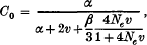
in which α = 2k/n2 with k = effective number of cycles of unequal crossover and with n = number of gene units in a family, v is the mutation rate per gene unit, β is the rate of interchromosomal crossover per family and Ne is the effective size of the population, all measured by the rate per generation. The clonality of a gene family between two different chromosomes becomes approximately C1 = C0/(l + 4Neν). Some models of natural selection which lowers the clonality or increases genetic variation in a multigene family were investigated. It was shown that natural selection may be quite effective in increasing genetic variation in a gene family.
