To save content items to your account,
please confirm that you agree to abide by our usage policies.
If this is the first time you use this feature, you will be asked to authorise Cambridge Core to connect with your account.
Find out more about saving content to .
To save content items to your Kindle, first ensure no-reply@cambridge.org
is added to your Approved Personal Document E-mail List under your Personal Document Settings
on the Manage Your Content and Devices page of your Amazon account. Then enter the ‘name’ part
of your Kindle email address below.
Find out more about saving to your Kindle.
Note you can select to save to either the @free.kindle.com or @kindle.com variations.
‘@free.kindle.com’ emails are free but can only be saved to your device when it is connected to wi-fi.
‘@kindle.com’ emails can be delivered even when you are not connected to wi-fi, but note that service fees apply.
Right now, we have limited understanding of how public whistleblowers prevail. But each year, with each emerging case, we learn more. The concept of collective bricolage – the focus of this chapter -- moves us forward. Bringing together insights from public whistleblowers’ experiences, we gain a deeper understanding of the unique and challenging work of public whistleblowers collaborating with allies. We gain insights into the relationships that make this work possible. We learn about the surprising ways in which aggressive employer reprisal can yield opportunities for public whistleblowers to leverage backlash, defend themselves and persist with their disclosures. Public whistleblowing alliances continue to develop and refine their strategies. Yet it is not straightforward. Pre-planned ‘campaigns’ are uncommon, and those that emerge rarely progress as intended. This book is a critical first step in understanding the organizing practices of ally partnerships in effective public whistleblowing.
This article follows the early history of the Eastman Kodak Company, examining how the photographic company came to be led by experts in chemistry, who created manufacturing processes that were crucial to the mass manufacture of motion pictures. It argues that celluloid film, the substance necessary for motion pictures, was central to the evolution of Kodak into an industrial chemical company. Kodak’s work to manage the specific technological problems and risks created by this material was itself constitutive of the new industrial shape the firm took. In embracing an intraplant goal of purity of raw materials and finished goods, Kodak made it possible for cinema to become a mass medium, with moving images able to look the same way across time and space, over countless copies. Kodak’s transformation, however, was uneven, as the firm’s photosensitive emulsion continued to be made according to far more empirical, secretive, and artisanal procedures, developed by a photographer without a high school degree. These artisanal processes coexisted alongside a highly standardized plant regime, and both were required to make celluloid film. This history demonstrates one way in which broad cultural transformations of the early twentieth century were closely tied to material and practical transformations within industrial firms.
The official whistleblowing channels are the first stop for most employees who speak out about wrongdoing. The channels often work. But sometimes, when a whistleblowing disclosure highlights serious and system-level wrongdoing, official channels can prove useless for preventing it. Worse, these channels can be actively used against a whistleblower who has been targeted for retaliation. The case of a whistleblower at a large electricity company shows how a manager speaking up on behalf of his staff can end up as a public whistleblower targeted for attack. Uniquely, this chapter also takes the perspective of the senior leaders in the organization who are doing the targeting. Large and complex organizations by their very nature give rise to anxiety, defensiveness and a need to scapegoat someone when things go wrong. When official channels fail, public whistleblowers need to look elsewhere to defend themselves and disclose wrongdoing.
Whistleblower protection laws are growing in strength and number across the globe. Whistleblowing workers enjoy stronger legal rights than ever before. But there are dangers. Laws can be undermined by powerful employers with deep pockets intent on exploiting loopholes to suppress public whistleblowing. Lawfare is one such tactic. Whistleblowers can find themselves exposed, and in extreme cases, prosecuted for speaking up. The high-profile story of Theranos’s Erika Cheung illustrates this chapter. As a twenty-three-year-old graduate, Erika blew the whistle on the most famous white-collar crime of recent years. After whistleblowing, she was aggressively pursued by her former employer’s legal counsel: a nationally renowned firm. Along with other whistleblowers, Erika’s testimony would prove pivotal in convicting senior executives. This chapter introduces the new world of whistleblower reprisal, including lawfare tactics ranging from NDAs to SLAPPs and over-reaching trade secrets laws. It points to the vulnerability faced by individual whistleblowers whose rights to protection ‘on paper’ offer scant help in practice. It shows how good lawyers are important, but in the end, they are often not enough.
An emerging strategy of ‘information matchmaking’ is being developed by experienced whistleblower advocates. This operates on the principle that an effective legal campaign needs a PR campaign running alongside it, in public whistleblowing cases. Information matchmaking involves advocates connecting whistleblowers with suitable partners: subject-expert journalists, activists, lawyers, academics, political figures – and any other party whose interests align with the information coming to light. If successful, the outcome is twofold: the whistleblowing disclosure reaches its intended audience and the wrongdoing is stopped, while the public whistleblower benefits from the personal and professional support of a chain of campaigners all committed to a common cause. The experiences of Dawn Wooten, a nurse at a US Immigration and Customs Enforcement (ICE) detention centre in Georgia, illustrates. Dawn spoke up about forced sterilization of immigrant women, along with insufficient protections against the first waves of COVID-19. Her case demonstrates how effective whistleblower advocacy demands significant empathy and care on the part of the advocate, as well as persistence and tactical skills. But these campaigns come with challenges. The landscape is often uncertain for people who disclose. And inequality among whistleblowers amplifies the uncertainty.
Some observers of the data economy have proposed that we treat data as labor. But are data contributions labor? Our folk conception of work emphasizes its importance and effort, such that work has a special interpersonal priority and deserves appreciation and compensation. The folk conception does not generally favor counting data as work, and so it serves as an error theory for reluctance to regulate data as labor. In contrast, labor regulation and policy focus on the political economy of labor, and in particular the bargaining dynamics that participants in a labor market face. Labor regulation aims to protect workers against the threats characteristically posed by such bargaining dynamics. Data-transferring interactions between internet platforms and users share similar bargaining dynamics, and so there is a promising functional similarity between labor regulation and proposals for data regulation that would facilitate data strikes and data unions.
Drawing from the literature strands of philanthropy, business, and history, this work explores the business, prosocial, and political activities of a prominent family in the Scotch whisky industry, with specific emphasis on two brothers’ philanthropy and its impact on a place—the city of Perth, Scotland. In our analysis, we tell the story of the second-generation owners of Dewar’s Scotch whisky company, brothers John Alexander and Tommy Dewar, and their journey of prosocial place-based service and giving. Consistent throughout are the themes of global success, family, local and national networks, and regional embeddedness, alongside the role of formal and informal giving. We offer an analysis of the prosocial activities that represent unexplored dimensions of business success, placing them in both spatial and temporal contexts. Within this is the story of a multigenerational family business’s international growth and success.
Large-scale investment projects often involve contestation over competing notions of ‘development’—from promises of economic growth and integration into global value chains to perspectives that emphasise strong connections between people, territory, culture and way of life. This contestation also echoes diverse theories that have variously conceptualised development as growth, freedom, right or sustainability. This article argues that, in the face of such diversity and complexity, the notion of development that underpins international investment law tends to prioritise economic considerations. In the context of investment disputes, this can marginalise the ideas of development advanced by local actors and indigenous peoples. By connecting human rights and development in immediate terms, ongoing discussions about the right to development can provide an arena to centre ‘peoples’ as the key actor in development processes. But this normative shift would also require ensuring that the wider frameworks of international economic law recognise and provide space for plural notions of development.
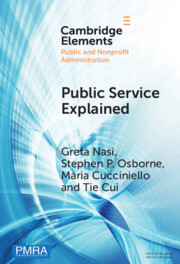
This Cambridge Element aims to advance theory by investigating the nature of participation in public service delivery. It situates itself under the theory of Public Service Logic to advocate for a strategic orientation to participation as an element of value creation in public services. It introduces the concept of participation and discusses the motives, incentives, and tools to engage citizens in public service delivery processes. Then, it frames citizens' participation under the approach public service ecosystem to capture the dynamic relationships among citizens, other actors, processes, and structures that may contribute to determining value in public service delivery. It presents the dynamics of value creation and destruction in public service. The Element concludes with implications for research and practice. This title is also available as Open Access on Cambridge Core.
How do public whistleblowers prevail despite employers' attempts to silence them? Whistleblowing is essential for raising awareness of extreme wrongdoing within organizations yet, despite changing laws designed to offer more protection, workers exposed for public disclosures frequently find themselves the targets of extreme retaliation. Featuring high-profile cases from Amazon, Facebook and Theranos, Kate Kenny reveals the critical - and often unseen - role that skilled allies play in supporting whistleblowers when official channels fail. Novel and sophisticated means of silencing require new strategies for whistleblowing – and supportive partners are key. In this new era of whistleblowing, oppressive lawfare is used against truth-telling workers, and official channels can be weaponized. Yet powerful employers can still make mistakes. Regulators of Last Resort shows how aggressive reprisals can yield surprising advantages for dissenters. Working in partnership with advocates, public whistleblowers can find strategies to survive, persist and bring their disclosures to light.
This Element investigates the historical and systemic roots of hedge-fund activism. It argues that the spirit of the New Deal financial regulations was subverted in the 1980s and 1990s in the name of shareholder democracy and opened the door for the rise of hedge-fund activism. It analyzes the effects of regulatory reforms including the introduction of compulsory voting by institutional investors, proxy-voting rule changes that greatly facilitated aggregation of the proxy votes of institutional investors, and rules that allow hedge funds to draw effectively limitless alternative investments from institutional investors. This Element also evaluates the recent empirical research on hedge-fund activism and explains why shareholder activism has gone awry. It argues that the regulatory changes created a large vacuum in the arena of corporate voting that hedge-fund activists can effectively exploit for their own profits. It concludes with policy proposals for rebuilding the proxy-voting and engagement system.
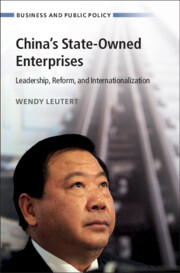
Why do Chinese state-owned enterprises routinely respond to central-level goals and policies in different ways, and why do their reform trajectories often vary significantly across firms and over time? This book introduces a leadership approach to studying the politics, process, and outcomes of economic reform in China's public sector. Using a series of in-depth case studies, Wendy Leutert analyses the exercise and effects of leadership in Chinese state-owned enterprises. She uncovers the 'intra-organizational politics of reform': the daily dynamics of cooperation and conflict between leaders and their subordinates inside public-sector organizations. She also identifies common tactics that Chinese state-owned enterprise leaders use to execute their agendas and ways their subordinates respond. Updating and expanding existing knowledge, this book highlights the growing global consequences of leadership in Chinese state-owned enterprises and why leadership remains vital for understanding China today.