To save content items to your account,
please confirm that you agree to abide by our usage policies.
If this is the first time you use this feature, you will be asked to authorise Cambridge Core to connect with your account.
Find out more about saving content to .
To save content items to your Kindle, first ensure no-reply@cambridge.org
is added to your Approved Personal Document E-mail List under your Personal Document Settings
on the Manage Your Content and Devices page of your Amazon account. Then enter the ‘name’ part
of your Kindle email address below.
Find out more about saving to your Kindle.
Note you can select to save to either the @free.kindle.com or @kindle.com variations.
‘@free.kindle.com’ emails are free but can only be saved to your device when it is connected to wi-fi.
‘@kindle.com’ emails can be delivered even when you are not connected to wi-fi, but note that service fees apply.
Abstract: Since the 1980s, the governance of business behavior in Western societies has been characterized by a move away from state-centered hierarchical forms of governance to networks of governance which include a wide variety of public and private actors. This chapter illustrates how this so-called governance turn has impacted compliance measurement by the state. The chapter begins by outlining the characteristics of the turn to governance and the questions this raises for the measurement of compliance by the state. The chapter is subsequently organized around two key issues: 1) What is it that we measure when we measure compliance? and 2) The reliability, magnitude, and ownership of the data used. Drawing on examples of certification and the global anti-money laundering regime, each section discusses how the governance turn has made compliance measurement by regulatory authorities more challenging.
Abstract: This chapter discusses how Monte Carlo Simulations (MCS) can be used to improve empirical studies of compliance. They are a form of stochastic simulation, which aim to imitate and represent real-world processes with the use of random variables. This chapter describes three applications of MCS using compliance-related examples, including (a) estimating total costs of noncompliance, (b) identifying the optimal sample size for a planned study, and (c) demonstrating potential bias in model estimates. Ultimately, MCS can assist the field of compliance in navigating certain problems faced by many research domains, such as replication problems.
Abstract: Drawing on data from two ethnographies on organizational compliance in China, this chapter offers three important insights about what gets lost in traditional quantitative measures of organizational compliance. First, the studies show that compliance is muddled. A close-up view of the actual business responses to the law are hard to capture in binary or numerical terms (or even in more nuanced labeling such as motivational postures or levels of commitment); in everyday practice there are many instances of both rule-obeying and rule-violating behavior. Second, compliance is dynamic and varies at different points in time and in their situational contexts. Third, the studies show that compliance can be a nonlinear process in which compliance occurs even when there is no chain of transmission from governmental regulators to compliance managers to individual workers. The chapter draws out what these insights mean for the study and practice of compliance measurement. Ultimately, there is a strong need for multi-method research that combines understanding complexity through in-depth case studies (combining participant observation with interviews) alongside statistical analysis in quantitative work.
Abstract: This chapter examines the different ways in which compliance programs of business organizations are used and measured by various legal and regulatory remedial regimes; nearly all have articulated the goals of compliance programs as prevention and detection of violations of laws and regulations, and nearly all measure compliance program processes and efforts toward these goals rather than results and achievements in the actual prevention and detection of violations. The chapter argues that in order to achieve consistencies between the stated goals and actual performance of the compliance programs, and to meet the public interest of prevention and detecting corporate violations of laws and regulations, a movement toward outcome-based measurement is necessary.
Abstract: Laws, rules, and regulations are intended to achieve goals, and the measurement of compliance is thought of as a way to verify if they function as intended. In this perspective, it may make sense to try and see not only whether and to what extent rules are complied with – but whether intended outcomes are achieved. In particular, the purpose of the chapter is measuring aggregate (rather than individual) compliance through outcomes measurement, and thus seeing the extent to which the entire regulatory system is functioning “as intended.” This contribution takes specifically the angle of outcomes measurement as proxy for the aggregate compliance level of regulated entities, providing an instrument to assess the performance of the regulatory system as a whole. Looking at several major regulatory fields, outcomes can be defined in terms of direct, physical-world results (occupational health and safety, food safety, environmental protection). The chapter also considers what the challenges are for the use of aggregate outcome data, how these can be managed, and what the practices of some leading regulatory agencies or services are. Often, these combine compliance measurement (direct) and outcomes measurement in order to compensate for each of the shortcomings and limitations of these approaches. Finally, the chapter briefly considers the obstacles and possible ways forward in applying “aggregate outcomes measurement” approaches – and the specific difficulties in using them in certain regulatory domains.
Abstract: This chapter discusses how environmental inspection data can and has been used to assess regulatory compliance, focusing primarily on the US, although the issues, methods, and limitations described can apply to environmental programs in other countries with similar inspection and enforcement regimes as well as to other settings where unscheduled inspections or audits play a key role in assessing compliance. The chapter starts by describing the role of regulatory inspections in US environmental programs before explaining where to get inspection data for those programs. It next discusses the key methodological issues with and limitations in using regulatory inspections to examine compliance and provides methods for correcting for those issues. The chapter presents a brief review of empirical evidence on compliance based on studies that use inspection data, focusing primarily on evidence from the US, before concluding.
Abstract: Is it possible for a business to measure if its compliance efforts produce results? That is, can a firm’s compliance team quantify whether their work reduces the risk of a compliance failure, before the failure itself takes place? This question plagues corporate compliance practitioners pressed to justify their efforts to stakeholders who want evidence that the money and time the company is investing in these efforts are actually reducing risk. And in contrast to those who argue that this question is simply not quantifiable – which leaves compliance practitioners without a compelling case for resources on a granular level – this chapter unpacks how this can be done using existing firm data. It does this by first offering clarity on what exactly it means to do this – what it means to measure compliance instead of measuring ethics, for example – and then a simplified, step-by-step guide to executing it that can be used by in-house practitioners, external advisors, and academics alike seeking to partner with businesses.
Abstract: Corporate compliance manages a diverse set of regulatory and reputational concerns ranging from fraud to privacy to discrimination. However, effectively managing such risks has often been hampered by a lack of adequate information about when, where, and why misconduct actually occurs. This chapter presents three case studies of corporate initiatives designed to improve measurement of potential compliance risks. These initiatives are designed to identify and respond to different organizational challenges and needs, but each applies an analytical approach. After discussing the cases, the chapter discusses the limitations and opportunities associated with compliance analytics.
Abstract: The main objective of this chapter is to present a concise overview of key debates and issues relating to the use of mixed methods and mixed strategies to understand compliance. We first engage with philosophical issues that underpin compliance research, the direction of different research traditions, and the implications of these for mixed strategy research. We argue that mixed methods should be attractive to researchers of compliance for a range of theoretical and methodological reasons and assess how these have been used so far in the discipline. In a bid to push forward the mixed methods movement in compliance research, we present further methods of inquiry and ways of thinking about compliance research: deliberative methods, comparative perspectives, time series analyses, and new technologies in the study of compliance. We then consider how mixed methods research designs can be fruitfully employed in the study of the complexities around compliance with COVID-19 regulations. We conclude by recognizing the practical, political, and resource challenges to undertaking mixed methods compliance research but argue that much can be gained in terms of the production of knowledge on the social complexity of compliance, by pursuing integrative, collaborative, and multidimensional research that encourages disciplinary and philosophical tensions to flourish, rather than constrain our understandings of compliance.
Abstract: A major question in corporate compliance research and practice is how to establish the effectiveness of compliance programs and policies on promoting desirable outcomes. To assess such effectiveness requires proper measurement. This chapter, which is the introduction to an edited volume on corporate compliance measurement, discusses the trade-offs involved in using different quantitative and qualitative approaches to measure corporate compliance and its predictors. It assesses the strengths and weaknesses of different research strategies in terms of their validity in capturing behavioral responses, their ability to establish causality, their precision in showing complexity, their generalizability, and their feasibility and cost-effectiveness. The chapter concludes that a mixed methods approach is the best way to reduce the trade-offs in measurement; using such an approach best accommodates the five quality standards of proper measurement.
Abstract: The decisions firms make surrounding compliance drive the work of academics and practitioners alike as they respond and seek to understand those actions. Fundamentally, compliance is about behavior, which necessitates not only measuring the what, but also the why and the how. Often, this measurement elicits quantitative research techniques to offer insights into compliance behavior. We argue that measuring compliance must include an understanding of the why and how decisions surrounding compliance are made, and qualitative techniques, including interviews and focus groups, enable a deeper understanding of compliance behaviors and decisions. In this chapter, we conceptualize compliance as a process between individuals and organizations and that a qualitative research approach enhances understandings of the how and why of compliance. We offer brief descriptions of both qualitative interviewing (including semi-structured and elite interviews) and focus groups and provide examples of how these techniques can be employed to examine compliance. We discuss the strengths and weaknesses of each methodological approach. We conclude by making a case for integrating these approaches alongside other research methodologies as part of a multi-method pursuit of compliance measurement.
Histories of semiconductor and computing technology in the United States have emphasized the supporting role of the U.S. state, especially the military, in answer to libertarian denials of state aid that are influential in Silicon Valley today. Somewhat implicit in that historiography, though, is the leading role of actors and organizations that blur any distinction between public and private. Some industries of this sort—telecommunications, aerospace, auto manufacturing—do figure in the historiography, but the class should be expanded further. One such industry—oil—has been exceptionally but almost invisibly influential in the development of computing and semiconductor manufacturing in the United States. Oil firms invested heavily in semiconductors and computing. There was also an “oil spillover” of personnel and technology from oil firms to computing and semiconductor manufacturing. Oil shows up in the biographies of many prominent individuals and organizations in the history of those technologies, from Fairchild Semiconductor to Edsger Dijkstra. These ties potentially hold important implications for the much-needed transition to a more sustainable energy regime.
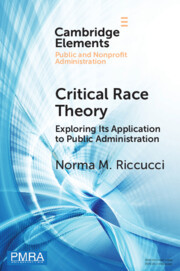
This Element explores Critical Race Theory (CRT) and its potential application to the field of public administration. It proposes specific areas within the field where a CRT framework would help to uncover and rectify structural and institutional racism. This is paramount given the high priority that the field places on social equity, the third pillar of public administration. If there is a desire to achieve social equity and justice, systematic, structural racism needs to be addressed and confronted directly. The Black Lives Matter (BLM) movement is one example of the urgency and significance of applying theories from a variety of disciplines to the study of racism in public administration.
The history of Plan Calcul―France's first information technology program, launched by de Gaulle's government in 1966―has been well described in the literature; however, few studies investigate the arsenal system of the program in depth. Drawing from Plan Calcul's archives, this article is the first to demonstrate that, in the context of de Gaulle's Cold War foreign policy, the French government, initially aiming to avoid an arsenal system, still became the program's funding supplier, entrepreneur, and client. Plan Calcul aimed to establish an industrial-type operation but was ultimately reduced to a state information technology arsenal program.