To save content items to your account,
please confirm that you agree to abide by our usage policies.
If this is the first time you use this feature, you will be asked to authorise Cambridge Core to connect with your account.
Find out more about saving content to .
To save content items to your Kindle, first ensure no-reply@cambridge.org
is added to your Approved Personal Document E-mail List under your Personal Document Settings
on the Manage Your Content and Devices page of your Amazon account. Then enter the ‘name’ part
of your Kindle email address below.
Find out more about saving to your Kindle.
Note you can select to save to either the @free.kindle.com or @kindle.com variations.
‘@free.kindle.com’ emails are free but can only be saved to your device when it is connected to wi-fi.
‘@kindle.com’ emails can be delivered even when you are not connected to wi-fi, but note that service fees apply.
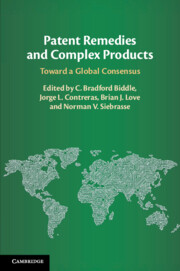
Through a collaboration among twenty legal scholars from eleven countries in North America, Europe and Asia, Patent Remedies and Complex Products presents an international consensus on the use of patent remedies for complex products such as smartphones, computer networks and the Internet of Things. It covers the application of both monetary remedies like reasonable royalties, lost profits, and enhanced damages, as well as injunctive relief. Readers will also learn about the effect of competition laws and agreements to license standards-essential patents on terms that are 'fair, reasonable and non-discriminatory' (FRAND) on patent remedies. Where national values and policy make consensus difficult, contributors discuss the nature and direction of further research required to resolve disagreements. This title is also available as Open Access on Cambridge Core.
The ethical sensemaking approach stands as an essential alternative to the dominant rational and objectivist paradigm of ethical decision-making in organizations. From this perspective, this research explores the intrapersonal interplay of emotions and reflexivity in ethical sensemaking. We analyzed thirty-seven semi-structured interviews conducted with executive coaches sharing a critical incident about an issue they framed as ethical. Our findings show that their ethical decisions unfolded over a three-phase emotional reflexive sensemaking process, where reflexivity allowed for the management of emotions in the form of emotional awareness, emotional unpacking, and emotional (dis)engagement. Therefore, we portray ethics as a fabric, produced through the knitting of emotions and reflexivity. And, while ethics certainly appear to be produced by the subject, we suggest a reciprocal relationship, whereby the very fabric of ethics contributes to the production of the ethical subject.
A panel of eight leadership scholars was convened to participate in a panel at the 20th International Leadership Association Conference to discuss the benefits and the pitfalls of applying authentic leadership theory to the classroom setting. Inspired by Ken Parry's masterful teaching and the authenticity that he displayed in the classroom, this paper provides an overview of the panel's discussion as they grappled with the attractions, the challenges and the risks that are posed to both teacher-scholars and student-scholars in bringing their full selves into the classroom.
This paper argues that the Big Four accountancy firms—PricewaterhouseCoopers, Deloitte, Ernst & Young, KPMG—operate as key political allies of the financial sector within financial regulatory battles. Leveraging the theoretical notion of “actor plurality” within the policymaking process, I demonstrate how, in the case of the European Union Financial Transaction Tax (FTT) initiative, accountancy professionals offered crucial support for the financial sector. They did so by disseminating key oppositional claims against the FTT proposal, developing tax mitigation and relocation strategies, preparing negative impact assessments, and advising on lobbying tactics. This allied stance of the Big Four is primarily a consequence of the ways in which their commercial priorities have been fundamentally transformed by the provision of consultancy services within the modern global economy. Moreover, the paper shows how accountancy experts are deeply embedded within a network of professional relationships that fosters substantive policy alignment between the Big Four and prominent financial lobbying groups. By highlighting the overlooked role of the major accountancy firms within post crisis regulatory reform, the study illuminates the unequal power relations that permeate financialized societies and contributes to a deeper understanding of how financial preferences continue to prevail within the policymaking process.
Nowadays social entrepreneurship is recognized as a two-way process, addressingboth social and economic concerns that can bring social inclusion, equity, anddevelopment to disadvantaged groups in society. This aspect is particularlyimportant and desirable within emerging economies. In these markets, which areconstantly faced with profound economic and social challenges, we see thegrowing importance of social entrepreneurs as they take upon themselves theprovision of welfare services and progressive activities. However, ourunderstanding of the mechanisms underlying the creation of social and economicvalues in social enterprises, and the factors contributing to the establishmentof these value creation objectives, is still rather fragmented. Our articlecontributes to this gap in the literature by decoding the process via whichfor-profit social entrepreneurs from China and India create social and economicvalue. In addition, by combining a deductive and an inductive approach ofanalysis, we offer novel insights into the context-dependent processual patternsdeciphered within the two countries. A new entrepreneurial process frameworkthat reflects the contextualized social value creation process by socialentrepreneurs is thus provided.
This paper strives to shed light on the interaction between business groups and the main governing parties after the onset of the economic crisis through a “thick narrative” approach. By focusing on the Portuguese case, the study aims to examine the preferences of the employer confederations during the distinct phases of the economic crisis and to analyze the political alignments established with different party governments. This contribution confirms the fragmentation of business interests on the one hand and tensions between the right-wing government and the main employer confederations on the other. While a pragmatic approach to party politics seems to be the predominant trend, historical and institutional legacies are still important factors when considering the actions and inner tensions of these organizations.
This article offers a contextualised explanation of the process of institutionalbridging by Delta, a British SME, in order to internationalise to China acrosshigh institutional distance. The study uncovers three novel mechanisms of‘Cross-institutional Dissonance Mitigation’,‘Multi-level Strategic Embedding’, and‘Cross-institutional Consonance Retuning’ to explain howand why a failing SME with limited resources and networks was able to bridge theinstitutional distance and internationalise to the challenging Chinese market.This article contributes to the literature on SME internationalisation acrosshigh institutional distance by opening the ‘black box’ ofSME institutional bridging, hence demonstrating the benefits of contextualisedexplanations to extend research into internationalisation phenomena that spanmultiple institutional boundaries.
Concerns over food safety in China not only direct public attention to negativeincidents, but also trigger the government's scrutiny of implicatedfirms, particularly MNCs. The question of how to repair legitimacy after mediacoverage of negative incidents has become a critical issue for MNCs. Althoughthe factors for MNCs’ public crises have been identified, how localcontexts and mechanisms shape repair approaches remain unclear. To address thisresearch gap, we conducted a study of Walmart China's approachesassociated with two negative incidents across two regions. We found that thenegative incidents can be framed differently depending on the localenvironment's unfavorability for MNCs. Specifically, the negativeframing gave rise to varying degrees of legitimacy loss and offered differentleeway for MNCs to repair their legitimacy. We also identified the variedoutcomes of different repair approaches. By revealing the linkages among localcontext, framing, legitimacy repair, and its outcomes, our study contributes toresearch on MNCs’ legitimacy management under institutionalcomplexity and underscores the China context for legitimacy maintenance. We alsooffer insights that advance the institutional approach to legitimacy repair inthis context. Last, we reflect on the techniques for conducting qualitativeresearch in China.
Social enterprises (SEs) primarily aim to create social value, that is, togenerate benefits or reduce costs for society, while maintaining financialsustainability. Owing to their unique operating conditions and organizationalcharacteristics, SEs face more severe resource challenges than their commercialcounterparts. These challenges are exacerbated for SEs operating in emergingeconomies with complex social contexts. Overcoming these resource constraintsand social challenges is vital for SEs to achieve their mission. Using aninductive multiple case-study approach, we identify a unique bricolage solutionfor achieving the dual objectives of SEs. Our findings suggest that identifyinglocally embedded village level entrepreneurs is a bricolageactivity that social entrepreneurs leverage in the resource constrainedenvironment of emerging economies, especially for the social enterprises thatare active in the villages but were founded by social entrepreneurs who are notfrom these villages. This article therefore contributes to both socialentrepreneurship literature as well as entrepreneurial bricolage literature andhas important implications for future research and practice.
Our understanding of how an organisation operates is elucidated by the hostcountry's political system. Myanmar has remained abstruse toresearchers for many decades, as do most emerging markets prior to theirtransition from a centrally planned economy to a market economy such as China.We establish how the problematising and contextualisation of the methodologiesadopted during longitudinal fieldwork in Myanmar (2008 to 2016) has influencedour research focus and question. By reflecting on our experience of conductingorganisational research in a highly institutionalised environment, we haveidentified limitations in the prevalent research methodologies used by theextant literature. Such methodologies tend to be incompatible with the Asiancontext. This process of problematisation required us to remain flexible andadaptive during the process of the generation of the research questions. Weadopted a context-informed theory-building process and reflect on the interplaybetween interviewer, interviewees, and local institutional contexts. Animportant insight from this process was the need to nullify the asymmetry ofpower between the interviewer and interviewees to obtain honest responses ratherthan superficial data that aimed to satisfy and please theinterviewer/institutional context.
Discursive voids in emerging markets present opportunities and challenges todebate meanings and taken-for granted assumptions. This article uncovers variousstrategies used by the researcher and the research participants to address thediscursive void and to negotiate shared meaning about employee empowerment inRussia. In the absence of a concept for empowerment in the languages of thestudy, the researcher and the research participants engaged in joint sensemakingto bridge discursive voids. We contribute to the discussion of qualitativecross-language research in emerging markets by identifying the strategies usednot only by the researcher, whose view has dominated previous research, but alsothose of the research participants. The researcher in our study addressed thediscursive void by taking on the dual role of researcher-translator, engaging incontextual approach to translation, consulting external interpreters, and usingiteration and flexibility in the course of the research process. Our researchparticipants resorted to proverbs to address the discursive void, make sense ofempowerment, and render it locally meaningful. Proverbs are a valuablemethodological tool for sensemaking and theorising about context-specificphenomena in IB research.
Business has been involved in cooperation with multilateral organizations through public-private partnerships (PPPs) since the late 1990s. With their adoption of the sustainable development goals (SDGs), multilateral institutions increasingly consider partnerships as a means to achieve their goals given their own limited implementation capacity. However, the global economic order has changed significantly since the first expansion of PPPs, particularly due to growing participation by non-western states and companies. This article asks how this shift has changed the eagerness to form partnerships, as well as their qualitative content. It analyzes the 3964 partnerships in the SDG partnership registry, focusing on the subset of them that includes business partners. We divide these into five groups: local implementation, resource mobilization, advocacy, policy, and operational partnerships. We study PPPs involving companies from different varieties of capitalism—private, market based forms, and state-led forms of capitalism. We find that PPPs are still dominated by companies and other actors from Western countries. Moreover, business participate more in U.S.- and Canadian-led partnerships than others. We also find strong differences regarding what category of PPPs that companies from different backgrounds engage in, and discuss the linkages between varieties of capitalism and PPP participation.