To save content items to your account,
please confirm that you agree to abide by our usage policies.
If this is the first time you use this feature, you will be asked to authorise Cambridge Core to connect with your account.
Find out more about saving content to .
To save content items to your Kindle, first ensure no-reply@cambridge.org
is added to your Approved Personal Document E-mail List under your Personal Document Settings
on the Manage Your Content and Devices page of your Amazon account. Then enter the ‘name’ part
of your Kindle email address below.
Find out more about saving to your Kindle.
Note you can select to save to either the @free.kindle.com or @kindle.com variations.
‘@free.kindle.com’ emails are free but can only be saved to your device when it is connected to wi-fi.
‘@kindle.com’ emails can be delivered even when you are not connected to wi-fi, but note that service fees apply.
In Mar. 2010, Japan’s financial regulator implemented the country’s first legislation concerning the disclosure of director compensation for named individuals. Using the first publicly available data for Japanese executives, we document direct evidence on the level, structure, and mechanisms of chief executive officer (CEO) compensation in Japan and perform a matched-sample comparison between Japan and the United States. In contrast to the findings of recent studies showing that international differentials in CEO pay have largely disappeared since the mid-2000s, our results show strikingly large differences between the Japanese and American systems that are difficult to explain by differences in conventional incentive contracts.
This article examines how a German firm in the Malay Peninsula—Behn, Meyer & Co.—capitalized on its knowledge management to overcome political risks during the period from 1840 until 1959. During the two world wars, all assets and properties of the Behn Meyer firm were systematically expropriated because of the introduction of the Alien Enemies (Winding Up) Act of 1914 and the subsequent imposition of a ten-year ban by the British colonial administration in the Malay Peninsula. However, Behn Meyer’s resilience and flexible outlook, as demonstrated by its management of political risks during these tumultuous periods, enabled it to rebuild its business interests and reestablish a foothold in postcolonial Malaysia and the region. This article argues that Behn Meyer displayed an exemplary business strategy, utilized its understanding of the geopolitics of the area, and leveraged its local and international networks to ensure its survival and longevity in the most tumultuous period in the history of the world.
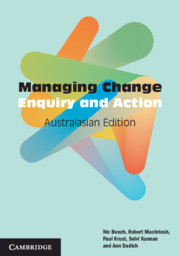
Managing Change: Enquiry and Action, Australasian edition offers a fresh perspective of change theory with contemporary examples providing students with the tools they need to navigate the complexities of change within organisations. The book features notions of innovation, disruption and agile learning that are necessary in an intensified business world. Using an enquiry-action framework, the text is separated into three parts: diagnosing, explaining and enacting to combine theory with the practical tools needed to understand and manage change. Cases reinforce student understanding and focus on actions and outcomes while a selection of fifteen extended cases bring different concepts together. Written by leading professionals, Managing Change: Enquiry and Action, Australasian Edition is an essential resource for students looking to develop a strong skills base that can be employed in practice.
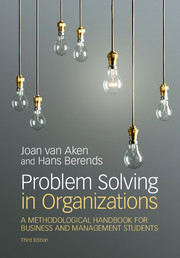
An indispensable guide enabling business and management students to develop their professional competences in real organizational settings, this new and fully updated edition of Problem Solving in Organizations equips the reader with the necessary toolkit to apply the theory to practical business problems. By encouraging the reader to use the theory and showing them how to do so in a fuzzy, ambiguous and politically charged, real-life organizational context, this book offers a concise introduction to design-oriented and theory-informed problem solving in organizations. In addition, it gives support for designing the overall approach to a problem-solving project as well as support for each of the steps of the problem-solving cycle: problem definition, problem analysis, solution design, interventions, and evaluation. Problem Solving in Organizations is suitable for readers with a wide range of learning objectives, including undergraduates and graduates studying business and management, M.B.A students and professionals working in organizations.
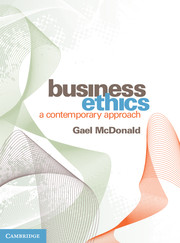
Business Ethics introduces students to ethical issues and decision-making in a variety of contemporary contexts. It develops an awareness of the many ways in which ethical considerations can manifest in commercial domains, thereby helping prepare students for their professional careers. Business Ethics shows how theory works in practice. It includes hundreds of real-world examples that will help engage students. Examples draw on recent and emerging concerns, such as the moral implications of social media and the enforcement of codes of behaviour within industries. The book also addresses corporate social responsibility, stakeholder management and sustainability, reflecting the broad scope of business ethics today. Comprehensive online resources are available at www.cambridge.edu.au/academic/businessethics. Student resources include additional review questions and case studies, with answer guides, to help students reinforce learning and prepare for assessment tasks. Instructor resources include an extensive set of tutorial exercises, PowerPoint slides and a test bank of assessment resources.
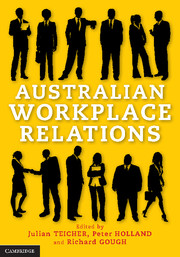
Australian Workplace Relations explains the defining themes in workplace relations in the twenty-first century. It explores issues relating to employee voice, declining trade union membership, occupational health, disadvantaged workers and surveillance in the workplace. The treatment of each topic is placed in both a national and an international context. The book examines the effects on Australian workplace relations of globalisation, the changing international economy and the Global Financial Crisis. It provides a comprehensive examination of the Fair Work Act 2009. Case studies provide in-depth explorations of four important sectors of the economy: health, retail and hospitality, the public sector and motor vehicle components. The textbook includes additional resources for students and lecturers on a companion website: Power-Point slides, lists for further reading, additional case studies and links to websites. Comprehensive and fully cross-referenced, Australian Workplace Relations is an invaluable resource for upper-level undergraduate students of workplace, employee or industrial relations.
When incentives work well, individuals prosper. When incentives are poor, the pursuit of self-interest is self-defeating. This book is wholly devoted to the topical subject of incentives from individual, collective, and institutional standpoints. This third edition is fully updated and expanded, including a new section on the 2007–08 financial crisis and a new chapter on networks as well as specific applications of school placement for students, search engine ad auctions, pollution permits, and more. Using worked examples and lucid general theory in its analysis, and seasoned with references to current and past events, Incentives: Motivation and the Economics of Information examines: the performance of agents hired to carry out specific tasks, from taxi drivers to CEOs; the performance of institutions, from voting schemes to medical panels deciding who gets kidney transplants; a wide range of market transactions, from auctions to labor markets to the entire economy. Suitable for advanced undergraduate and graduate students studying incentives as part of courses in microeconomics, economic theory, managerial economics, political economy, and related areas of social science.
Innovation is the main determinant of long-term economic development. In order to have a long-lasting effect, innovation must be produced and diffused regularly by innovation systems.
This book is about innovation, its policy, its institutional systems and its management. It is the result of an international conference held in Montreal in July 2016 where 290 speakers presented as many papers on innovation. It collects some of the best presentations on the three related topics of innovation: policy, systems and management.