To save content items to your account,
please confirm that you agree to abide by our usage policies.
If this is the first time you use this feature, you will be asked to authorise Cambridge Core to connect with your account.
Find out more about saving content to .
To save content items to your Kindle, first ensure no-reply@cambridge.org
is added to your Approved Personal Document E-mail List under your Personal Document Settings
on the Manage Your Content and Devices page of your Amazon account. Then enter the ‘name’ part
of your Kindle email address below.
Find out more about saving to your Kindle.
Note you can select to save to either the @free.kindle.com or @kindle.com variations.
‘@free.kindle.com’ emails are free but can only be saved to your device when it is connected to wi-fi.
‘@kindle.com’ emails can be delivered even when you are not connected to wi-fi, but note that service fees apply.
A hot wire chemical vapor deposition technique is described for synthesis of 1D nanostructures of a controlled morphology, stoichiometry, and composition. The synthesis involves the evaporation and condensation of metal oxide vapor through the reaction of oxygen with the hot filaments of respective transition metals. The stoichiometry and morphology of MoO3 and WO3 were modulated by varying the filament temperature and partial pressure of oxygen in the growth chamber. Based on the results under different conditions, a morphological phase diagram, and a growth model based on the extent of gas phase supersaturation were developed to understand the growth mechanism. Further, ternary transition metal oxide, NiMoO4, was synthesized as a proof-of-concept for tuning the composition of deposition through simultaneous evaporation of two metal oxides.
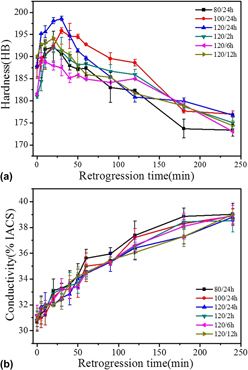
In the present work, the effect of pre-ageing temperature and time variations on the mechanical properties and electrical conductivity of the Retrogression and re-aging (RRA) treated 7050 has been investigated. The results reveal that the electronic conductivity and hardness of RRA-treated samples are sensitive to the pre-ageing tempers. The RRA-treated samples with 120 °C/2 h pre-ageing +180 °C/2 h retrogression +120 °C/24 h re-ageing temper can be tailored toward a good combination of strength and elongation, while the electrical conductivity of re-ageing samples is also higher than that of 120 °C/24 h pre-ageing RRA-treated samples. With an intermediate pre-ageing temperature of 80 °C/24 h RRA-treated samples possess a higher re-aged electronic conductivity, while no significant differences can be found between hardness of 120 °C/2 h and 120 °C/24 h pre-ageing RRA-treated samples. The variation of hardness and electronic conductivity during retrogression depends on the pre-ageing tempers. For under-aged sample, the retrogression hardness appears a stage of hardness increasing followed by a further decrease in hardness results, owing to disappearance of dissolving stage of fine GP zone and η′ phase during pre-ageing.
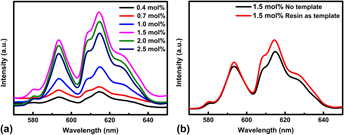
ZrO2:Eu3+ hollow spheres were successfully fabricated with the resin microspheres as the template. The sample characterizations were carried out by means of x-ray diffraction (XRD), scanning electron microscope (SEM), and photoluminescence spectra. XRD results revealed that Eu3+-doped samples were pure t-ZrO2 phase after being calcined at 873 K. SEM results exhibited that this Eu3+ doped ZrO2 was hollow spheres; the diameter and thickness of which were about 450 and 50 nm, respectively. Upon excitation at 394 nm, the orange-red emission bands at the wave length longer than 570 nm were from 5D0 → 7FJ (J = 1, 2) transitions. The asymmetry ratio of (5D0 → 7F2)/(5D0 → 7F1) intensity is about 1.61, 1.26, 1.42, 1.42, 1.40, and 1.38 for the Eu3+ concentration 0.4, 0.7, 1.0, 1.5, 2.0, and 2.5 mol%, respectively. These values suggest that the asymmetry ratio of Eu3+ ions is independent of the doping concentration. The optimal doping concentration of Eu3+ ions in ZrO2 is 1.5 mol%. According to Dexter's theory, the critical distance between Eu3+ ions for energy transfer was determined to be 16 Å.
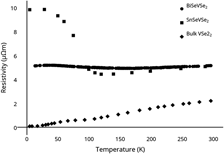
The [(BiSe)1+δ]1(VSe2)1 heterostructure was characterized structurally and electrically to determine the effects of interlayer interaction on the charge density wave (CDW) found in VSe2 and compared to previously reported [(SnSe)1.15]1(VSe2)1. Out-of-plane x-ray diffraction scans contain reflections that can be indexed as 00l reflections of a BiSe–VSe2 supercell. Structure refinement indicates that the VSe2 layer is very similar structurally to that found in [(SnSe)1.15]1(VSe2)1. Scanning transmission electron microscopy images show a turbostratically disordered layer structure and the formation of anti-phase boundaries in the BiSe bilayer. The [(BiSe)1+δ]1(VSe2)1 heterostructure is metallic with a negative Hall coefficient, in contrast to the positive Hall coefficient found for [(SnSe)1.15]1(VSe2)1. The CDW found [(SnSe)1.15]1(VSe2)1 is not present in [(BiSe)1+δ]1(VSe2)1. This work illustrates the importance of inter constituent interactions in determining the transport properties of single layer films.
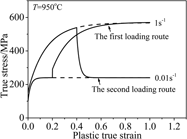
The strain hardening effect and dynamic recovery behavior of a Ni-based superalloy are studied by isothermal compressive tests. A new unified dislocation-density based constitutive model is developed to characterize the strain hardening effect and dynamic recovery behavior of the studied superalloy. In the developed constitutive model, some material parameters (yield stress, strain hardening coefficient, and dynamic recovery coefficient) are assumed as functions of initial grain size, deformation temperature, and strain rate. An iterative algorithm is designed to predict the high-temperature deformation behaviors under time-variant hot working conditions. The hot deformation parameters and material parameters can be updated in each strain increment. Comparisons between the experimental and calculated flow stresses indicate that the developed constitutive model can accurately describe the high-temperature deformation behavior of the studied superalloy. Furthermore, the developed constitutive model is also successfully used for analyzing time-variant hot working processes.
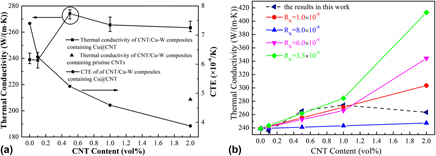
The effect of interface tailoring by Cu coating carbon nanotubes (CNTs) on the properties of CNTs enhanced copper–tungsten (CNT/Cu–W) composites is investigated. Thermal, electrical, and mechanical properties were measured, and interfacial thermal resistance between Cu and CNT was calculated according to the thermal conductivity curves. CNTs with interface tailoring showed superior dispersion state in the Cu–W composites. When the CNT contents were lower than 0.5 vol%, homogeneous dispersion CNTs and strong interfacial bond between CNTs and Cu had a positive effect on the physical properties of CNT/Cu–W composites. Such interface modification can effectively achieve thermal and electrical conduction, as well as transfer load between CNTs and Cu in the CNT/Cu–W composites. When the CNT contents were higher than 0.5 wt%, the CNT agglomerations became the dominant factor to decrease the physical properties of the composites.
Structural characterization, quantitative phase analysis, and morphological behavior of biomineralized deposits in human pancreas [pancreatic stones (PSs)] have been carried out using infrared (IR)-spectroscopy, scanning electron microscopy (SEM), powder x-ray diffraction, and thermogravimetry - differential scanning calorimetry (TG–DSC). The fourier transform infrared (FT-IR) spectra indicated that the primary composition of PSs was calcium carbonate. An x-ray powder diffraction phase quantification using the Rietveld method revealed that five of the pancreatic calculi were composed exclusively of calcite (CAL) and the remaining four contained small amounts of vaterite and aragonite in addition to the CAL phase. The crystallite size of CAL in the PSs study varied between 104(6) and 181(2) nm. The SEM images of pancreatic calculi showed a variety of crystal morphologies for biogenic CAL crystallites such as, thin plates, spherulites, prisms, and cylindrical laths. Thermogravimetric analysis of PS1 reveals that biogenic CAL is stable up to 910 K, above which temperature CAL transforms into calcium oxide.
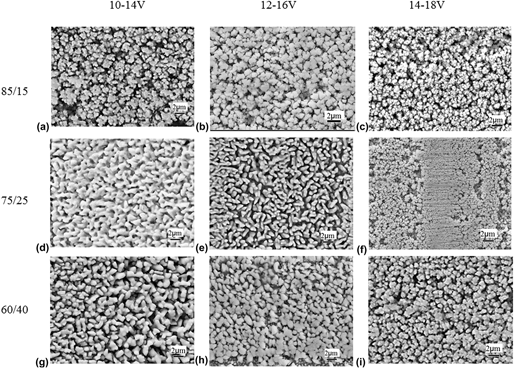
The technologies of brush plating and dealloying were used to treat the surface of rolled copper foil. Zn–Ni and Sn–Zn alloy coatings were prepared. The laws of plating solutions composition and technological parameters on coatings quality were investigated. The results show that with the decreasing of main elements mass ratio or increasing of brush time, thickness and corrosion resistance of Zn–Ni alloy coating increase. With the increasing of brush plating voltage or time, surface roughness of Sn–Zn alloy coating decreases. Turning up brush plating voltage could raise deposition rate of sub-tin and zinc ions and refine surface grains of coating. The angle of dealloying has the significant effect on the roughness of dealloyed Sn–Zn alloy coating. As the dealloying angle increases, surface roughness of dealloyed Sn–Zn alloy coating increases. The contribution of dealloying time to surface roughness of treated coating is obviously larger than that of corrosion solution concentration.
Nanocolloidal crystals (NCCs) have promising applications in optical and photonic devices. However, it is critical to mechanically reinforce NCCs for device reliability, since as-synthesized NCCs are fragile due to weak interparticle bonding. Thermal sintering is currently the most common reinforcement technique; however, this method could induce serious cracking and is not suitable for temperature-sensitive materials. In this study, by characterizing silica NCCs reinforced through sintering and alumina atomic layer deposition (ALD), we find that the ALD treatment is much more effective for hardening, stiffening, and more importantly toughening NCCs. Thermally sintered NCCs are prone to indentation-induced cracking due to large residual tensile stress, significantly impairing the toughness. In contrast, the ALD treatment toughens NCCs by much over 300%. Our finding provides insights for reinforcing and toughening various nanoparticle-based and nanoporous materials.
Microwave sintering is a novel and efficient technology for the rapid preparation of metallic materials. In this paper, an investigation has been performed on the distribution of microwave electromagnetic fields in a metallic particle system and its influence on sintering behavior. The results show that the microstructure of the “metallic-void” will induce a nonuniform distribution and focusing effect of electromagnetic fields during microwave processing, which may accelerate the sintering process. However, further study shows that the focusing effect will decline as the neck grows larger, and will also decline from outside to inside within the loosely packed powder system, which will result in the slowdown of the sintering rate. These results were supported by the synchrotron radiation computed tomography experimental observation of the microstructure evolution of metallic powders during an entire uninterrupted microwave sintering process.
Laser metal deposition (LMD) additive manufacturing was used to deposit Inconel 625 matrix composites reinforced with nano-TiC particles. The effects of laser energy input per unit length (E) on the densification level, microstructural features, mircohardness, and wear property were investigated. The relatively low E induced insufficient liquid with higher viscosity, thus inhibiting the melted liquid from spreading out smoothly. As a result, a large number of micropores and reduced densification level of LMD-processed parts were obtained. When the E of 100 kJ/m was properly settled, the obtainable densification level generally approached 98.8%. The TiC reinforcements experienced successive microstructural changes from agglomeration to uniform distribution with coarsening grain, as the applied E increased. The nearly fully dense parts using optimal experimental parameters achieved an increased average microhardness of 330 HV0.2, resultant considerably low coefficient of friction of 0.41 and reduced wear rate of 5.4 × 10⁻⁴ mm3/(N m) in dry sliding wear tests.
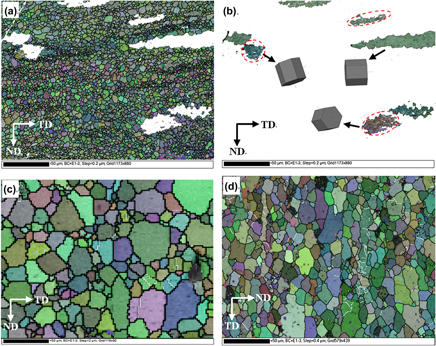
An extruded Mg–8Gd–4Y–1Nd–0.5Zr alloy was preheated at 500 °C for 0.5 h and then subjected to hot compression to a true strain of 0.69 at temperature 450 °C and a strain rate of 0.2 s−1. It is observed that boundaries of small grains (∼3 μm) in the extruded alloy are decorated with irregular-shaped particles; small grains show a weak texture of three main components of $\left\langle {0001} \right\rangle //{\rm{TD}}$, $\left\langle {11\overline 2 1} \right\rangle //{\rm{ND}}$, and $\left\langle {10\overline 1 0} \right\rangle //{\rm{ED}}$. Dynamic recrystallization is concurrent with dynamic precipitation of particles during hot compression, resulting in both a uniform grain structure and a redistribution of particles. The retained particles before compression keep the texture unchanged during compression, leading to the same texture type of $\left\langle {0001} \right\rangle //{\rm{TD}}$ of the compressed alloy as that of the preheated alloy. The compressed alloy exhibits a better aging hardening ability than the extruded alloy. After peak aging, the compressed alloy presents an ultimate tensile strength of 416 MPa, a yield tensile strength of 317 MPa, and an elongation of 2.7%.
This work describes the effects of different atmospheres used during the thermal treatment of hematite films synthesized on transparent conductive substrates of fluorine-doped tin oxide by a newly reported wet chemical route assisted by microwave. The as-synthesized films were subjected to additional thermal treatment at 750 °C for 30 min in different gas flux (air, O2, and N2) to obtain a desirable phase and surface activation. A series of techniques were used to elucidate effects of each atmosphere used during the thermal treatment. The morphology of the films, as analyzed by top-view and cross-sectional scanning electron microscopy images, showed no significant changes and was composed of rods homogeneously distributed over the substrate, which covered the immersed area with a thickness between 98 and 100 nm. The photoelectrochemical response of the N2-hematite films was found to be 80 and 50% more efficient at 1.23 VRHE (reversible hydrogen electrode) than those of films produced in air and an O2 atmosphere. The photocurrent enhancement achieved by treatment in an oxygen-deficient atmosphere was attributed to the improvement of hematite catalytic activity, which produced a hematite–electrolyte interface favorable for water oxidation. Since an increase in the donor density by one order of magnitude was found for the N2-hematite films, a reduction of charge transfer resistance was expected in these films. However, the Nyquist plot analysis showed that the O2-hematite film had a lower charge transfer resistance. As a result, it is impossible to relate the photocurrent enhancement observed in N2-hematite film to electronic changes or vacancy formation, as previously reported in the literature. Indeed, by performing photoelectrochemical measurements in the presence of hole scavengers, it became clear that the major improvement caused by the oxygen-deficient atmosphere was in the catalytic activity efficiency of the hematite films for water oxidation. It was found that the oxygen-deficient atmosphere could improve the overall photoelectrochemical performance of the hematite by acting as a hole scavengers. This finding contrasts with a previous report, in which the use of an oxygen-deficient atmosphere during the phase transformation from akaganeite to hematite was found to enhance the photocurrent density by inducing an increased donor density caused by the formation of vacancies [Y. Ling et al., Angew. Chem., Int. Ed.51, 4074 (2012)].
Steel coils coated with Zn–Mg alloy containing high Mg content develop dark rust when exposed to an extremely limited amount of aqueous environment. To understand the nature of the dark rust and its formation mechanism, the steel is evaluated by the immersion test and high temperature–humidity test followed by critical evaluation with transmission electron microscopy for cross-sectional observation, field-emission scanning electron microscopy for surface morphology observation, Auger electron spectroscopy and glow discharge spectroscopy for identification of chemical composition as a function of depth. The results indicate that the dark rust is formed by precipitation of Mg-based corrosion product on the outermost surface when the steel is exposed to aqueous environment at high temperature. This is due mainly to preferential dissolution of Mg phases by the galvanic action with MgZn2 and Mg2Zn11 composed of the coating layer, and easy precipitation of Mg2+ ion in a form of Mg(OH)2 in a limited volume of the condensed water film on the surface.
In this study, the effects of Sm on the microstructure and corrosion resistance of hot-extruded AZ61 magnesium alloys were investigated by optical microscopy, scanning electron microscopy, and transmission electron microscopy. The results showed that uniformly dispersed Al2Sm particles with size of ∼2 μm were discovered in the hot-extruded AZ61 magnesium alloy sample modified with 1.0 wt% Sm, which promoted dynamic recrystallization grain growth during the hot-extruded process, gradually increasing the grain of the alloy as Sm content increased. The morphology of the corroded surface and the corrosion rate of the hot-extruded AZ61 magnesium alloy both were significantly improved after Sm addition. The alloy sample modified with 2.0 wt% Sm after immersion in 3.5 wt% NaCl solution for 12 h showed minimum corrosion rate value, 3.1 mg/cm2 day, which is only 3.7% of the corrosion rate of unmodified alloy (82 mg/cm2 day).
Thermal degradation of graphene based mineral oil lubricants was studied using thermogravimetric analysis (TGA). As-synthesized graphene sheets of 8, 12, and 60 nm thick and engine oil formulations 20W50 SN/CF and 20W50 SJ/CF were used for synthesizing various test samples. UV-Vis spectrophotometry, zeta potential, field emission scanning electron microscopy, and energy-dispersive x-ray spectroscopy were used to characterize the graphene sheets and the nanolubricants. TGA revealed that the onset temperature of oxidation for the SN/CF oil could be delayed by 13–17 °C in the presence of graphene. Moreover the rate of oxidation when the weight loss of oil in the presence of graphene reaches 40–20% could be delayed by more than 30 °C. Resistance to oil degradation depends strongly on the graphene nanoparticle size and concentration. TGA kinetics studies show that the base oils have higher activation energy (Ea) and the addition of graphene significantly reduces Ea.
Written by the founder of the field, this is the first text of its kind, providing a definitive introduction to structural DNA nanotechnology. Readers will learn everything there is to know about the subject from the unique perspective of the leading expert in the field. Topics covered range from origins and history, to design, experimental techniques, DNA nanomechanics devices, computing, and the uses of DNA nanotechnology in organising other materials. Clearly written, and benefiting from over 200 full colour illustrations, readers will find this an accessible and easy to follow text that is essential reading for anyone who wants to enter this rapidly growing field. Ideal for advanced undergraduate and graduate students, as well as researchers in a range of disciplines including nanotechnology, materials science, physics, biology, chemistry, computational science and engineering.