To save content items to your account,
please confirm that you agree to abide by our usage policies.
If this is the first time you use this feature, you will be asked to authorise Cambridge Core to connect with your account.
Find out more about saving content to .
To save content items to your Kindle, first ensure no-reply@cambridge.org
is added to your Approved Personal Document E-mail List under your Personal Document Settings
on the Manage Your Content and Devices page of your Amazon account. Then enter the ‘name’ part
of your Kindle email address below.
Find out more about saving to your Kindle.
Note you can select to save to either the @free.kindle.com or @kindle.com variations.
‘@free.kindle.com’ emails are free but can only be saved to your device when it is connected to wi-fi.
‘@kindle.com’ emails can be delivered even when you are not connected to wi-fi, but note that service fees apply.
After studying this chapter you will be able to identify all of the significant applications of biomaterials in those devices that replace the structure and/or function of tissues and organs by the use of medical devices. These may be implanted within the patients, usually for the remainder of their lives, or connected to the patient for some short-term assistance; these applications were summarized at the end of Chapter 1. This discussion covers all of the clinical disciplines. It includes implantable devices that have been in use for decades, and you will be able to understand the reasons for their success, and the reasons for failures where they have occasionally occurred. It also covers the implantable and support systems that have recently been developed and introduced into clinical practice so that you can appreciate where the technology of the twenty-first century is leading us in health care products.
As noted earlier, implantable medical devices were, for many years, the main focus of attention within biomaterials science. The rationale and performance of such devices are discussed in this chapter. Each application and each situation is different and it is not possible to deal with this in an entirely satisfactory systematic manner, but the major headings given in Chapter 1 are covered and dealt with in relation to the clinical discipline that is involved. This includes permanent (or long-term) devices, short-term devices, invasive but removable devices and artificial organs or assist devices that are attached to the body. We will conclude the chapter with an assessment of the overall performance of implantable devices and the lessons learned.
Biocompatibility is the most critical factor that controls the success of biomaterials and those health care products that incorporate biomaterials. It is concerned with the mechanisms of interaction between biomaterials and the human body, and the consequences of these interactions. This chapter first introduces the concept of biocompatibility and then provides you with a series of scenarios that cover the whole range of situations in which biomaterials come into contact with tissues. In each case, critical mechanisms are explained and discussed, leading to the presentation of a unified framework of the sequence of events that constitute biocompatibility. This is based on the simple concept that in biocompatibility there are causative events within the biomaterial–host interactions that lead, through a variety of different but interconnected pathways, to physiological or pathological effects and then to their clinicalconsequences. This framework is then used to explain a variety of situations in which biocompatibility has proved to be so important.
Introduction
We discuss here a wide variety of situations in which interactions take place between biomaterials and the patients in which they are placed, and where the nature of that interaction determines both the level of satisfaction and risk that the patient receives or perceives.
In this opening chapter you will be introduced to the extent to which health care products contribute to the delivery of therapeutic and diagnostic procedures across a massive array of clinical problems and solutions. Included here are examples of long-term implantable devices, procedures of regenerative medicine, the diagnosis of disease and injury, and the specialized delivery of drugs and genes. You will then see how biomaterials science has evolved in order to optimize the performance of these products. The concepts of biomaterials science are introduced, along with a general discussion of the requirements of biomaterials and their essential characteristics.
Health care products in medical practice
You are an observer in a busy doctor’s clinic on a Monday morning during a cold wet month of the winter. This is a large polyclinic, which includes not only primary care physicians but a plethora of specialists, who deal with the diagnosis and uncomplicated treatments for a variety of conditions, ranging from dental and ophthalmological conditions, to neonatal care, trauma, geriatric complaints and common infectious diseases. A few hundred meters away is a major teaching hospital, able to deal with virtually every acute and chronic condition that is likely to be seen in this mid-size industrial city, which encompasses people of all ages and genetic background.
Selective laser melting (SLM) process was used to prepare the nanocrystalline titanium carbide (TiC)-reinforced Inconel 718 matrix bulk-form nanocomposites in the present study. An in-depth relationship between SLM process, microstructures, properties, and metallurgical mechanisms was established. The insufficient laser energy density (η) input limited the densification response of shaped parts due to the formation of either larger-sized pore chains or interlayer micropores. The densification of SLM-processed part increased to a near-full level as the applied η was properly settled. The TiC reinforcements generally experienced successive changes from severely agglomerated in a polygon shape to the uniformly distributed with smoothened and refined structures on increasing the applied η, while the columnar dendrite matrix exhibited strong epitaxial growth characteristic concurrently. The optimally prepared fully dense part achieved a high microhardness with a mean value of 419 HV0.2, a considerably low friction coefficient of 0.29, and attendant reduced wear rate of 2.69 × 10⁻⁴ mm3/N m in dry sliding wear tests. The improved densification response, SLM-inherent nonequilibrium metallurgical mechanisms with resultant uniformly dispersed reinforcement microstructures, and elevated microhardness were believed to be responsible for the enhancement of wear performance.
High Speed Sintering (HSS) is a novel additive manufacturing technology which currently uses Nylon 12 as the standard feedstock material. To expand the number of processable materials, the preferred characteristics of polymeric powder as a feedstock powder are presented, appropriate materials identified, parts made, and mechanical properties measured. Two commercially available laser sintering (LS) grade powders previously untested for HSS were selected, DuraForm® HST10 and ALM TPE 210-S. Tensile test specimens were manufactured using each material and mechanical properties analyzed and compared to the manufacturers' specification for LS. Tensile test specimens built using DuraForm® PA show higher tensile strength and elongation at break than LS whereas DuraForm® HST10 shows somewhat reduced tensile strength but slightly increased elongation at break. ALM TPE 210-S shows elongation at break of more than double that of LS demonstrating the capability of HSS to process viscous materials. The results indicate that HSS is capable of processing LS grade polymeric powders and may extend beyond.
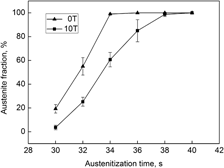
The effects of magnetic field on the austenite formation and grain size were studied by applying high magnetic field during the different stages. Optical microscopy and scanning electron microscopy were used to characterize the microstructure evolution for the samples treated without and with magnetic field. Magnetic field dramatically retards the austenite formation kinetics including pearlite to austenite transformation and cementite dissolution. The austenite grain size is enlarged by the magnetic field applied during austenite formation and not affected by the magnetic field applied only during austenite grain coarsening. The austenite treated with magnetic field during the whole austenitization process also has a larger grain size. The changes in austenite formation kinetics and grain size are related to lower nucleation rate of austenite caused by magnetic field.
Au nanoparticles (Au NPs) have attracted much interest owing to their unique optical properties. In this paper, a facile process has been successfully developed to synthesize the SiO2/Au hybrid microspheres with a diameter of 200 nm via the galvanic replacement of SiO2/Ag hybrid microspheres and chlorauric acid (HAuCl4) solution. The as-prepared products were investigated by x-ray diffraction (XRD), field-emission scanning electron microscopy (FESEM, JEOL-6700F), and transmission electron microscopy (TEM, JEOL 3010), respectively. As expected, the as-prepared SiO2/Au hybrid microspheres show strong chemical stability and superior catalytic reduction of 4-nitrophenol (4-NP) to 4-aminophenol (4-AP). The SiO2/Au hybrid microspheres would be found widely used in wastewater treatment, catalytic reaction, bacteriostatic and bactericidal applications.
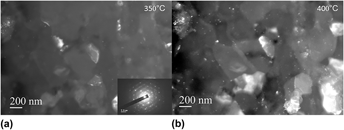
In situ transmission electron microscopy (TEM) analysis shows that submicrometer grains formed by ultrasonic impact treatment (UIT) of sensitized 5456-H116 Al–Mg alloy products are thermally stable up to ∼300 °C which is consistent with previous research on annealing of heavily deformed Al–Mg. Grain growth occurs above 300 °C with significant growth at ∼400 °C. Grain growth continued upon heating to 450 °C; the grain size did not significantly increase when the temperature was held at 450 °C long term. In situ TEM revealed a duplex microstructure that was not fully recrystallized. The activation energy for grain growth was determined to be ∼32 kJ/mol. The submicrometer grains produced by UIT offer improved resistance to fatigue and corrosion. The majority of sensitized 5456-H116 failures are sensitive to the material's surface properties and operational service temperature; the stability of the submicrometer grains in the UIT Al–Mg makes them more stable in practical operations where increase in the material temperature is an issue.
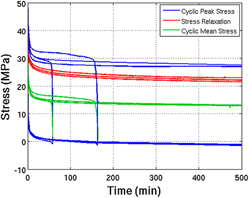
Laser sintering allows producing end-use parts directly from computer files with no tooling required. For these parts to be used in industrial applications, their mechanical properties throughout in-service applications must be examined. The aim of this article is to provide an understanding of the dynamic performance of laser-sintered Nylon 12 parts. To investigate the viscoelastic properties of the material, dynamic thermal mechanical analysis has been performed in different frequencies and temperatures. Tension–tension cyclic behavior of samples has been studied and creep is shown to have a great impact in such behavior in addition to fatigue. Stress relaxation plots are provided and compared with the cyclic loading plots validating the fact that samples experience a combination of creep and fatigue in tension–tension loading. Hysteresis loops indicate brittle crack propagation in the samples experiencing fatigue.