To save content items to your account,
please confirm that you agree to abide by our usage policies.
If this is the first time you use this feature, you will be asked to authorise Cambridge Core to connect with your account.
Find out more about saving content to .
To save content items to your Kindle, first ensure no-reply@cambridge.org
is added to your Approved Personal Document E-mail List under your Personal Document Settings
on the Manage Your Content and Devices page of your Amazon account. Then enter the ‘name’ part
of your Kindle email address below.
Find out more about saving to your Kindle.
Note you can select to save to either the @free.kindle.com or @kindle.com variations.
‘@free.kindle.com’ emails are free but can only be saved to your device when it is connected to wi-fi.
‘@kindle.com’ emails can be delivered even when you are not connected to wi-fi, but note that service fees apply.
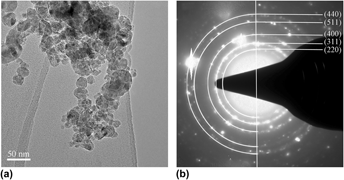
Tungsten oxide (WO3) nanostructures receive sustained interest for a wide variety of applications, and especially for its usage as a photocatalyst. It is therefore important to find suitable methods allowing for its easy and inexpensive large scale production. Tungstite (WO3·H2O) nanoparticles were synthesized using a simple and inexpensive low temperature and low pressure hydrothermal (HT) method. The precursor solution used for the HT process was prepared by adding hydrochloric acid to diluted sodium tungstate solutions (Na2WO4·2H2O) at temperatures below 5 °C and then dissolved using oxalic acid. This HT process yielded tungstite (WO3·H2O) nanoparticles with the orthorhombic structure. A heat treatment at temperatures at or above 300 °C resulted in a phase transformation to monoclinic WO3, while preserving the nanoparticles morphology. The production of WO3 nanoparticles using this method is therefore a three step process: protonation of tungstate ions, crystallization of tungstite, and phase transformation to WO3. Furthermore, this process can be tailored. For example, we show that WO3 can be doped with cesium and that nanorods can also be obtained. The products were characterized using powder x-ray diffraction, transmission electron microscopy (including electron energy-loss spectroscopy and electron diffraction), and x-ray photoelectron spectroscopy.
Titanium dioxide (TiO2), a widely used inorganic semiconductor owing to its superb photoelectric properties, has frequently been fabricated into composites to reduce its relatively large band gap and overcome its limited visible light absorption. In this article, a “layer-by-layer” method has been developed to prepare the composite structure of nitrogen (N)-doped graphene quantum dots (GQDs)-sensitized TiO2 nanofibers. The as-prepared structure shows considerable luminescence and exhibits excellent photoelectric properties. Various factors including the crystalline phase of TiO2, amount of N in GQDs, and irradiation wavelength were investigated to find the optimal conditions for enhanced photoelectric activity. It is demonstrated that the combination of highest N amount GQDs with TiO2 nanofibers of mixed phases (750 °C-sintered TiO2 nanofibers) possess the best photoelectric properties. The enhancement of properties using TiO2 nanofibers with mixed phases mainly contributes to the transfer of electrons between conduction bands of different phases in TiO2 and the distinctive photoluminescence (PL) property of N-GQDs. Furthermore, this enhancement can be achieved in most areas of the visible light range. The general mechanism of the electron generation and transfer of the structure is based on the normal PL and upconversion PL property of N-GQDs which serve as the sensitizer. We consider it a feasible method to improve the photoelectric conversion efficiency in photovoltaic devices.
The Debye temperature of wurtzite aluminum nitride (AlN) was determined by the Rietveld refinement method based on the room-temperature X-ray powder diffraction data. The refined lattice parameters are a = 3.11139(1) Å, c = 4.978 43(3) Å; the refined positional parameter for N is z = 0.384 59(33) Å; and the refined temperature factors of Al and N were 0.442(12) Å2 and 0.559(33) Å2, respectively. Using this refined temperature factor, the Debye temperature was evaluated as 971 K through the Debye approximation.
Ultrasonic additive manufacturing (UAM) is a solid state manufacturing process that combines additive joining of thin metal tapes and subtractive computer numerical control milling operations to generate near-net shape metallic parts. We conducted a design of experiments study with the goal to optimize UAM process parameters for aluminum 6061. Weld force, weld speed, amplitude, and temperature were varied based on a Taguchi L18 experimental design matrix and tested for mechanical strength using a shear test and a comparative push-pin test. Statistical methods including analysis of variance (ANOVA), mean effects plots, and interaction effects plots were conducted to determine optimal process parameters. Results indicate that weld amplitudes of 32.76 µm and weld speeds of 84.6 mm/s yield maximum mechanical strength while temperature and force are statistically insignificant for the parameter levels tested. Annealing of cold-worked foil stock produces a 13% strength increase for UAM samples over homogeneous annealed material.
Binary interdiffusion data as function of composition in the Mg–{Ce, Nd, Zn} and Zn–{Ce, Nd} systems were obtained experimentally using solid–solid diffusion couples. For the studied systems, all intermetallic compounds were produced, based on the equilibrium phase diagrams, eliminating the problem of missing compounds in the diffusion couples found in the literature. The composition profiles were obtained using wavelength dispersive spectroscopy line-scans across diffusion couples. The composition-dependent diffusion coefficient at each interface was determined using Boltzmann–Matano analysis. For the available literature data for some of the compounds in the Mg–{Ce, Nd, Zn} systems, the calculated interdiffusion coefficients were in good agreement. No diffusion data regarding Zn–{Ce, Nd} systems could be found in the literature. The activation energy and the preexponential factor of the growth of the Mg–{Ce, Nd, Zn} compounds were determined using Arrhenius equation. The activation energies of the growth of the Mg–Ce compounds showed relatively higher values than those of Mg–Nd and Mg–Zn compounds.
Oxide-dispersion-strengthened (ODS) ferritic alloys are fascinating materials for future high temperature energy production technologies. MgAl2O4 ODS alloy incorporating nanoscale oxide particles were produced by mechanical milling (MM) followed by hot isostatic pressing (HIP). The MgAl2O4 nanoscale oxide particles were formed during the HIP process by the addition of MgO and Al2O3 to the Fe–Cr matrix. Microstructural evolution of ODS alloys was structurally characterized at each step of the elaboration processes by means of scanning electron microscope (SEM), transmission electron microscope (TEM), and x-ray diffraction (XRD). The observations of structure of the mixed powders in ODS alloys after MM indicated that the initial powders, coupled with the original MgO and Al2O3 powders, got fractured by severe plastic deformation and ultrafine bcc grains (∼17 nm) of the matrix and amorphous phase composed of Mg, Al, and O were formed during MM. The main driving force for the formation of amorphous phase comes from the increase of volume fraction of bcc Fe grain boundary and the increase of interfacial energy due to the decrease in the size of MgO and Al2O3 powders. The MgAl2O4 nanoscale oxide particles formed at 1173 K which was far below the traditional sintering temperature of the raw material. And the structures of MgAl2O4 nanoscale oxide particles were observed by TEM.
NiO nanoplatelet-based materials with different dimensionality are synthesized by a one-step hydrothermal route at 120 °C for 4 h. The morphologies and structure of the obtained NiO nanoplatelets grown on Ni foam and NiO microspheres composed of nanoplatelets are characterized. The results show that the former has a length of 5–10 μm and a uniform thickness of ∼100 nm, while the latter has a diameter of 5–10 μm. Their electrochemical properties as anode materials for lithium-ion batteries are evaluated and compared. The discharge capacities of NiO nanoplatelet electrode are 663, 516, 370, 258, and 169 mAh g−1 at current densities of 250, 500, 1000, 2500, and 5000 mA g−1, respectively. Such a lithium storage capability is much higher than that of the NiO microsphere electrode. The reasons for the enhanced electrochemical performance of the nanoplatelet electrode were investigated, which suggested that more active sites for electrochemical reactions and faster ion/electron transfer realized on nanoplatelets are facilitating lithium storage.
The submicrometer Ni cones have been successfully prepared through a simple solvothermal method in glycerol. The as-prepared products were extensively characterized by x-ray diffraction, field emission scanning electron microscopy, energy-dispersive x-ray spectroscopy, Fourier transform infrared spectroscopy, and thermogravimetric analysis. The effects of the volume ratios of glycerol to water, and the concentration of alkali on morphologies of Ni samples were investigated. The electromagnetic wave absorption properties of Ni cones were evaluated based on the relative complex permeability (μr) and permittivity (εr). A minimum reflection loss (RL) of −41.6 dB was observed at 4.7 GHz with the thickness of 3.8 mm and the RL values below −10 dB were obtained in the range of 3.9–15.0 GHz with the corresponding thickness of 1.8–3.8 mm. The excellent wave absorption properties of the obtained products are due to the synergic effect of dielectric loss and magnetic loss, geometry effect and unique morphology.
To selectively detect Cu2+ ions is very important for controlling daily intake of Cu2+ ions and monitoring numerous biological processes. Fluorescence spectroscopic technique is a useful one for detection of copper ions. Previous methods always involve the use of metal Cd-based quantum dots (QDs), which suffer to the photobleaching and subsequent release of toxic metal ions. Herein, a simple method has been developed to detect Cu2+ ions by using pristine graphene QDs. Graphene QDs are synthesized by chemical oxidation of pitch graphite fibers. Our results indicate the photoluminescence (PL) of as-synthesized graphene QDs could be quenched by a group of metal ions while adding biothiol cysteine can only cause the significant recovery of the PL of graphene QDs quenched by Cu2+ ions. Our approach provides an easy and environmental friendly method for detection of Cu2+ ions and has the potential for future practical applications.
Aluminum metal matrix hybrid composites were synthesized through powdermetallurgy route from ball milled powders to yield the compositions: Al+ 0% TiO2, Al + 2.5% TiO2, Al +2.5% TiO2 + 2% Gr, and Al + 2.5% TiO2+ 4% Gr. The densification and deformation properties of sinteredAl–TiO2–Gr composites during cold upsettingwere investigated experimentally. The powder preforms are compacted usingsuitable punch and die in 40 kN hydraulic press and the initial percentagetheoretical density was maintained as 85%. Sintering was done in an electricmuffle furnace at the temperature of 590 °C for a period of 3 h. Thesintered preforms were subjected to incremental compressive loading of 10 kNuntil cracks were found at the free surface. The true axial stress(σz), true hoop stress(σθ), true hydrostatic stress(σm), and true effective stress (σeff)were calculated for all the preforms and all these stresses are correlated withthe true axial strain (εz). The densification behaviors ofthe composites were studied against true axial strain (εz)and lateral strain. Better densification and deformation property were obtainedfor pure aluminum preforms compared with other composite preforms. Addition ofTiO2 to the pure Al and Gr reinforcements increases the strengthcoefficient of the Al–TiO2 composite.
The effect of annealing on the tribological and corrosion properties of Al–12Si samples produced by selective laser melting (SLM) is evaluated via sliding and fretting wear tests and weight loss experiments and compared to the corresponding material processed by conventional casting. Sliding wear shows that the as-prepared SLM material has the least wear rate compared to the cast and heat-treated SLM samples with abrasive wear as the major wear mechanism along with oxidation. Similar trend has also been observed for the fretting wear experiments, where the as-prepared SLM sample displays the minimum wear loss. On the other hand, the acidic corrosion behavior of the as-prepared SLM material as well as of the cast samples is similar and the corrosion rate is accelerated by increasing the heat treatment temperature. This behavior is due to the microstructural changes induced by the heat treatment, where the continuous network of Si characterizing the as-prepared SLM sample transforms to isolated Si particles in the heat-treated SLM specimens. This shows that both the wear and corrosion behaviors are strongly associated with the change in microstructure of the SLM samples due to the heat-treatment process, where the size of the hard Si particles increases, and their density decreases with increasing annealing temperature.
The fundamental factors of polymer powders, their importance for successful selective laser sintering (SLS) processing, and the outstanding position of polyamide 12 (PA12) powders in this connection are presented. Considering key factors, the combination of intrinsic and extrinsic properties necessary to generate a powder likely for SLS application is emphasized. Only a specific combination of indicated points leads to success. This is one reason for fewer materials commercially available to date for SLS application. PA12 and some dry blends based on PA12 are today the materials that are used to generate almost all commercial SLS parts. The specific performance of particular PA12 for SLS processing is unmatched from other polymers so far. Reasons are the precise molecular control of SLS polymers for thermal behavior (enlargement of sintering window) and the open chain structure. This is for generation of sufficient mechanical properties and to induce interlayer bonding of successively sintered layers to reduce anisotropic parts.
Laser additive manufacturing allows the production of polymeric or metallic parts with complex shapes. A major advantage of this contactless technology is that it allows reaching very high energy densities with an excellent precision in short times. This is very suitable for processing hard refractory metals for instance. Unfortunately, current results are less satisfactory for ceramics as a consequence of their intrinsic properties such as a low thermal shock resistance and very high refractoriness. Another significant limitation is related to the poor absorptivity of oxide ceramics in the near-infrared region which is typical for most commercial selective laser melting (SLM) machines. This study considers an alternative to overcome the above-mentioned limitations, especially the lack of absorptivity. SLM of oxide ceramics has become possible. Large parts with complex shapes and relative densities up to 90% have been manufactured on a commercial SLM machine.
The iron aluminide Fe3Al has been successfully processed by selective laser melting (SLM) and laser metal deposition (LMD). Process parameters have been determined by which defect free and dense (>99.5%) samples were produced. However, due to the low thermal conductivity of Fe3Al, preheating the substrate to 200 °C was necessary to prevent cracking during cooling. Microstructural characterization by electron backscatter diffraction (EBSD) showed that in spite of the high cooling rates large elongated grains grew in the building direction, more distinctive for SLM than for LMD. These grains show a continuous change in the crystallographic orientation. Evaluation of the compressive flow stress showed that the anisotropic microstructure results in anisotropic mechanical properties, depending whether the samples are loaded in building direction or perpendicular to it. The alloy shows a very high strength up to 600 °C and – concerning the coarse microstructure – becomes ductile already at low temperatures.
The introduction of numerical methods, particularly finite element (FE) analysis, represents a significant advance in metal forming operations. Numerical methods are used increasingly to optimize product design and deal with problems in metal forging, rolling, and extrusion processes. Metal Forming Analysis, first published in 2001, describes the most important numerical techniques for simulating metal forming operations. The first part of the book describes principles and procedures and includes numerous examples and worked problems. The remaining chapters focus on applications of numerical analysis to specific forming operations. Most of these results are drawn from the authors' research in the areas of metal testing, sheet metal forming, forging, extrusion, and similar operations. Sufficient information is presented so that readers can understand the nonlinear finite element method as applied to forming problems without a prior background in structural finite element analysis. Graduate students, researchers, and practising engineers will welcome this thorough reference to state-of-the-art numerical methods used in metal forming analysis.
Ultrasonic guided waves in solid media have become a critically important subject in nondestructive testing and structural health monitoring, as new faster, more sensitive, and more economical ways of looking at materials and structures have become possible. This book will lead to fresh creative ideas for use in new inspection procedures. Although the mathematics is sometimes sophisticated, the book can also be read by managers without detailed understanding of the concepts as it can be read from a 'black box' point of view. Overall, the material presented on wave mechanics - in particular, guided wave mechanics - establishes a framework for the creative data collection and signal processing needed to solve many problems using ultrasonic nondestructive evaluation and structural health monitoring. The book can be used as a reference in ultrasonic nondestructive evaluation by professionals and as a textbook for seniors and graduate students. This work extends the coverage of Rose's earlier book Ultrasonic Waves in Solid Media.
Thin films are widely used in the electronic device industry. As the trend for miniaturization of electronic devices moves into the nanoscale domain, the reliability of thin films becomes an increasing concern. Building on the author's previous book, Electronic Thin Film Science by Tu, Mayer and Feldman, and based on a graduate course at UCLA given by the author, this new book focuses on reliability science and the processing of thin films. Early chapters address fundamental topics in thin film processes and reliability, including deposition, surface energy and atomic diffusion, before moving onto systematically explain irreversible processes in interconnect and packaging technologies. Describing electromigration, thermomigration and stress migration, with a closing chapter dedicated to failure analysis, the reader will come away with a complete theoretical and practical understanding of electronic thin film reliability. Kept mathematically simple, with real-world examples, this book is ideal for graduate students, researchers and practitioners.
Presenting the latest coverage of the fundamentals and applications of nanofibrous materials and their structures for graduate students and researchers, this book bridges the communication gap between fiber technologists and materials scientists and engineers. Featuring intensive coverage of electroactive, bioactive and structural nanofibers, it provides a comprehensive collection of processing conditions for electrospinning and includes recent advances in nanoparticle-/nanotube-based nanofibers. The book also covers mechanical properties of fibers and fibrous assemblies, as well as characterization methods.