To save content items to your account,
please confirm that you agree to abide by our usage policies.
If this is the first time you use this feature, you will be asked to authorise Cambridge Core to connect with your account.
Find out more about saving content to .
To save content items to your Kindle, first ensure no-reply@cambridge.org
is added to your Approved Personal Document E-mail List under your Personal Document Settings
on the Manage Your Content and Devices page of your Amazon account. Then enter the ‘name’ part
of your Kindle email address below.
Find out more about saving to your Kindle.
Note you can select to save to either the @free.kindle.com or @kindle.com variations.
‘@free.kindle.com’ emails are free but can only be saved to your device when it is connected to wi-fi.
‘@kindle.com’ emails can be delivered even when you are not connected to wi-fi, but note that service fees apply.
High quality factor and near-zero temperature coefficient of resonant frequency (τf) are the two key issues for a certain microwave dielectric material system used in microstrip patch antennas. ZnTiO3-based ceramics is a promising candidate for microstrip patch antennas. On inhibiting the decomposition of ZnTiO3 by adding sufficient amount of MgO, high quality factor microwave dielectric material (Zn0.7Mg0.3)TiO3 was obtained. The deviations between theoretical and observed dielectric polarizabilites, the packing fraction, and bond valence were calculated to analyze correlation between structure and properties of (Zn0.7Mg0.3)TiO3. TiO2 was added to adjust τf of (Zn0.7Mg0.3)TiO3, and 0.82(Zn0.7Mg0.3)TiO3–0.18TiO2 with an εr of 28.5, a Qf of 125,050 GHz, and a near-zero τf which satisfied the requirement as a substrate material for microstrip patch antenna was obtained at 1100 °C. In addition, a dielectric microstrip antenna was designed and fabricated using the proposed dielectric materials. The microstrip patch antenna exhibited a −34.96 dB return loss and a 1.05 voltage standing wave ratio at 2.5 GHz.
Pure Ni and Ni–W thin films with different W contents (<22 at.%) and a thickness of 500 nm have been produced by (co)sputtering. The phase composition, changes in residual stress, crystallite size, microstrain, and texture have been investigated employing in-situ x-ray diffraction measurements (25–550 °C) and ex-situ transmission electron microscopy analyses. For all compositions investigated, W dissolves substitutionally in Ni. The dissolution of W results in a highly columnar nanocrystalline microstructure with grain aspect ratios (height to width) exceeding 10. The Ni(W) solid solution exhibits a very high density of planar (twin and intrinsic stacking) faults oriented perpendicular to the growth direction. Whereas grain coarsening occurs for the nanocrystalline pure Ni thin films already upon heating to temperatures as low as about 125 °C, the microstructure of the nanocrystalline Ni–W thin films remains stable up to much higher temperatures, that is, even exceeding 350 °C. Above 350 °C, a W depletion of the Ni–W layer as a result of W segregation at planar faults occurs, which is accompanied by a change in lattice constant and in-plane stress.
Core–shell structured Sn/carbon nanotube (CNT) was prepared by one-pot chemical vapor deposition (CVD) method in N2/C2H2 (10% C2H2) using nanosized SnO2 as the starting material. The obtained one-dimensional material is composed of a disordered carbon shell and a single-crystalline Sn nanorod core. The diameter of the Sn nanorod and the thickness of the carbon shell are around 40–50 and 4–5 nm, respectively, when the CVD reaction was carried out at 650 °C for 2 h. The core–shell structured Sn/CNT exhibits improved electrochemical performance compared with bare Sn with a diameter of around 100 nm. A reversible capacity of around 350 mAh/g can be retained after 20 cycles at 50 mA/g for Sn/CNT, while for bare Sn, the capacity drops rapidly to 100 mAh/g after the same cycles.
A Mn3O4/graphene hybrid material is fabricated using a facile and simple in-situ reduction process and shown to be a promising anode for lithium rechargeable batteries. The hybrid material retains a high capacity with a good cycle life of up to 990 mAh g−1 after 30 cycles. The excellent electrochemical performance is attributable to the unique nanostructure of the hybrid material. Highly crystalline Mn3O4 particles (20–30 nm) are uniformly dispersed on graphene whose high electronic conductivity and high surface area provide a conductive percolating network throughout the electrode in the hybrid material. The conductive graphene networks enhance an electron transfer in the electrode and promote the electrochemical activity of the crystalline Mn3O4.
Sn/Ni–8.0 at.%V (Ni–7.0 wt%V) couples are prepared and the interfacial reactions at 210 and 250 °C are examined. In the early stage of reaction at 250 °C, a T phase is formed as a result of fast diffusion of Sn into the Ni–8.0 at.%V substrate. With a longer reaction, the outer region of the T phase transforms to a Ni-depletion layer, which has not been observed previously. Both the T phase and the Ni-depletion layer are analyzed using transmission electronic microscopy. This newly found Ni-depletion layer is composed of Sn and nanosize “VSn2(V2Sn3)” particulates. The solid/solid reaction paths in the Sn/Ni–8.0 at.%V couples evolve from Sn/T/Ni–V, Sn/Ni3Sn4/T/Ni–V to Sn/Ni3Sn4/VSn2(V2Sn3). During the liquid/solid reactions, the paths are liquid/T/Ni–V, liquid/liquid + Ni3Sn4/T/Ni–V, liquid/liquid + Ni3Sn4/liquid + VSn2(V2Sn3)/T/Ni–V, and liquid/liquid + Ni3Sn4/liquid + VSn2(V2Sn3).
A study is made of the rotation field in wedge indentation of metals using copper as the model material system. Wedges with apical angles of 60° and 120° are used to indent annealed copper, and the deformation is mapped using image correlation. The indentation of annealed and strain-hardened copper is simulated using finite element analysis. The rotation field, derived from the deformation measurements, provides a clear way of distinguishing between cutting and compressive modes of deformation. Largely unidirectional rotation on one side of the symmetry line with small spatial rotation gradients is characteristic of compression. Bidirectional rotation with neighboring regions of opposing rotations and locally high rotation gradients characterizes cutting. In addition, the rotation demarcates such characteristic regions as the pile-up zone in indentation of a strain-hardened metal. The residual rotation field obtained after unloading is essentially the same as that at full load, indicating that it is a scalar proxy for plastic deformation as a whole.
Nanofiber yarns with controlled twist levels were prepared by twisting a narrow fibrous strip cut directly from electrospun nanofiber mats. The effects of fiber morphology, diameter and orientation, as well as the yarn twist level on the yarn tensile properties were examined. For the yarns made from randomly oriented fine uniform nanofibers (e.g., diameter 359 nm) and beaded nanofibers, the tensile strength increased with increasing the yarn twist level. Higher fiber diameter (e.g., 634 nm) led to the tensile strength having an initial increase and then decrease trend. The modulus increased with the twist level for all the yarns studied. However, the elongation at break increased initially with the twist level and subsequently decreased. The orientation of aligned fibers within the fiber strip greatly influenced the yarn tensile properties. When the fibers were oriented along the fiber length direction, both tensile strength and modulus were the largest.
The (001) GaAs surfaces have been modified by thin elastically stressed InGaAs-buried layers and tested under Berkovich contact. The elastic–plastic transition determined from the pop-in event observed in the force control mode of the indentation machine appears at slightly lower loads (0.44–0.46 mN) when compared to bare GaAs surface (0.50 mN). Estimations indicate that for both studied sublayers, the stored elastic energy is about 20% of the elastic indentation energy reached at elastic–plastic transition when the sublayer is observed not to relax plastically.
We present a low-temperature, hydrothermal synthesis method for Ta-doped TiO2. Here, alkoxide-based precursors are mixed at low temperatures to suppress differential hydrolysis and phase separation. This method ensures homogeneous, molecular mixing of the Ta dopant with the native oxide up to a concentration of ∼2.5 at.%. X-ray diffraction and energy dispersive spectrometer analyses confirm a uniformly doped rutile TiO2. Scanning electron microscopy and transmission electron microscopy analyses reveal a highly branched structure. Optoelectronic properties of these structures were investigated using ultraviolet-visible spectroscopy and low-temperature photoluminescence.
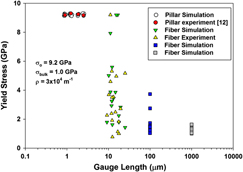
In-situ tensile tests have been performed in a dual beam focused ion beam and scanning electron microscope on as-grown and prestrained single-crystal molybdenum-alloy (Mo-alloy) fibers. The fibers had approximately square cross sections with submicron edge lengths and gauge lengths in the range of 9–41 μm. In contrast to previously observed yield strengths near the theoretical strength of 10 GPa in compression tests of ∼1–3-μm long pillars made from similar Mo-alloy single crystals, a wide scatter of yield strengths between 1 and 10 GPa was observed in the as-grown fibers tested in tension. Deformation was dominated by inhomogeneous plastic events, sometimes including the formation of Lüders bands. In contrast, highly prestrained fibers exhibited stable plastic flow, significantly lower yield strengths of ∼1 GPa, and stress–strain behavior very similar to that in compression. A simple, statistical model incorporating the measured dislocation densities is developed to explain why the tension and compression results for the as-grown fibers are different.
Instrumented nanoindentation technique is a powerful approach for accurately measuring mechanical properties of materials in micron or even nanoscale. In this article, the effect of tin (Sn) content upon mechanical properties of the α-phase in Cu–Sn alloys was studied by using an instrumented nanoindentation. The experimental results revealed that: (i) the hardness of the α-phase exhibited a linear relationship with Sn content (C) increasing, i.e., H = 0.0757C + 0.8916, when it was less than the maximum solid solubility (15.8 wt.%), which is in good agreement with the Friedel–Mott–Suzuki theory; (ii) the variation of Young’s modulus in a narrow range of 120–130 GPa is attributed to orientation variation of the α-phase in casting Cu–Sn dendrites.
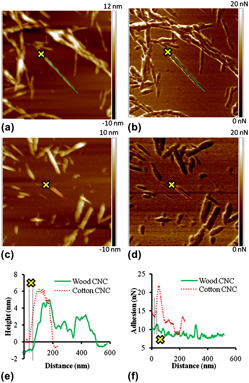
The ultimate properties of a fibrous composite system depend highly on the transverse mechanical properties of the fibers. Here, we report the size dependency of transverse elastic modulus in cellulose nanocrystals (CNCs). In addition, the mechanical properties of CNCs prepared from wood and cotton resources were investigated. Nanoindentation in an atomic force microscope (AFM) was used in combination with analytical contact mechanics modeling (Hertz model) and finite element analysis (FEA) to estimate the transverse elastic moduli (Et) of CNCs. FEA modeling estimated the results more accurately than the Hertz model. Based on the AFM–FEA calculations, wood CNCs had higher transverse elastic moduli in comparison to the cotton CNCs. Additionally, Et was shown to increase with a reduction in the CNCs’ diameter. This size-scale effect was related to the Iα/Iβ ratio and crystalline structure of CNCs.
This study investigates spherical indentation of plastically graded materials (PGMs). The hardness of these materials decreases with depth due to microstructural or compositional changes. To predict the behavior of PGM, the knowledge of the plastic properties of the surface and the substrate is necessary. In this work, the spherical indentation technique is applied on carbonitrided steels to obtain their mechanical properties. First, spherical indentation was applied to characterize homogenous materials using inverse analysis. The comparison with tensile test’s results shows that the inverse analysis using spherical indentation data is a reliable method to determine the plastic properties of homogeneous materials. In the second part spherical indentation was used to characterize carbonitrided steels using inverse analysis to obtain plastic properties of the surface. The results show that spherical indentation using inverse analysis has a real potential for evaluating mechanical properties of PGM.
Nucleation doping strategy is an effective doping method; herein the synthesis of MnSe/CdSe nanocrystals using this strategy with different anion precursors was demonstrated. The resulted nanocrystals were characterized by various test technology to confirm the composition and structure. Wurtzite CdSe shell was achieved without using alkylphosphine, this is meaningful for the development of green chemistry. It is argued that the shell growth is more like a second nucleation process, rather than the epitaxial growth; this conclusion is believed to shed some light on the nucleation doping process.
Bulk production of iron nanowire inside carbon nanotubes (CNTs) from iron phthalocyanine (FePc) polymer under 800 °C is presented for the first time. The bis-phthalonitrile was firstly reacted with iron nanoparticles to produce iron phthalonitrile oligomer, and heat treatments made the formation of CNTs occurred during the carbonization process of FePc polymer at ambient pressure in nitro atmosphere under 800 °C. The iron nanowire inside carbon tubes from the metal Pc polymer possessed excellent electromagnetic loss and magnetic loss properties.
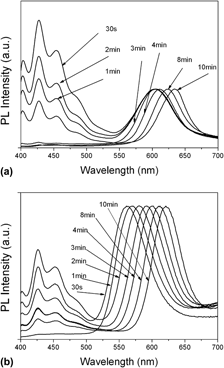
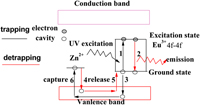
With 2 mol% Zn2+ codoping and 2 mol% K+ charge compensation, the red-emitting phosphor [K0.8Y0.63Eu3+0.08Zn0.02][Mo0.2W0.8O4] was synthesized by solid-state reaction. X-ray powder diffraction spectrum indicates that it owns single phase. Through its emission spectra, excitation spectra, and fluorescence decay curves measured, its emission mechanism was mentioned and it was calculated for its partial J-O parameters and quantum efficiency of Eu3+5D0 energy level under 395 nm excitation. The results indicate that Eu3+5D0 → 7F2 red luminescence in the host can be excited by 395 nm, but its quantum efficiency can be improved in space and it has potential applications for white light-emitting diode as the red luminescent materials.
We demonstrate the fabrication of shadow mask (SM) patterned as well as nanoimprint lithography (NIL) patterned organic transistors and integrated complementary organic inverters (ICOIs). As active layers pentacene (p-type) and either PTCDI-C13H27 or F16CuPc (n-type) were used. The SM-patterned ICOIs with a staggered bottom gate configuration, a nanocomposite dielectric and both active layer combinations (pentacene/PTCDI C13H27, pentacene/F16CuPc) exhibited high performance (3 V operation voltage; gain around 60; high level 3 V; low level 5 mV; noise margin 0.9 V). Flexible ICOIs with transistor channel lengths of 900 nm were successfully fabricated by NIL, using a benzocyclobutene derivative as dielectric. Because of the process inherent coplanar bottom gate configuration, F16CuPc was used. The ICOIs showed proper functionality (3 V operation voltage; gain around 5; high level 2.9 V; low level 25 mV). To our knowledge, this study demonstrates the first complementary submicron inverters based on fully R2R compatible imprint processes.
Cu6Sn5 is a common intermetallic compound formed during electrical packaging. It has an allotropic transformation from the low-temperature monoclinic η’-Cu6Sn5 to high-temperature hexagonal η-Cu6Sn5 at equilibrium temperature 186 °C. In this research, the effects of this allotropic transformation and Ni addition on the thermal expansion of η’- and/or η-Cu6Sn5 were characterized using synchrotron x-ray diffraction and dilatometry. A volume expansion during the monoclinic to hexagonal transformation was found. The addition of Ni was found to decrease the undesirable thermal expansion by stabilizing the hexagonal Cu6Sn5 at temperatures below 186 °C and reducing the overall thermal expansion of Cu6Sn5.
Over the past two decades, nanoindentation has been the most versatile method for mechanical testing at small length scales. Because of large strain gradients, it does not allow for a straightforward identification of material parameters such as yield and tensile strength, though. This represents a major drawback and has led to the development of alternative microscale testing techniques with microcompression as one of the most popular ones today. In this research, the influence of the realistic sample configuration and unavoidable variations in the experimental conditions is studied systematically by combing in-situ microcompression experiments on ultrafine-grained nickel and finite element simulations. It will be demonstrated that neither qualitative let alone quantitative analyses are as straightforward as they may appear, which diminishes the apparent advantages of microcompression testing.
The elastic anisotropy of cementite (Fe3C) is still under discussion. Recent theoretical (ab initio) calculations predict a very high elastic anisotropy for this iron carbide, and a few published experiments suggest that prediction could be true. This work presents a first attempt of using nanoindentation for assessing the elastic anisotropy of such an important component of steels. Our nanoindentation results show that the elastic anisotropy of Fe3C is high but smaller than predicted by ab initio calculations. The elastic modulus is obtained from the load–penetration curves before the first pop-in indicative of plasticity nucleation is detected. The tests thus provide information on the plastic anisotropy of cementite. Surprisingly, the mean indentation pressure or the maximum shear stress under the indenter at the onset of plasticity has been observed to be nearly independent of the crystalline orientation of the indented surface.