To save content items to your account,
please confirm that you agree to abide by our usage policies.
If this is the first time you use this feature, you will be asked to authorise Cambridge Core to connect with your account.
Find out more about saving content to .
To save content items to your Kindle, first ensure no-reply@cambridge.org
is added to your Approved Personal Document E-mail List under your Personal Document Settings
on the Manage Your Content and Devices page of your Amazon account. Then enter the ‘name’ part
of your Kindle email address below.
Find out more about saving to your Kindle.
Note you can select to save to either the @free.kindle.com or @kindle.com variations.
‘@free.kindle.com’ emails are free but can only be saved to your device when it is connected to wi-fi.
‘@kindle.com’ emails can be delivered even when you are not connected to wi-fi, but note that service fees apply.
“In the most exquisite measurements yet, researchers declared the [electron] particle to be a perfect sphere to within one billionth of a billionth of a billionth of a centimetre.”—The Guardian, May 25, 2011
Bio-based plastics, in which the fossil carbon is replaced by bio/renewable-based carbon, offer the intrinsic value proposition of a reduced carbon footprint and are in complete harmony with the rates and time scale of the biological carbon cycle. Identification and quantification of bio-based content is based on the radioactive C-14 signature associated with (new) biocarbon. Using experimentally determined biocarbon content values, one can calculate the intrinsic CO2 emissions reduction achieved by substituting petrocarbon with biocarbon—the material carbon footprint value proposition. The process carbon footprint arising from the conversion of feedstock to final product is computed using life-cycle assessment methodology. Biodegradability in conjunction with selected disposal systems such as composting and anaerobic digestion offers an end-of-life solution to completely remove the plastic substrate from the environment. Not all bio-based polymer materials are biodegradable, and not all biodegradable polymers are bio-based. Most importantly, complete biodegradability (complete utilization of the polymer by the microorganisms present in the disposal environment) is necessary as per ASTM and ISO standards, otherwise there could be serious health and environmental consequences.
A significant change is occurring in the global polymer industries. Development of a new generation of bio-based polymers, polymers derived from renewable resources, is progressing rapidly. Complementing historical biopolymers such as natural rubber and cellulosics, these new bioplastics include a growing number of commercial successes, including polylactides and polyhydroxyalkanoates. Many more bioplastics are on the near horizon, made possible by rapid advances in biotechnology. The molecular specificity of biochemical transformations is ideally suited for producing high purity monomers needed for making high molecular weight polymer molecules. Some of the newest developments involve the creation of well-established polymers (polyethylene, polybutlylene, poly(ethylene terephthalate)) via new biochemical pathways that start with renewable, rather than fossil, resources. This article highlights some recent advances in bio-based polymers. Specifically, this review includes topics ranging from novel biopolymer synthesis, new bio-based nanocomposites, novel processing, and holistic assessments of sustainability through quantitative life-cycle analysis. It is demonstrated that greener plastic materials can be produced through ecologically responsible conversion of renewable resources using industrial biotechnology and enhanced by nanotechnology. This emerging approach represents a triple technological convergence that promises to significantly alter the value chains of the global plastics industries.
In recent years, bio-based products have been of great interest since sustainable development policies have tended to expand with decreasing reserves of fossil fuels and growing concerns for the environment. Consequently, biodegradable and renewable polymers have been the topic of significant research. These polymers can mainly be classified as agro-polymers (starch, chitosan) and biopolyesters (polyhydroxyalkanoates, poly(lactic acid)). Unfortunately, for certain applications, these bio-based polymers cannot be fully competitive with conventional thermoplastics since some of their properties are too weak. Therefore, to extend the range of their applications, current bio-based polymers have to be reformulated. Some of the most promising are nano-biocomposites, where nano-sized fillers are dispersed into a biopolymer matrix, which could yield a range of improved properties (stiffness, permeability). This article reports the most recent developments in renewable nano-biocomposites based on the use of nanoclay fillers.
There are a large number of natural fibers that have the potential to replace synthetic fibers made from glass, carbon, and polymers as the reinforcing phase in composites. Interest in these fibers has increased, as they offer a sustainable, readily available, high specific modulus option. The high modulus of cellulose crystals makes them attractive as a reinforcing phase in composites. These cellulose crystals are the key structural component in natural fibers, but the complex microstructure of the fiber means that the full value of the cellulose crystal modulus cannot be utilized. Moreover, the surface of natural fibers can have varying chemistry depending on the pretreatment of the fiber and the degree to which lignin and other hydrophobic materials are removed from the fiber. In addition, cellulose swells in contact with water, and this can degrade the properties of the fiber and composite. A better understanding of the surface properties and techniques to control the composite interface are required if natural fibers are to fulfill their potential.
Nanoindentation is a popular experimental technique for characterization of the mechanical properties of soft and biological materials. With its force resolution of tens of pico-Newtons, the atomic force microscope (AFM) is well-suited for performing indentation experiments on soft materials. However, nonlinear contact and adhesion complicate such experiments. This paper critically examines the application of the Johnson-Kendall-Roberts (JKR) adhesion model to nanoindentation data collected with an AFM. The use of a nonlinear least-square error-fitting algorithm to calculate reduced modulus from the nanoindentation data using the JKR model is discussed. It is found that the JKR model fits the data during loading but does not fit the data during unloading. A fracture stability analysis shows that the JKR model does not fit the data collected during unloading because of the increased stability provided by the AFM cantilever.
We have studied the dynamic response of Fe-doped manganites with ac susceptibility measurements in La0.65Ca0.35Mn1−xFexO3 with 0.01 ≤ x ≤ 0.10 as functions of temperature and dc magnetic field. It is observed that the in-phase part of susceptibility goes through a maximum that is removed on the application of moderate dc field. DC fields suppress both the components (real and imaginary parts) with the strongest effects being at or close to TC. Conduction and ferromagnetism have been consistently suppressed by Fe substitution. Increased spin disorder and decrease in TC with increasing Fe content are evident. The effect of Fe is seen to be consistent with the disruption of the Mn–Mn exchange possibly due to the formation of magnetic clusters. There is clear correlation between the resistivity and susceptibility. Low-temperature dissipation in high-Fe-doped samples is observed; that is, increasing the Fe leads to increased spin disorder and dissipation at low temperature. The effect of the dc field is discussed in terms of the suppression of spin fluctuations close to TC.
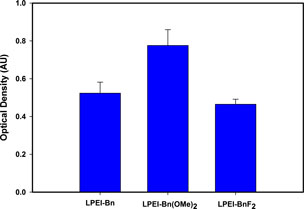
The extraordinary electronic, thermal, and mechanical properties of carbon nanotubes (CNTs) make them attractive materials for incorporation into polymer films. However, retaining these outstanding properties of CNTs during processing can be difficult due to the attractive forces that cause the nanotubes to bundle together. In this study, six different hydrophobically modified linear poly(ethylenimine) (LPEI) polymers are evaluated and effectively used as aqueous nanotube dispersants. This study also shows that the polymers are bifunctional in nature as aqueous polymer/nanotube mixtures can be cross-linked into CNT-impregnated hydrogels.
The Oliver and Pharr method for evaluating nanoindentation load–displacement data is based on the measurement of the contact stiffness, which is usually determined at the very beginning of the unloading sequence, or, using dynamic nanoindentation, continuously during the whole loading segment. A new experimental method has been developed to continuously monitor the contact stiffness throughout the unloading sequence. It provides supplementary information about the shape and area of the residual impression, as well as a direct measurement of the shape of the effective indenter previously introduced by Pharr and Bolshakov. The new method was applied to indentations on fused silica, sapphire, nanocrystalline nickel, and ultrafine-grained aluminum. Lastly, the new procedure was adapted to directly measure the epsilon factor used in the Oliver and Pharr method. A value of 0.76 was found from indentation into fused silica, in close agreement with literature values.
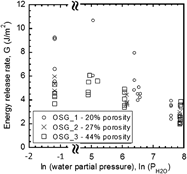
A novel load–displacement sensing instrument has been designed and fabricated to characterize the fracture properties of brittle thin films at low temperature (approximately −30 °C) and pressure (1.6e-4 Pa) environments. In this study, the instrument was used to investigate the effects of harsh environments on the fracture behaviors of organosilicate glass (OSG) and silicon carbonitride (SiCN) thin films under four-point bend loading. Experimental results showed that the fracture strengths of film stacks are the highest when the environment contains a very low water molecule concentration. This condition can be achieved by purging the testing chamber with pure nitrogen or reducing the chamber pressure to less than 1 Pa. In contrast, cracks propagated readily along OSG/SiCN interfaces when experiments were performed in deionized water. The effects of low temperature (approximately −30 °C) and pressure on thin film fracture were also studied, and the results demonstrated that there is no observed degradation of the OSG fracture properties. X-ray photoelectron spectroscopy (XPS) technique was used to identify the chemical composition of the fracture surfaces.
Low-voltage-driven organic thin-film transistors (organic TFTs) with spatially controlled threshold voltages (−1.2 and −0.36 V) were fabricated for the first time. Using the microcontact printing method, tetradecylphosphonic acid (HC14-PA) and pentadecylfluoro-octadecylphosphonic acid (FC18-PA) were transferred to form ultrathin layers in different regions on a substrate. Together with plasma-grown aluminum oxide (AlOx) layer, the stamped layers were shown to have equal insulating ability as the dipped method monolayer. The feasibility of the area-selective stamping method was displayed using locally controlled inverter circuits. The shift of turn-on voltage for those transistors was consistent with the threshold voltage shift of the transistors.
The analysis of nanoindentation force data are based on Sneddon’s solution for a linear elastic half space with a rigid axisymmetric indenter. Berkovich indenters commonly used in indentation experiments are normally modeled as cones. The idea of effective tip shape was presented to better explain the behavior of the unloading curve and pressure distribution under the tip in real experiments. We examine the concept of effective tip in three dimensions by importing real indenter metrology by atomic force microscope directly into finite element analysis and simulate fused silica indentation experiments. We show that fitting the elastic reloading curves overestimates the elastic modulus of fused silica. This is explained by studying the pressure distribution at maximum depth under the effective tip. While the effective tip describes the problem geometrically, it is believed that neglecting the deformed zone in the indented material is responsible for over estimating the modulus value.
ReB2 was recently reported to exhibit high hardness and low compressibility, which both are strong functions of its stoichiometry, namely Re to B ratio. Most of the techniques used for ReB2 synthesis reported 1:2.5 Re to B ratio because of the loss of the B during high temperature synthesis. However, as a result of B excess, the amorphous boron, located along the grain boundaries of polycrystalline ReB2, would degrade the ReB2 properties. Therefore, techniques which could allow synthesizing the stoichiometric ReB2 preferably at room temperature are in high demand. Here, we report synthesis of ReB2 powders using mechanochemical route by milling elemental crystalline Re and amorphous B powders in the SPEX 8000 high-energy ball mill for 80 h. The formation of boron and perrhenic acids are also reported after ReB2 powder was exposed to the moist air environment for a 12-month period of time.
We investigated microstructures, compositional distributions, and electrical properties of dielectric CaCu3Ti4O12 (CCTO) thin films deposited on Pt/TiO2/SiO2/Si substrates from 700 to 800 °C by pulsed laser deposition. With increasing the deposition temperature from 700 to 750 °C, the dielectric constants (εr) of CCTO films were greatly enhanced from ∼300 to ∼2000 at 10 kHz, respectively. However, the εr values of CCTO films were gradually decreased above 750 °C, which was surely attributable to the formation of a TiO2-rich dead layer at the interface between CCTO and Pt electrode. Compositional analyses by Auger electron spectroscopy, energy dispersive spectroscopy, and electron energy loss spectroscopy revealed that the TiO2-rich dead layer became thicker because of severe Cu diffusion from CCTO films to Pt electrode. The leakage current behaviors of CCTO films are in good agreement with Poole–Frenkel conduction mechanism, where both the TiO2-rich dead layer and rutile TiO2 nanocrystalline particles are considered to play a role of charge trapping centers.