Refine search
Actions for selected content:
26076 results in Abstract analysis
Liouville properties on graphs
- Part of
-
- Journal:
- Mathematika / Volume 44 / Issue 1 / June 1997
- Published online by Cambridge University Press:
- 26 February 2010, pp. 133-148
- Print publication:
- June 1997
-
- Article
- Export citation
Self-Affine Carpets on the Square Lattice
-
- Journal:
- Combinatorics, Probability and Computing / Volume 6 / Issue 2 / June 1997
- Published online by Cambridge University Press:
- 01 June 1997, pp. 197-204
-
- Article
- Export citation
All-sum sets in (0,1]—Category and measure
- Part of
-
- Journal:
- Mathematika / Volume 44 / Issue 1 / June 1997
- Published online by Cambridge University Press:
- 26 February 2010, pp. 61-87
- Print publication:
- June 1997
-
- Article
- Export citation
-
We provide a unified and simplified proof that for any partition of (0, 1] into sets that are measurable or have the property of Baire, one cell will contain an infinite sequence together with all of its sums (finite or infinite) without repetition. In fact any set which is large around 0 in the sense of measure or category will contain such a sequence. We show that sets with 0 as a density point have very rich structure. Call a sequence
 and its resulting all-sums set structured provided for each
  We show further that structured all-sums sets with positive measure are not partition regular even if one allows shifted all-sums sets. That is, we produce a two cell measurable partition of (0, 1 ] such that neither set contains a translate of any structured all-sums set with positive measure.
 and its resulting all-sums set structured provided for each
  We show further that structured all-sums sets with positive measure are not partition regular even if one allows shifted all-sums sets. That is, we produce a two cell measurable partition of (0, 1 ] such that neither set contains a translate of any structured all-sums set with positive measure.
Theoretical studies of Freedericksz transitions in SmC liquid crystals
-
- Journal:
- European Journal of Applied Mathematics / Volume 8 / Issue 3 / June 1997
- Published online by Cambridge University Press:
- 01 June 1997, pp. 253-262
-
- Article
- Export citation
Covering convex bodies by translates of convex bodies
- Part of
-
- Journal:
- Mathematika / Volume 44 / Issue 1 / June 1997
- Published online by Cambridge University Press:
- 26 February 2010, pp. 215-218
- Print publication:
- June 1997
-
- Article
- Export citation
On the fractional dimension of sets of continued fractions
- Part of
-
- Journal:
- Mathematika / Volume 44 / Issue 1 / June 1997
- Published online by Cambridge University Press:
- 26 February 2010, pp. 50-53
- Print publication:
- June 1997
-
- Article
- Export citation
-
Let [0;a1(ξ), a2(ξ),…] denote the continued fraction expansion of ξ∈[0, 1]. The problem of estimating the fractional dimension of sets of continued fractions emerged in late twenties in papers by Jarnik [6, 7] and Besicovitch [1] and since then has been addressed by a number of authors (see [2, 4, 5, 8, 9]). In particular, Good [4] proved that the set of all ξ, for which an(ξ)→∞ as n→∞ has the Hausdorff dimension ½ For the set of continued fractions whose expansion terms tend to infinity doubly exponentially the dimension decreases even further. More precisely, let

Hirst [5] showed that dim
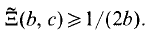 On the other hand, Moorthy [8] showed that dim
  where
where
 On the other hand, Moorthy [8] showed that dim
  where
where
A continuum theory for smectic liquid crystals allowing layer dilation and compression
-
- Journal:
- European Journal of Applied Mathematics / Volume 8 / Issue 3 / June 1997
- Published online by Cambridge University Press:
- 01 June 1997, pp. 273-280
-
- Article
- Export citation
M. Aschbacher. 3-Transposition Groups. Cambridge Tracts in Mathematics No. 124. Cambridge University Press. 1997, ISBN 0 521 57196 0, 260 pp., hardback, £35. - S. Axler. Linear Algebra done right. Springer. 1995, ISBN 0 387 94596 2, 238 pp. paperback, DM 40. - E. D. Bloch. A first course in Geometric Topology and Differential Geometry. Birkhäuser. 1997, ISBN 3 7643 3840 7, 421 pp., SFr 98. - J. F. Carlson. Modules and Group Algebras. Birkhäuser. 1996, ISBN 3 7643 5389 9, 91 pp., DM 34. - R. Carter, G. Segal and I. Macdonald. Lectures on Lie Groups and Lie Algebras. LMS Student Texts 32. Cambridge University Press. 1995, ISBN 0 521 49922 4, 190 pp., paperback, £13·95. - J. W. S. Cassels and E. V. Flynn. Prolegomina to a Middle-brow Arithmetic of Curves of Genus 2. Cambridge University Press. 1996, ISBN 0 521 48370 0, 219 pp., paperback, £24·95. - B. Fornberg. A Practical Guide to Pseudospectral Methods. Cambridge Monographs on Applied and Computational Mathematics. Cambridge University Press. 1996, ISBN 0 521 49582 2, 231 pp., £37·50. - B. V. Gnedenko and V. Y. Korolev. Random Summation: Limit Theorems and Applications. CRC Press. 1996, ISBN 0 8493 2875 6, 267 pp., $79.95. - I. Gratton Guinness. The Fontana History of the Mathematical Sciences. Fontana Press. 1997, ISBN 0 00 686179 2, 817 pp., paperback, £12·99. - E. Hernández and G. Weiss. A first course on Wavelets. CRC Press. 1996, ISBN 0 8493 8274 2, 489 pp., $64.95. - N. H. Ibragimov. Editor. Lie group analysis of differential equations. Vol. 3. New Trends in Theoretical Developments and Computational Methods. CRC Press. 1996, ISBN 0 8493 9419 8, 536 pp., $95. - T. W. Körner. The Pleasures of counting. Cambridge University Press. 1996, ISBN 0 521 56823 4, 534 pp., paperback, £17·95. - M. Machover. Set Theory, Logic and their Limitations. Cambridge University Press. 1996, ISBN 0 521 47998 3, 288 pp., paperback, £14·95. - I. Madsen and J. Tornehave. From Calculus to Cohomology. Cambridge University Press. 1997, ISBN 0 521 58956 8, 8, pp. paperback, £16·95. - C. Moeglin and J.-L. Waldspurger. Spectral Decomposition and Eisenstein Series. Cambridge University Press. 1995, ISBN 0 521 41893 3, 338 pp., £50. - C. E. Praeger and L. H. Soicher. Low Rank Representations and Graphs for Sporadic Groups. Australian Math. Soc. Lecture Series, No. 8. Cambridge University Press. 1997, ISBN 0 521 56737 8, 541 pp., paperback, £24·95. - D. Quinney and R. Harding. Calculus Connections, Vol. 1, A Multimedia Adventure. Wiley. 1996, Workbook ISBN 0 471 02111 3, 120 pp., and CD ISBN 0 471 01040, Workbook and CD, £22·50. - L. T. Rigatelli. Evariste Galois, 1811–1832. Birkhäuser. 1996, ISBN 0 8176 5410 0, 163, pp., paperback, SFr 32. - P. G. Saffman. Vortex Dynamics. Cambridge University Press. Reprinted 1995, ISBN 0 521 47739 5, 311 pp., paperback, £17·95. - A. D. Taylor. Mathematics and Politics, Strategy, voting, power and proof. Springer. 1995, ISBN 0 387 94391 9, 284 pp., paperback, £16. - G. Tenenbaum. Introduction to Analytic and Probabilistic Number Theory. Cambridge University Press. 1995, ISBN 0 521 41261 7, 448 pp., £45. - A. van der Poorten. Notes on Fermat's Last Theorem. Wiley. 1996, ISBN 0 471 06261 8, 222 pp., £35. - P. Wojtaszczyk. A mathematical introduction to Wavelets. Cambridge University Press. 1997, ISBN 0 521 57894 9, 261 pp., paperback, £13·95.
-
- Journal:
- Mathematika / Volume 44 / Issue 1 / June 1997
- Published online by Cambridge University Press:
- 26 February 2010, pp. 219-224
- Print publication:
- June 1997
-
- Article
- Export citation
Some Diophantine equations with almost all solutions trivial
- Part of
-
- Journal:
- Mathematika / Volume 44 / Issue 1 / June 1997
- Published online by Cambridge University Press:
- 26 February 2010, pp. 14-36
- Print publication:
- June 1997
-
- Article
- Export citation
-
In this paper we investigate the solutions in integers x, y, z, X, Y, Z of the system

where P is a real number that may be taken to be arbitrarily large, and the (fixed) integer exponent h satisfies h≥4. The system has 6P3 + O(P2) “trivial” solutions in which x, y, z are a permutation of X, Y, Z. Our result implies that the number of non-trivial solutions is at most o(P3), so that the total number of solutions is asymptotic to 6P3.
On gaps between numbers that are sums of three cubes
- Part of
-
- Journal:
- Mathematika / Volume 44 / Issue 1 / June 1997
- Published online by Cambridge University Press:
- 26 February 2010, pp. 1-13
- Print publication:
- June 1997
-
- Article
- Export citation
-
Let (Sn)n = 1,2,… be the strictly increasing sequence of those natural numbers that can be represented as the sum of three cubes of positive integers. The estimate

is easily proved as follows: Let x1 be the largest natural number with
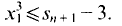 Then
Then  This procedure is iterated by choosing x2 and then x3 as the largest natural numbers satisfying
  and
and  Thus
Thus 
 Since
Since 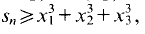 this implies (1).
 Then
Then  This procedure is iterated by choosing x2 and then x3 as the largest natural numbers satisfying
  and
and  Thus
Thus 
 Since
Since  this implies (1).
On discrepancy bounds via dual shatter function
- Part of
-
- Journal:
- Mathematika / Volume 44 / Issue 1 / June 1997
- Published online by Cambridge University Press:
- 26 February 2010, pp. 42-49
- Print publication:
- June 1997
-
- Article
- Export citation
-
Recently, it has been shown that tight or almost tight upper bounds for the discrepancy of many geometrically denned set systems can be derived from simple combinatorial parameters of these set systems. Namely, if the primal shatter function of a set system ℛ on an n-point set X is bounded by const. md, then the discrepancy disc (ℛ) = O(n(d−1)/2d) (which is known to be tight), and if the dual shatter function is bounded by const. md, then disc
 We prove that for d = 2, 3, the latter bound also cannot be improved in general. We also show that bounds on the shatter functions alone do not imply the average (L1)-discrepancy to be much smaller than the maximum discrepancy: this contrasts results of Beck and Chen for certain geometric cases. In the proof we give a construction of a certain asymptotically extremal bipartite graph, which may be of independent interest.
 We prove that for d = 2, 3, the latter bound also cannot be improved in general. We also show that bounds on the shatter functions alone do not imply the average (L
Editorial. Mathematical models of liquid crystals
-
- Journal:
- European Journal of Applied Mathematics / Volume 8 / Issue 3 / June 1997
- Published online by Cambridge University Press:
- 01 June 1997, pp. 251-252
-
- Article
-
- You have access
- Export citation
MTK volume 44 issue 1 Cover and Front matter
-
- Journal:
- Mathematika / Volume 44 / Issue 1 / June 1997
- Published online by Cambridge University Press:
- 26 February 2010, pp. f1-f4
- Print publication:
- June 1997
-
- Article
-
- You have access
- Export citation
Stochastic Analysis of Convergence via Dynamic Representation for a Class of Line-search Algorithms
-
- Journal:
- Combinatorics, Probability and Computing / Volume 6 / Issue 2 / June 1997
- Published online by Cambridge University Press:
- 01 June 1997, pp. 205-229
-
- Article
- Export citation
4 - The principal and dual graphs
-
- Book:
- Introduction to Subfactors
- Published online:
- 21 October 2009
- Print publication:
- 15 May 1997, pp 47-64
-
- Chapter
- Export citation
Contents
-
- Book:
- Introduction to Subfactors
- Published online:
- 21 October 2009
- Print publication:
- 15 May 1997, pp vii-viii
-
- Chapter
- Export citation
2 - Subfactors and index
-
- Book:
- Introduction to Subfactors
- Published online:
- 21 October 2009
- Print publication:
- 15 May 1997, pp 19-32
-
- Chapter
- Export citation
5 - Commuting squares
-
- Book:
- Introduction to Subfactors
- Published online:
- 21 October 2009
- Print publication:
- 15 May 1997, pp 65-100
-
- Chapter
- Export citation
Bibliography
-
- Book:
- Introduction to Subfactors
- Published online:
- 21 October 2009
- Print publication:
- 15 May 1997, pp 151-155
-
- Chapter
- Export citation
Bibliographical Remarks
-
- Book:
- Introduction to Subfactors
- Published online:
- 21 October 2009
- Print publication:
- 15 May 1997, pp 156-159
-
- Chapter
- Export citation
