Refine search
Actions for selected content:
26077 results in Abstract analysis
Least energy solutions for elliptic equations in unbounded domains
-
- Journal:
- Proceedings of the Royal Society of Edinburgh. Section A: Mathematics / Volume 126 / Issue 1 / 1996
- Published online by Cambridge University Press:
- 14 November 2011, pp. 195-208
- Print publication:
- 1996
-
- Article
- Export citation
-
In this paper we study the existence of least energy solutions to subcritical semilinear elliptic equations of the form
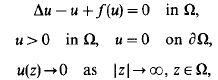
where Ω is an unbounded domain in RN and f is a C1 function, with appropriate superlinear growth. We state general conditions on the domain Ω so that the associated functional has a nontrivial critical point, thus yielding a solution to the equation. Asymptotic results for domains stretched in one direction are also provided.
PRM volume 126 issue 3 Cover and Back matter
-
- Journal:
- Proceedings of the Royal Society of Edinburgh. Section A: Mathematics / Volume 126 / Issue 3 / 1996
- Published online by Cambridge University Press:
- 14 November 2011, pp. b1-b2
- Print publication:
- 1996
-
- Article
-
- You have access
- Export citation
Stochastic generalised KPP equations
-
- Journal:
- Proceedings of the Royal Society of Edinburgh. Section A: Mathematics / Volume 126 / Issue 5 / 1996
- Published online by Cambridge University Press:
- 14 November 2011, pp. 957-983
- Print publication:
- 1996
-
- Article
- Export citation
-
We classify multiplicative white noise perturbations k(·) dw, of generalised KPP equations and their effects on deterministic approximate travelling wave solutions by the behaviour of
 , the solutions of the stochastic generalised KPP equations converge to deterministic approximate travelling waves and if
 being an associated potential energy, Фs a solution of the corresponding classical mechanical equations of Newton, D being a certain domain in R1 × Rr then the white noise perturbations essentially destroy the wave structure and force the solutions to die down.
For the case

(suppose the existence of the limit) we show that there is a residual wave form but propagating at a different speed from that of the unperturbed equations. Numerical solutions are included and give good agreement with theoretical results.
 , the solutions of the stochastic generalised KPP equations converge to deterministic approximate travelling waves and if
 being an associated potential energy, Ф
Regular and singular Sturm–Liouville problems with coupled boundary conditions
-
- Journal:
- Proceedings of the Royal Society of Edinburgh. Section A: Mathematics / Volume 126 / Issue 3 / 1996
- Published online by Cambridge University Press:
- 14 November 2011, pp. 505-514
- Print publication:
- 1996
-
- Article
- Export citation
Positivity of solutions of elliptic equations with nonlocal terms*
-
- Journal:
- Proceedings of the Royal Society of Edinburgh. Section A: Mathematics / Volume 126 / Issue 3 / 1996
- Published online by Cambridge University Press:
- 14 November 2011, pp. 643-663
- Print publication:
- 1996
-
- Article
- Export citation
-
In this paper we study a nonlocal problem for a second-order partial differential equation which depends on a parameter n. We prove the existence of critical values 0 <
 and 0 >
 such that for all ≦ɳ≦ and for all non-negative right-hand sides, our problem has nonnegative solutions. We obtain a formula for ɳ0, the maximal possible value of , and find the exact value of ɳ for spherical ɳ. We also study the corresponding eigenvalue problem. At the end of the paper, we consider the application of our results to the nonlinear system describing the distribution of temperature and potential in a microsensor.
 and 0 >
 such that for all
 Existence of two solutions of nonlinear elliptic equations with critical Sobolev exponents and mixed boundary conditions
-
- Journal:
- Proceedings of the Royal Society of Edinburgh. Section A: Mathematics / Volume 126 / Issue 1 / 1996
- Published online by Cambridge University Press:
- 14 November 2011, pp. 47-75
- Print publication:
- 1996
-
- Article
- Export citation
-
Let Ω be a bounded domain in Rn(n ≧ 3) with Lipschitz-continuous boundary, ∂Ω = Γ0∪Γ1. In this paper we consider the following problem:
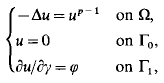
where φ ∈ L2 (Γ1), φ ≢ 0 on Γ1 and γ is the unit outward normal and p = 2n/(n − 2) = 2* is the critical exponent for the Sobolev embedding
 . We prove that for φ ∈ L2(Γ1) satisfying suitable conditions, the problem admits two solutions.
 . We prove that for φ ∈ L
PRM volume 126 issue 6 Cover and Back matter
-
- Journal:
- Proceedings of the Royal Society of Edinburgh. Section A: Mathematics / Volume 126 / Issue 6 / 1996
- Published online by Cambridge University Press:
- 14 November 2011, pp. b1-b3
- Print publication:
- 1996
-
- Article
-
- You have access
- Export citation
Riemann problem for a class of 2 × 2 hyperbolic conservation laws*
-
- Journal:
- Proceedings of the Royal Society of Edinburgh. Section A: Mathematics / Volume 126 / Issue 4 / 1996
- Published online by Cambridge University Press:
- 14 November 2011, pp. 719-724
- Print publication:
- 1996
-
- Article
- Export citation
Foundations of a theory of convexity on affine Grassmann manifolds
- Part of
-
- Journal:
- Mathematika / Volume 42 / Issue 2 / December 1995
- Published online by Cambridge University Press:
- 26 February 2010, pp. 305-328
- Print publication:
- December 1995
-
- Article
- Export citation
A counterexample in parabolic potential theory
- Part of
-
- Journal:
- Mathematika / Volume 42 / Issue 2 / December 1995
- Published online by Cambridge University Press:
- 26 February 2010, pp. 392-396
- Print publication:
- December 1995
-
- Article
- Export citation
Ramanujan's explicit values for the classical theta-function
- Part of
-
- Journal:
- Mathematika / Volume 42 / Issue 2 / December 1995
- Published online by Cambridge University Press:
- 26 February 2010, pp. 278-294
- Print publication:
- December 1995
-
- Article
- Export citation
-
Let

where φ is the notation used by Ramanujan in his notebooks [15], and is the familiar notation of Whittaker and Watson [20, p. 464]. It is well known that [1, p. 102] (with a misprint corrected)

where
 denotes the ordinary or Gaussian hypergeometric function; k, 0 < k < 1, is the modulus; K is the complete elliptic integral of the first kind; and
where K′=K(k′) and
 is the complementary modulus. Thus, an evaluation of any one of the functions φ, , or K yields an evaluation of the other two functions. However, such evaluations may not be very explicit. For example, if K(k) is known for a certain value of k, it may be difficult or impossible to explicitly determine K′, and so q cannot be explicitly determined. Conversely, it may be possible to evaluate φ(q) for a certain value of q, but it may be impossible to determine the corresponding value of k. (Recall that
  [1, p. 102].)
 denotes the ordinary or Gaussian hypergeometric function; k, 0 < k < 1, is the modulus; K is the complete elliptic integral of the first kind; and
 is the complementary modulus. Thus, an evaluation of any one of the functions φ,
  [1, p. 102].)
Matrix transformations of series of orthogonal polynomials
- Part of
-
- Journal:
- Mathematika / Volume 42 / Issue 2 / December 1995
- Published online by Cambridge University Press:
- 26 February 2010, pp. 427-443
- Print publication:
- December 1995
-
- Article
- Export citation
-
For a sequence of polynomials (Pn) orthonormal on the interval [−1, 1], we consider the sequence of transforms (gn) of the series
 given by
  . We establish necessary and sufficient conditions on the matrix (bnk) for the sequence (gn) to converge uniformly on compact subsets of the interior of an appropriate ellipse to a function holomorphic on that interior.
 given by
  . We establish necessary and sufficient conditions on the matrix (b
A new approach to covering
- Part of
-
- Journal:
- Mathematika / Volume 42 / Issue 2 / December 1995
- Published online by Cambridge University Press:
- 26 February 2010, pp. 251-263
- Print publication:
- December 1995
-
- Article
- Export citation
Multipliers of Cauchy integrals of logarithmic potentials
- Part of
-
- Journal:
- Mathematika / Volume 42 / Issue 2 / December 1995
- Published online by Cambridge University Press:
- 26 February 2010, pp. 397-405
- Print publication:
- December 1995
-
- Article
- Export citation
-
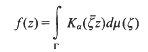
Let Δ = {z:|Z|<1}, Γ={z:|z|=1}, and ℳ denote the set of complex-valued Borel measures on Γ. Let Kα(z)=(1−z)−α for α>0 and K0(z)=log 1/(1−z). For α > 0 let ℱα denote the family of functions f on Δ having the property that there exists a measure μ∈ℳ such that
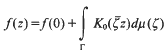
for |z|<1. When α=0, this condition is replaced by
MTK volume 42 issue 2 Cover and Front matter
-
- Journal:
- Mathematika / Volume 42 / Issue 2 / December 1995
- Published online by Cambridge University Press:
- 26 February 2010, pp. f1-f2
- Print publication:
- December 1995
-
- Article
-
- You have access
- Export citation
On the positivity of solutions to the Smoluchowski equations
- Part of
-
- Journal:
- Mathematika / Volume 42 / Issue 2 / December 1995
- Published online by Cambridge University Press:
- 26 February 2010, pp. 406-412
- Print publication:
- December 1995
-
- Article
- Export citation
-
The dynamics of cluster growth can be modelled by the following infinite system of ordinary differential equations, first proposed by Smoluchowski, [8],

where cj=cj(t) represents the physical concentration of j-clusters (aggregates of j identical particles), aj,k=aj,k≥0 are the time-independent coagulation coefficients, measuring the effectiveness of the coagulation process between a j-cluster and a k-cluster, and the first sum in the right-hand side of (1) is defined to be zero if j = 1.
A second genus of regular ternary forms
- Part of
-
- Journal:
- Mathematika / Volume 42 / Issue 2 / December 1995
- Published online by Cambridge University Press:
- 26 February 2010, pp. 444-447
- Print publication:
- December 1995
-
- Article
- Export citation
-
In the paper [2] Hsia noted that the forms x2+xy+y2+9z2 and x2+3y2+3yz+3z2 constitute a genus and that both forms are regular; he asked whether there exist any other genera containing two or more regular forms. In this note it is proved that the forms

are regular. They constitute a genus with discriminant 27 (in the normalization used by Brandt and Intrau in [1]). It is noteworthy that Hsia's genus has the same discriminant.
Reconstructing curves from sets of quantized observations
- Part of
-
- Journal:
- Mathematika / Volume 42 / Issue 2 / December 1995
- Published online by Cambridge University Press:
- 26 February 2010, pp. 340-353
- Print publication:
- December 1995
-
- Article
- Export citation
-
For arbitrary f: R → R and ϒ ⊂ Z × R we define the set
 of quantized observations of f relative to ϒ as follows: for each integer n and each y∈R we write
(the supremum of an empty set is taken to be −∞ ) and we put

Thus for example
 and
and  , where [x] (without subscript) denotes as usual the integer part of x.
 of quantized observations of f relative to ϒ as follows: for each integer n and each y∈
 and
and  , where [x] (without subscript) denotes as usual the integer part of x.
A short proof of Hadwiger's characterization theorem
- Part of
-
- Journal:
- Mathematika / Volume 42 / Issue 2 / December 1995
- Published online by Cambridge University Press:
- 26 February 2010, pp. 329-339
- Print publication:
- December 1995
-
- Article
- Export citation
Radiation of acoustic power from a two-dimensional double elastic panel
- Part of
-
- Journal:
- Mathematika / Volume 42 / Issue 2 / December 1995
- Published online by Cambridge University Press:
- 26 February 2010, pp. 368-391
- Print publication:
- December 1995
-
- Article
- Export citation
