Refine search
Actions for selected content:
26077 results in Abstract analysis
Exact multiplicity results for boundary value problems with nonlinearities generalising cubic
-
- Journal:
- Proceedings of the Royal Society of Edinburgh. Section A: Mathematics / Volume 126 / Issue 3 / 1996
- Published online by Cambridge University Press:
- 14 November 2011, pp. 599-616
- Print publication:
- 1996
-
- Article
- Export citation
-
Using techniques of bifurcation theory we present two exact multiplicity results for boundary value problems of the type

The first result concerns the case when the nonlinearity is independent of x and behaves like a cubic in u. The second one deals with a class of nonlinearities with explicit x dependence.
H-measures applied to symmetric systems*
-
- Journal:
- Proceedings of the Royal Society of Edinburgh. Section A: Mathematics / Volume 126 / Issue 6 / 1996
- Published online by Cambridge University Press:
- 14 November 2011, pp. 1133-1155
- Print publication:
- 1996
-
- Article
- Export citation
-
H-measures were recently introduced by Luc Tartar as a tool which might provide better understanding of propagating oscillations. Independently, Patrick Gerard introduced the same objects under the name of microlocal defect measures. Partial differential equations of mathematical physics can often be written in the form of a symmetric system:
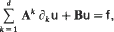
where Ak and B are matrix functions, while u is an unknown vector function, and f a known vector function. In this work we prove a general propagation theorem for H-measures associated to symmetric systems. This result, combined with the localisation property, is then used to obtain more precise results on the behaviour of H-measures associated to the wave equation, Maxwell's and Dirac's systems, and second-order equations in two variables.
A phase transition speed estimate in the Stefan problem*
-
- Journal:
- Proceedings of the Royal Society of Edinburgh. Section A: Mathematics / Volume 126 / Issue 6 / 1996
- Published online by Cambridge University Press:
- 14 November 2011, pp. 1341-1347
- Print publication:
- 1996
-
- Article
- Export citation
Large-time behaviour of solutions for the outer pressure problem of a viscous heat-conductive one-dimensional real gas
-
- Journal:
- Proceedings of the Royal Society of Edinburgh. Section A: Mathematics / Volume 126 / Issue 6 / 1996
- Published online by Cambridge University Press:
- 14 November 2011, pp. 1277-1296
- Print publication:
- 1996
-
- Article
- Export citation
Dense point spectrum for the one-dimensional Dirac operator with an electrostatic potential
-
- Journal:
- Proceedings of the Royal Society of Edinburgh. Section A: Mathematics / Volume 126 / Issue 5 / 1996
- Published online by Cambridge University Press:
- 14 November 2011, pp. 1087-1096
- Print publication:
- 1996
-
- Article
- Export citation
A global continuation theorem and bifurcation from infinity for infinite-dimensional dynamical systems
-
- Journal:
- Proceedings of the Royal Society of Edinburgh. Section A: Mathematics / Volume 126 / Issue 4 / 1996
- Published online by Cambridge University Press:
- 14 November 2011, pp. 725-738
- Print publication:
- 1996
-
- Article
- Export citation
A fixed-point theorem for weakly condensing operators
-
- Journal:
- Proceedings of the Royal Society of Edinburgh. Section A: Mathematics / Volume 126 / Issue 2 / 1996
- Published online by Cambridge University Press:
- 14 November 2011, pp. 391-398
- Print publication:
- 1996
-
- Article
- Export citation
Existence and uniqueness of the global admissible solution for a viscoelastic model with relaxation
-
- Journal:
- Proceedings of the Royal Society of Edinburgh. Section A: Mathematics / Volume 126 / Issue 5 / 1996
- Published online by Cambridge University Press:
- 14 November 2011, pp. 1113-1132
- Print publication:
- 1996
-
- Article
- Export citation
-
This paper examines the Cauchy problem for a viscoelastic model with relaxation

with discontinuous, large initial data, where ½ ≦ μ <1, δ > 0 are constants. We first give a definition of admissible (or entropic) solutions to the system. Under this definition, we prove the existence, uniqueness and continuous dependence of the global admissible solution for the system. Our methods are essentially due to Kruzkov, and the requirement that f(u) is not badly degenerate (more precisely, meas {x: f″(x) = 0} = 0), needed previously when considering the global existence problem for the same system, is removed.
Large-time asymptotic behaviour of a step for the Benjamin–Bona–Mahony–Burgers equation
-
- Journal:
- Proceedings of the Royal Society of Edinburgh. Section A: Mathematics / Volume 126 / Issue 1 / 1996
- Published online by Cambridge University Press:
- 14 November 2011, pp. 1-18
- Print publication:
- 1996
-
- Article
- Export citation
On the number of nonorientable Wicks forms in a free group
-
- Journal:
- Proceedings of the Royal Society of Edinburgh. Section A: Mathematics / Volume 126 / Issue 1 / 1996
- Published online by Cambridge University Press:
- 14 November 2011, pp. 113-116
- Print publication:
- 1996
-
- Article
- Export citation
-
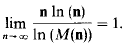
The paper is concerned with the estimation of the number of maximal-length genus n nonorientable Wicks forms for n → ∞. It is shown how to apply a graph theory for this problem. It is proved that if M(n) be the number of all nonequivalent nonorientable genus n Wicks forms of maximal length, then
Uniqueness, multiplicity and stability for positive solutions of a pair of reaction–diffusion equations
-
- Journal:
- Proceedings of the Royal Society of Edinburgh. Section A: Mathematics / Volume 126 / Issue 4 / 1996
- Published online by Cambridge University Press:
- 14 November 2011, pp. 777-809
- Print publication:
- 1996
-
- Article
- Export citation
Sturm–Liouville problems with indefinite weights and Everitt's inequality
-
- Journal:
- Proceedings of the Royal Society of Edinburgh. Section A: Mathematics / Volume 126 / Issue 5 / 1996
- Published online by Cambridge University Press:
- 14 November 2011, pp. 1097-1112
- Print publication:
- 1996
-
- Article
- Export citation
Solutions in the large for certain nonlinear parabolic equations and applications*
-
- Journal:
- Proceedings of the Royal Society of Edinburgh. Section A: Mathematics / Volume 126 / Issue 1 / 1996
- Published online by Cambridge University Press:
- 14 November 2011, pp. 19-45
- Print publication:
- 1996
-
- Article
- Export citation
Stable periodic solutions of a spatially homogeneous nonlocal reaction–diffusion equation
-
- Journal:
- Proceedings of the Royal Society of Edinburgh. Section A: Mathematics / Volume 126 / Issue 4 / 1996
- Published online by Cambridge University Press:
- 14 November 2011, pp. 867-884
- Print publication:
- 1996
-
- Article
- Export citation
-
Nonlocal reaction–diffusion equations of the form ut = uxx + F(u, α(u)), where
 are considered together with Neumann or Dirichlet boundary conditions. One of the main results deals with linearisation at equilibria. It states that, for any given set of complex numbers, one can arrange, choosing the equation properly, that this set is contained in the spectrum of the linearisation. The second main result shows that equations of the above form can undergo a supercritical Hopf bifurcation to an asymptotically stable periodic solution.
 are considered together with Neumann or Dirichlet boundary conditions. One of the main results deals with linearisation at equilibria. It states that, for any given set of complex numbers, one can arrange, choosing the equation properly, that this set is contained in the spectrum of the linearisation. The second main result shows that equations of the above form can undergo a supercritical Hopf bifurcation to an asymptotically stable periodic solution.
Jacobi's elliptic functions and Lagrangian immersions
-
- Journal:
- Proceedings of the Royal Society of Edinburgh. Section A: Mathematics / Volume 126 / Issue 4 / 1996
- Published online by Cambridge University Press:
- 14 November 2011, pp. 687-704
- Print publication:
- 1996
-
- Article
- Export citation
-
First, we establish a sharp inequality between the squared mean curvature and the scalar curvature for a Lagrangian submanifold in a nonflat complex-space-form. Then, by utilising the Jacobi's elliptic functions en and dn, we introduce three families of Lagrangian submanifolds
 and two exceptional Lagrangian submanifolds Fn, Ln in nonflat complex-space-forms which satisfy the equality case of the inequality. Finally, we obtain the complete classification of Lagrangian submanifolds in nonflat complex-space-forms which satisfy this basic equality.
 and two exceptional Lagrangian submanifolds F
The initial-value problem for the forced Korteweg-de Vries equation*
-
- Journal:
- Proceedings of the Royal Society of Edinburgh. Section A: Mathematics / Volume 126 / Issue 3 / 1996
- Published online by Cambridge University Press:
- 14 November 2011, pp. 571-598
- Print publication:
- 1996
-
- Article
- Export citation
Spectral asymptotics with a remainder estimate for Schrödinger operators with slowly growing potentials
-
- Journal:
- Proceedings of the Royal Society of Edinburgh. Section A: Mathematics / Volume 126 / Issue 4 / 1996
- Published online by Cambridge University Press:
- 14 November 2011, pp. 829-836
- Print publication:
- 1996
-
- Article
- Export citation
Stability and instability of some nonlinear dispersive solitary waves in higher dimension
-
- Journal:
- Proceedings of the Royal Society of Edinburgh. Section A: Mathematics / Volume 126 / Issue 1 / 1996
- Published online by Cambridge University Press:
- 14 November 2011, pp. 89-112
- Print publication:
- 1996
-
- Article
- Export citation
The limit of the anisotropic double-obstacle Allen–Cahn equation
-
- Journal:
- Proceedings of the Royal Society of Edinburgh. Section A: Mathematics / Volume 126 / Issue 6 / 1996
- Published online by Cambridge University Press:
- 14 November 2011, pp. 1217-1234
- Print publication:
- 1996
-
- Article
- Export citation
-
In this paper, we prove that solutions of the anisotropic Allen–Cahn equation in doubleobstacle form

where A is a strictly convex function, homogeneous of degree two, converge to an anisotropic mean-curvature flow

when this equation admits a smooth solution in ℝn. Here VN and R respectively denote the normal velocity and the second fundamental form of the interface, and
 More precisely, we show that the Hausdorff-distance between the zero-level set of φ and the interface of the above anisotropic mean-curvature flow is of order O(ε2).
 More precisely, we show that the Hausdorff-distance between the zero-level set of φ and the interface of the above anisotropic mean-curvature flow is of order O(ε
PRM volume 126 issue 5 Cover and Front matter
-
- Journal:
- Proceedings of the Royal Society of Edinburgh. Section A: Mathematics / Volume 126 / Issue 5 / 1996
- Published online by Cambridge University Press:
- 14 November 2011, pp. f1-f2
- Print publication:
- 1996
-
- Article
-
- You have access
- Export citation
