Refine search
Actions for selected content:
26077 results in Abstract analysis
The distance function and defect energy
-
- Journal:
- Proceedings of the Royal Society of Edinburgh. Section A: Mathematics / Volume 126 / Issue 5 / 1996
- Published online by Cambridge University Press:
- 14 November 2011, pp. 923-938
- Print publication:
- 1996
-
- Article
- Export citation
PRM volume 126 issue 4 Cover and Back matter
-
- Journal:
- Proceedings of the Royal Society of Edinburgh. Section A: Mathematics / Volume 126 / Issue 4 / 1996
- Published online by Cambridge University Press:
- 14 November 2011, pp. b1-b2
- Print publication:
- 1996
-
- Article
-
- You have access
- Export citation
PRM volume 126 issue 4 Cover and Front matter
-
- Journal:
- Proceedings of the Royal Society of Edinburgh. Section A: Mathematics / Volume 126 / Issue 4 / 1996
- Published online by Cambridge University Press:
- 14 November 2011, pp. f1-f2
- Print publication:
- 1996
-
- Article
-
- You have access
- Export citation
On the convolution operators arising in the study of abstract initial boundary value problems
-
- Journal:
- Proceedings of the Royal Society of Edinburgh. Section A: Mathematics / Volume 126 / Issue 3 / 1996
- Published online by Cambridge University Press:
- 14 November 2011, pp. 515-539
- Print publication:
- 1996
-
- Article
- Export citation
-
We consider convolution operators arising in the study of abstract initial boundary value problems. These operators are of the form

where {S(t)}t ≧0 is a C0-semigroup in a Banach space X,, with infinitesimal generator A0,: D(A0), ⊂ X, → X, and K(z): Y → X is a linxear, continuous mapping defined in another Banach space Y., We study the continuity of T between the spaces Lp([0, + ∞), Y), and Lq([0, + ∞), X), 1 ≦ p, q, ≦ + ∞. We give several examples of the applicability of the results to some familiar initial boundary value problems, including both parabolic and hyperbolic cases.
On the decay of higher-order norms of the solutions of Navier–Stokes equations
-
- Journal:
- Proceedings of the Royal Society of Edinburgh. Section A: Mathematics / Volume 126 / Issue 3 / 1996
- Published online by Cambridge University Press:
- 14 November 2011, pp. 677-685
- Print publication:
- 1996
-
- Article
- Export citation
Global smooth solution of the nonisentropic gas dynamics system*
-
- Journal:
- Proceedings of the Royal Society of Edinburgh. Section A: Mathematics / Volume 126 / Issue 4 / 1996
- Published online by Cambridge University Press:
- 14 November 2011, pp. 769-775
- Print publication:
- 1996
-
- Article
- Export citation
Affine length and affine dimension of a 1-set of ℝ2
-
- Journal:
- Proceedings of the Royal Society of Edinburgh. Section A: Mathematics / Volume 126 / Issue 5 / 1996
- Published online by Cambridge University Press:
- 14 November 2011, pp. 985-993
- Print publication:
- 1996
-
- Article
- Export citation
An exotic totally real minimal immersion of S3 in ℂP3 and its characterisation
-
- Journal:
- Proceedings of the Royal Society of Edinburgh. Section A: Mathematics / Volume 126 / Issue 1 / 1996
- Published online by Cambridge University Press:
- 14 November 2011, pp. 153-165
- Print publication:
- 1996
-
- Article
- Export citation
On positive entire solutions of the elliptic equation Δu + K(x)up = 0 and its applications to Riemannian geometry
-
- Journal:
- Proceedings of the Royal Society of Edinburgh. Section A: Mathematics / Volume 126 / Issue 2 / 1996
- Published online by Cambridge University Press:
- 14 November 2011, pp. 225-237
- Print publication:
- 1996
-
- Article
- Export citation
On the algebra of a free monoid
-
- Journal:
- Proceedings of the Royal Society of Edinburgh. Section A: Mathematics / Volume 126 / Issue 5 / 1996
- Published online by Cambridge University Press:
- 14 November 2011, pp. 939-945
- Print publication:
- 1996
-
- Article
- Export citation
-
Let
 denote a subring of the complex field that contains 1 and is closed under complex conjugation. It is shown that, with respect to the involution induced by word-reversal, the algebra over of a free monoid admits a trace and a separating family of star matrix representations. From the existence of a trace it is deduced that the aforementioned involution is special, in the sense of Easdown and Munn. Similar results hold for the algebra over of a free monoid with involution.
 denote a subring of the complex field that contains 1 and is closed under complex conjugation. It is shown that, with respect to the involution induced by word-reversal, the algebra over
 Dilation method and smoothing effects of solutions to the Benjamin–Ono equation
-
- Journal:
- Proceedings of the Royal Society of Edinburgh. Section A: Mathematics / Volume 126 / Issue 2 / 1996
- Published online by Cambridge University Press:
- 14 November 2011, pp. 273-285
- Print publication:
- 1996
-
- Article
- Export citation
-
In this paper we study smoothing effects of solutions to the Benjamin–Ono equation

where H is the Hilbcrt transform defined by
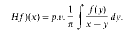
We prove that if φ ∈ H2 and (x∂x)4φ then the solution u of(BO) belongs to
 , where
 , where
On convexity properties of homogeneous functions of degree one*
-
- Journal:
- Proceedings of the Royal Society of Edinburgh. Section A: Mathematics / Volume 126 / Issue 5 / 1996
- Published online by Cambridge University Press:
- 14 November 2011, pp. 947-956
- Print publication:
- 1996
-
- Article
- Export citation
Exponential formulae in quantum stochastic calculus
-
- Journal:
- Proceedings of the Royal Society of Edinburgh. Section A: Mathematics / Volume 126 / Issue 2 / 1996
- Published online by Cambridge University Press:
- 14 November 2011, pp. 375-389
- Print publication:
- 1996
-
- Article
- Export citation
The Cauchy problem for the system of Zakharov equations arising from ion-acoustic modes
-
- Journal:
- Proceedings of the Royal Society of Edinburgh. Section A: Mathematics / Volume 126 / Issue 4 / 1996
- Published online by Cambridge University Press:
- 14 November 2011, pp. 811-820
- Print publication:
- 1996
-
- Article
- Export citation
Cauchy problem for hyperbolic conservation laws with a relaxation term
-
- Journal:
- Proceedings of the Royal Society of Edinburgh. Section A: Mathematics / Volume 126 / Issue 4 / 1996
- Published online by Cambridge University Press:
- 14 November 2011, pp. 821-828
- Print publication:
- 1996
-
- Article
- Export citation
-
This paper considers the Cauchy problem for hyperbolic conservation laws arising in chromatography:
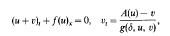
with bounded measurable initial data, where the relaxation term g(δ, u, v) converges to zero as the parameter δ > 0 tends to zero. We show that a solution of the equilibrium equation

is given by the limit of the solutions of the viscous approximation

of the original system as the dissipation ε and the relaxation δ go to zero related by δ = O(ε). The proof of convergence is obtained by a simplified method of compensated compactness [2], avoiding Young measures by using the weak continuity theorem (3.3) of two by two determinants.
Resolution of the spherical piston problem for compressible isentropic gas dynamics via a self-similar viscous limit
-
- Journal:
- Proceedings of the Royal Society of Edinburgh. Section A: Mathematics / Volume 126 / Issue 6 / 1996
- Published online by Cambridge University Press:
- 14 November 2011, pp. 1309-1340
- Print publication:
- 1996
-
- Article
- Export citation
-
This paper proves the existence of solutions to the spherical piston problem for isentropic gas dynamics with equation of state p(p) = Apγ, γ≧ 1. The method of analysis is to replace the usual viscosity ε with εt, thus permitting a search for self-similar viscous limits. The main result of the paper is that self-similar viscous limits are proved to exist and converge to a solution to the piston problem when
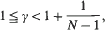
N = 1, 2, 3 space dimensions.
Commutative orders
-
- Journal:
- Proceedings of the Royal Society of Edinburgh. Section A: Mathematics / Volume 126 / Issue 6 / 1996
- Published online by Cambridge University Press:
- 14 November 2011, pp. 1201-1216
- Print publication:
- 1996
-
- Article
- Export citation
Multiple positive solutions of nonhomogeneous semilinear elliptic equations in ℝN*
-
- Journal:
- Proceedings of the Royal Society of Edinburgh. Section A: Mathematics / Volume 126 / Issue 2 / 1996
- Published online by Cambridge University Press:
- 14 November 2011, pp. 443-463
- Print publication:
- 1996
-
- Article
- Export citation
-
We consider the following problem

where for all ≦f(x,u)≦c1up-1 + c2u for all x ∈ℝN,u≧0 with c1>0,c2∈(0, 1), 2<p<(2N/(N – 2)) if N ≧ 3, 2 ≧ + ∝ if N = 2. We prove that (*) has at least two positive solutions if
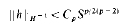
and h≩0 in ℝN, where S is the best Sobolev constant and

The Penrose–Fife-type equations: counting the one-dimensional stationary solutions
-
- Journal:
- Proceedings of the Royal Society of Edinburgh. Section A: Mathematics / Volume 126 / Issue 3 / 1996
- Published online by Cambridge University Press:
- 14 November 2011, pp. 483-504
- Print publication:
- 1996
-
- Article
- Export citation
Heat invariants for odd-dimensional hemispheres
-
- Journal:
- Proceedings of the Royal Society of Edinburgh. Section A: Mathematics / Volume 126 / Issue 1 / 1996
- Published online by Cambridge University Press:
- 14 November 2011, pp. 187-193
- Print publication:
- 1996
-
- Article
- Export citation
