Refine search
Actions for selected content:
26077 results in Abstract analysis
Symmetry and convergence properties for non-negative solutions of nonautonomous reaction–diffusion problems
-
- Journal:
- Proceedings of the Royal Society of Edinburgh. Section A: Mathematics / Volume 124 / Issue 3 / 1994
- Published online by Cambridge University Press:
- 14 November 2011, pp. 573-587
- Print publication:
- 1994
-
- Article
- Export citation
Rearrangements of functions on unbounded domains
-
- Journal:
- Proceedings of the Royal Society of Edinburgh. Section A: Mathematics / Volume 124 / Issue 4 / 1994
- Published online by Cambridge University Press:
- 14 November 2011, pp. 621-644
- Print publication:
- 1994
-
- Article
- Export citation
Harmonic maps from noncompact Riemannian manifolds with non-negative Ricci curvature outside a compact set
-
- Journal:
- Proceedings of the Royal Society of Edinburgh. Section A: Mathematics / Volume 124 / Issue 6 / 1994
- Published online by Cambridge University Press:
- 14 November 2011, pp. 1259-1275
- Print publication:
- 1994
-
- Article
- Export citation
PRM volume 124 issue 3 Cover and Front matter
-
- Journal:
- Proceedings of the Royal Society of Edinburgh. Section A: Mathematics / Volume 124 / Issue 3 / 1994
- Published online by Cambridge University Press:
- 14 November 2011, pp. f1-f2
- Print publication:
- 1994
-
- Article
-
- You have access
- Export citation
On the fixpoints of composite entire functions of finite order
-
- Journal:
- Proceedings of the Royal Society of Edinburgh. Section A: Mathematics / Volume 124 / Issue 5 / 1994
- Published online by Cambridge University Press:
- 14 November 2011, pp. 995-1001
- Print publication:
- 1994
-
- Article
- Export citation
Integral maximum principle and its applications
-
- Journal:
- Proceedings of the Royal Society of Edinburgh. Section A: Mathematics / Volume 124 / Issue 2 / 1994
- Published online by Cambridge University Press:
- 14 November 2011, pp. 353-362
- Print publication:
- 1994
-
- Article
- Export citation
Localising and seminormal composition operators on L2
-
- Journal:
- Proceedings of the Royal Society of Edinburgh. Section A: Mathematics / Volume 124 / Issue 2 / 1994
- Published online by Cambridge University Press:
- 14 November 2011, pp. 301-316
- Print publication:
- 1994
-
- Article
- Export citation
M-function behaviour for a periodic Dirac system
-
- Journal:
- Proceedings of the Royal Society of Edinburgh. Section A: Mathematics / Volume 124 / Issue 1 / 1994
- Published online by Cambridge University Press:
- 14 November 2011, pp. 149-159
- Print publication:
- 1994
-
- Article
- Export citation
Blow-up for quasilinear heat equations with critical Fujita's exponents
-
- Journal:
- Proceedings of the Royal Society of Edinburgh. Section A: Mathematics / Volume 124 / Issue 3 / 1994
- Published online by Cambridge University Press:
- 14 November 2011, pp. 517-525
- Print publication:
- 1994
-
- Article
- Export citation
-
We consider the Cauchy problem for the quasilinear heat equation

where σ > 0 is a fixed constant, with the critical exponent in the source term β = βc = σ + 1 + 2/N. It is well-known that if β ∈(1,βc) then any non-negative weak solution u(x, t)≢0 blows up in a finite time. For the semilinear heat equation (HE) with σ = 0, the above result was proved by H. Fujita [4].
In the present paper we prove that u ≢ 0 blows up in the critical case β = σ + 1 + 2/N with σ > 0. A similar result is valid for the equation with gradient-dependent diffusivity

with σ > 0, and the critical exponent β = σ + 1 + (σ + 2)/N.
Poincaré–Bendixson theory for certain reaction–diffusion boundary-value problems
-
- Journal:
- Proceedings of the Royal Society of Edinburgh. Section A: Mathematics / Volume 124 / Issue 1 / 1994
- Published online by Cambridge University Press:
- 14 November 2011, pp. 33-69
- Print publication:
- 1994
-
- Article
- Export citation
Products of nilpotent linear transformations
-
- Journal:
- Proceedings of the Royal Society of Edinburgh. Section A: Mathematics / Volume 124 / Issue 6 / 1994
- Published online by Cambridge University Press:
- 14 November 2011, pp. 1135-1150
- Print publication:
- 1994
-
- Article
- Export citation
Elliptic solutions and blow-up in an integrable Hénon–Heiles system
-
- Journal:
- Proceedings of the Royal Society of Edinburgh. Section A: Mathematics / Volume 124 / Issue 6 / 1994
- Published online by Cambridge University Press:
- 14 November 2011, pp. 1151-1164
- Print publication:
- 1994
-
- Article
- Export citation
Homogenisation of two-phase emulsions
-
- Journal:
- Proceedings of the Royal Society of Edinburgh. Section A: Mathematics / Volume 124 / Issue 6 / 1994
- Published online by Cambridge University Press:
- 14 November 2011, pp. 1119-1134
- Print publication:
- 1994
-
- Article
- Export citation
Time-dependent solutions of the Navier–Stokes equations for spatially-uniform velocity gradients
-
- Journal:
- Proceedings of the Royal Society of Edinburgh. Section A: Mathematics / Volume 124 / Issue 1 / 1994
- Published online by Cambridge University Press:
- 14 November 2011, pp. 127-136
- Print publication:
- 1994
-
- Article
- Export citation
PRM volume 124 issue 1 Cover and Front matter
-
- Journal:
- Proceedings of the Royal Society of Edinburgh. Section A: Mathematics / Volume 124 / Issue 1 / 1994
- Published online by Cambridge University Press:
- 14 November 2011, pp. f1-f2
- Print publication:
- 1994
-
- Article
-
- You have access
- Export citation
On the uniqueness of arithmetic structures
-
- Journal:
- Proceedings of the Royal Society of Edinburgh. Section A: Mathematics / Volume 124 / Issue 5 / 1994
- Published online by Cambridge University Press:
- 14 November 2011, pp. 1037-1044
- Print publication:
- 1994
-
- Article
- Export citation
28 real bitangents: Dedicated to Ian Porteus
-
- Journal:
- Proceedings of the Royal Society of Edinburgh. Section A: Mathematics / Volume 124 / Issue 4 / 1994
- Published online by Cambridge University Press:
- 14 November 2011, pp. 729-736
- Print publication:
- 1994
-
- Article
- Export citation
Multiple homoclinic orbits for autonomous, singular potentials
-
- Journal:
- Proceedings of the Royal Society of Edinburgh. Section A: Mathematics / Volume 124 / Issue 4 / 1994
- Published online by Cambridge University Press:
- 14 November 2011, pp. 785-802
- Print publication:
- 1994
-
- Article
- Export citation
-
We consider the problem
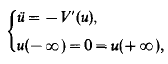
where u ∊ Rn, n ≧ 2, and V ∊ C2(Rn∖e, R) is a potential having an absolute maximum at 0 and such that V(x) → − ∞ as x → e. We prove that, under some conditions on V, this problem has at least n − 1 geometrically distinct solutions.
Relaxation of quasi-convex integrals of arbitrary order
-
- Journal:
- Proceedings of the Royal Society of Edinburgh. Section A: Mathematics / Volume 124 / Issue 5 / 1994
- Published online by Cambridge University Press:
- 14 November 2011, pp. 927-946
- Print publication:
- 1994
-
- Article
- Export citation
Invariant algebraic curves and conditions for a centre
-
- Journal:
- Proceedings of the Royal Society of Edinburgh. Section A: Mathematics / Volume 124 / Issue 6 / 1994
- Published online by Cambridge University Press:
- 14 November 2011, pp. 1209-1229
- Print publication:
- 1994
-
- Article
- Export citation
