Refine search
Actions for selected content:
26077 results in Abstract analysis
PRM volume 124 issue 1 Cover and Back matter
-
- Journal:
- Proceedings of the Royal Society of Edinburgh. Section A: Mathematics / Volume 124 / Issue 1 / 1994
- Published online by Cambridge University Press:
- 14 November 2011, pp. b1-b2
- Print publication:
- 1994
-
- Article
-
- You have access
- Export citation
The travelling wave fronts of nonlinear reaction–diffusion systems via Friedlin's stochastic approaches
-
- Journal:
- Proceedings of the Royal Society of Edinburgh. Section A: Mathematics / Volume 124 / Issue 2 / 1994
- Published online by Cambridge University Press:
- 14 November 2011, pp. 273-299
- Print publication:
- 1994
-
- Article
- Export citation
Linked eigenvalue problems for the p-Laplacian
-
- Journal:
- Proceedings of the Royal Society of Edinburgh. Section A: Mathematics / Volume 124 / Issue 5 / 1994
- Published online by Cambridge University Press:
- 14 November 2011, pp. 1023-1036
- Print publication:
- 1994
-
- Article
- Export citation
-
Linked equations of the form

are studied on a bounded smooth domain in RN for λ ∈ R2. Existence and uniqueness of solutions are discussed for fi homogeneous of order p – 1 in ui, generalising the ‘Klein Oscillation Theorem’ when p = 2, N = 1. Bifurcation from the principal eigenvalue is also considered for nonhomogeneous perturbations fi of order greater than p – 1.
A Poincaré–Bendixson theorem for scalar balance laws
-
- Journal:
- Proceedings of the Royal Society of Edinburgh. Section A: Mathematics / Volume 124 / Issue 3 / 1994
- Published online by Cambridge University Press:
- 14 November 2011, pp. 589-607
- Print publication:
- 1994
-
- Article
- Export citation
-
We study the dynamical behaviour, as t → ∞, of admissible weak solutions of the scalar balance law

with x ∊ ≡ ℝ/Lℤ, L > 0, 0 < t < ∞, and f(·) ∊ C2, g(·) ∊ C1. We assume that f(·) is strictly convex, while g(·) is of at most linear growth, has finitely many zeros and changes sign across them. We show that, if u(·,t) stays bounded in L∞(S1), as t → ∞, then it either converges to a constant state or approaches asymptotically a rotating wave, i.e. an admissible weak solution of (1.1) of the form ũ(x − ct), c ∈ ℝ. Hence, the asymptotic state of every bounded solution of (1.1) consists precisely of either an equilibrium or one time-periodic solution. Furthermore, each one of these two alternatives is characterised by the Conley indices of the critical points of the ordinary differential equation
 .
.
 .
.Cesàro averaging operators
-
- Journal:
- Proceedings of the Royal Society of Edinburgh. Section A: Mathematics / Volume 124 / Issue 1 / 1994
- Published online by Cambridge University Press:
- 14 November 2011, pp. 121-126
- Print publication:
- 1994
-
- Article
- Export citation
-
We define a family of Cesàro operators
 , Reα≧0, and consider the question of their boundedness on Hp spaces. We also consider discrete versions of these operators acting on sequence spaces.
 , Reα≧0, and consider the question of their boundedness on H
Anisotropic singular perturbations—the vectorial case
-
- Journal:
- Proceedings of the Royal Society of Edinburgh. Section A: Mathematics / Volume 124 / Issue 3 / 1994
- Published online by Cambridge University Press:
- 14 November 2011, pp. 527-571
- Print publication:
- 1994
-
- Article
- Export citation
-
We obtain the Γ(L1(Ώ))-limit of the sequence
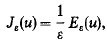
where Eε is the family of anisotropic perturbations

of the nonconvex functional of vector-valued functions
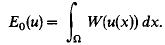
The proof relies on the blow-up argument introduced by Fonseca and Müller.
On the absolutely continuous spectrum of a vector-matrix Dirac system
-
- Journal:
- Proceedings of the Royal Society of Edinburgh. Section A: Mathematics / Volume 124 / Issue 2 / 1994
- Published online by Cambridge University Press:
- 14 November 2011, pp. 253-262
- Print publication:
- 1994
-
- Article
- Export citation
Collocation methods for second-kind Volterra integral equations with weakly singular kernels
-
- Journal:
- Proceedings of the Royal Society of Edinburgh. Section A: Mathematics / Volume 124 / Issue 2 / 1994
- Published online by Cambridge University Press:
- 14 November 2011, pp. 199-210
- Print publication:
- 1994
-
- Article
- Export citation
Decay of solutions of a higher order multidimensional nonlinear Korteweg–de Vries–Burgers system
-
- Journal:
- Proceedings of the Royal Society of Edinburgh. Section A: Mathematics / Volume 124 / Issue 2 / 1994
- Published online by Cambridge University Press:
- 14 November 2011, pp. 263-271
- Print publication:
- 1994
-
- Article
- Export citation
Modelling the effective conductivity function of an arbitrary two–dimensional polycrystal using sequential laminates
-
- Journal:
- Proceedings of the Royal Society of Edinburgh. Section A: Mathematics / Volume 124 / Issue 4 / 1994
- Published online by Cambridge University Press:
- 14 November 2011, pp. 757-783
- Print publication:
- 1994
-
- Article
- Export citation
Necessary and sufficient conditions for optimal controls in viscous flow problems
-
- Journal:
- Proceedings of the Royal Society of Edinburgh. Section A: Mathematics / Volume 124 / Issue 2 / 1994
- Published online by Cambridge University Press:
- 14 November 2011, pp. 211-251
- Print publication:
- 1994
-
- Article
- Export citation
Switched diffusion processes and systems of elliptic equations: a Dirichlet space approach
-
- Journal:
- Proceedings of the Royal Society of Edinburgh. Section A: Mathematics / Volume 124 / Issue 4 / 1994
- Published online by Cambridge University Press:
- 14 November 2011, pp. 673-701
- Print publication:
- 1994
-
- Article
- Export citation
PRM volume 124 issue 4 Cover and Front matter
-
- Journal:
- Proceedings of the Royal Society of Edinburgh. Section A: Mathematics / Volume 124 / Issue 4 / 1994
- Published online by Cambridge University Press:
- 14 November 2011, pp. f1-f2
- Print publication:
- 1994
-
- Article
-
- You have access
- Export citation
On a class of semilinear elliptic systems
-
- Journal:
- Proceedings of the Royal Society of Edinburgh. Section A: Mathematics / Volume 124 / Issue 3 / 1994
- Published online by Cambridge University Press:
- 14 November 2011, pp. 609-620
- Print publication:
- 1994
-
- Article
- Export citation
PRM volume 124 issue 4 Cover and Back matter
-
- Journal:
- Proceedings of the Royal Society of Edinburgh. Section A: Mathematics / Volume 124 / Issue 4 / 1994
- Published online by Cambridge University Press:
- 14 November 2011, pp. b1-b2
- Print publication:
- 1994
-
- Article
-
- You have access
- Export citation
A necessary and sufficient condition for nonattainment and formation of microstructure almost everywhere in scalar variational problems
-
- Journal:
- Proceedings of the Royal Society of Edinburgh. Section A: Mathematics / Volume 124 / Issue 3 / 1994
- Published online by Cambridge University Press:
- 14 November 2011, pp. 437-471
- Print publication:
- 1994
-
- Article
- Export citation
-
For scalar variational problems
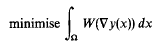
subject to linear boundary values, we determine completely those integrands W: ℝn → ℝ for which the minimum is not attained, thereby completing previous efforts such as a recent nonexistence theorem of Chipot [9] and unifying a large number of examples and counterexamples in the literature.
As a corollary, we show that in case of nonattainment (and provided W grows superlinearly at infinity), every minimising sequence converges weakly but not strongly in W1,1(Ω) to a unique limit, namely the linear deformation prescribed at the boundary, and develops fine structure everywhere in Ω, that is to say every Young measure associated with the sequence of its gradients is almost-nowhere a Dirac mass.
Connections with solid–solid phase transformations are indicated.
The thermistor problem with conductivity vanishing for large temperature
-
- Journal:
- Proceedings of the Royal Society of Edinburgh. Section A: Mathematics / Volume 124 / Issue 1 / 1994
- Published online by Cambridge University Press:
- 14 November 2011, pp. 1-21
- Print publication:
- 1994
-
- Article
- Export citation
Idempotent depth in semigroups of order-preserving mappings
-
- Journal:
- Proceedings of the Royal Society of Edinburgh. Section A: Mathematics / Volume 124 / Issue 5 / 1994
- Published online by Cambridge University Press:
- 14 November 2011, pp. 1045-1058
- Print publication:
- 1994
-
- Article
- Export citation
Point interactions on bounded domains
-
- Journal:
- Proceedings of the Royal Society of Edinburgh. Section A: Mathematics / Volume 124 / Issue 5 / 1994
- Published online by Cambridge University Press:
- 14 November 2011, pp. 917-926
- Print publication:
- 1994
-
- Article
- Export citation
-
The Laplacian operator Δ on a bounded domain Ω in ℝn containing 0, with Dirichlet boundary condition, is perturbed by a pseudopotential δ, the Dirac measure at 0. Such a perturbation will be defined in Lp(ℝ) for n = 2, 1 <lt; p < ∞, and for n = 3
 , < p < 3, and is shown to be the generator of an analytic semigroup. Thus solutions of the corresponding evolutionary system are well defined. The necessary estimates involve the Gagliardo– Nirenberg inequality and the Kato inequality.
 , < p < 3, and is shown to be the generator of an analytic semigroup. Thus solutions of the corresponding evolutionary system are well defined. The necessary estimates involve the Gagliardo– Nirenberg inequality and the Kato inequality.
The interaction between bulk energy and surface energy in multiple integrals
-
- Journal:
- Proceedings of the Royal Society of Edinburgh. Section A: Mathematics / Volume 124 / Issue 4 / 1994
- Published online by Cambridge University Press:
- 14 November 2011, pp. 737-756
- Print publication:
- 1994
-
- Article
- Export citation
-
This paper is devoted to the study of integral functional denned on the space SBV(Ω ℝk) of vector-valued special functions with bounded variation on the open set Ω⊂ℝn, of the form

We suppose only that f is finite at one point, and that g is positively 1-homogeneous and locally bounded on the sets ℝk⊗vm, where {v1,…, vR} ⊂ Sn−1 is a basis of ℝn. We prove that the lower semicontinuous envelope of F in the L1(Ω;ℝk)-topology is finite and with linear growth on the whole BV(Ω;ℝk), and that it admits the integral representation

A formula for ϕ is given, which takes into account the interaction between the bulk energy density f and the surface energy density g.
