Refine search
Actions for selected content:
26077 results in Abstract analysis
On the frequency distribution of partial quotients of U-numbers
- Part of
-
- Journal:
- Mathematika / Volume 40 / Issue 2 / December 1993
- Published online by Cambridge University Press:
- 26 February 2010, pp. 215-225
- Print publication:
- December 1993
-
- Article
- Export citation
-
In Mahler's classification of complex numbers [10] (see [4]), a transcendental number ξ is called a U-number if there exists a fixed integer N ≥ 1 so that for all ω > 0, there exists a polynomial
 so that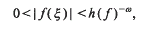
where the height h(f) = max {|α0|, |α1|, …, |αN|}. The number ξ is called a Um-number if the above holds for N = m but for no smaller value of N (examples and further details may be found in [9,1 and 2]). Thus the set of U1-numbers is precisely the set of Liouville numbers. In this paper we investigate the statistical behavior of the partial quotients of real U-numbers, in particular, U2-numbers. In addition, we demonstrate the existence of a U2-number with the property that if it is translated by any nonnegative integer and then squared, the result is a Liouville number. Related results involving badly approximate U2-numbers are also discussed.
 so that
Estimates of spherial averages of Fourier transforms and dimensions of sets
- Part of
-
- Journal:
- Mathematika / Volume 40 / Issue 2 / December 1993
- Published online by Cambridge University Press:
- 26 February 2010, pp. 322-330
- Print publication:
- December 1993
-
- Article
- Export citation
-
Let ℳ denote the class of all finite positive Borel measures μ in Rn with compact support. We define the Fourier transform of μεℳ by writing
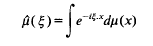
and the α-energy of μ is given by

Determination of convex bodies by their brightness functions
- Part of
-
- Journal:
- Mathematika / Volume 40 / Issue 2 / December 1993
- Published online by Cambridge University Press:
- 26 February 2010, pp. 161-168
- Print publication:
- December 1993
-
- Article
- Export citation
Sums and differences of quartic norms
- Part of
-
- Journal:
- Mathematika / Volume 40 / Issue 2 / December 1993
- Published online by Cambridge University Press:
- 26 February 2010, pp. 233-245
- Print publication:
- December 1993
-
- Article
- Export citation
-
Let K be a number field of degree k > 1. We would like to know if a positive integer N can be represented as the sum, or the difference, of two norms of integral ideals of K. Suppose K/ℚ is abelian of conductor Δ. Then from the class field theory (Artin's reciprocity law) the norms are fully characterized by the residue classes modulo Δ. Precisely, a prime number p ∤ Δ (unramified in K) is a norm (splits completely in K), if, and only if,

where k is a subgroup of (ℤ/Δℤ)* of index k. Accordingly we may ask N to be represented as the sum

or the difference

of positive integers a, b each of which splits completely in K. For N to be represented in these ways the following congruences

must be solvable in α β є k, respectively. Moreover the condition

must hold. Presumably the above local conditions are sufficient for (−) to have infinitely many solutions and for (+) to have arbitrarily many solutions, provided N is sufficiently large in the latter case.
A short algebraic proof of a theorem of Warfield
-
- Journal:
- Mathematika / Volume 40 / Issue 2 / December 1993
- Published online by Cambridge University Press:
- 26 February 2010, pp. 275-277
- Print publication:
- December 1993
-
- Article
- Export citation
The volume of the intersection of a convex body with its translates
- Part of
-
- Journal:
- Mathematika / Volume 40 / Issue 2 / December 1993
- Published online by Cambridge University Press:
- 26 February 2010, pp. 278-289
- Print publication:
- December 1993
-
- Article
- Export citation
Index to Volume 31–40
-
- Journal:
- Mathematika / Volume 40 / Issue 2 / December 1993
- Published online by Cambridge University Press:
- 26 February 2010, pp. 383-391
- Print publication:
- December 1993
-
- Article
- Export citation
87 - Will a Brownian motion return?
-
- Book:
- Exercises in Fourier Analysis
- Published online:
- 05 August 2012
- Print publication:
- 19 August 1993, pp 313-313
-
- Chapter
- Export citation
54 - Lord Kelvin
-
- Book:
- Exercises in Fourier Analysis
- Published online:
- 05 August 2012
- Print publication:
- 19 August 1993, pp 211-211
-
- Chapter
- Export citation
Preface
-
- Book:
- Exercises in Fourier Analysis
- Published online:
- 05 August 2012
- Print publication:
- 19 August 1993, pp ix-x
-
- Chapter
- Export citation
105 - A formula of Euler
-
- Book:
- Exercises in Fourier Analysis
- Published online:
- 05 August 2012
- Print publication:
- 19 August 1993, pp 347-348
-
- Chapter
- Export citation
82 - Haldane on fraud
-
- Book:
- Exercises in Fourier Analysis
- Published online:
- 05 August 2012
- Print publication:
- 19 August 1993, pp 310-310
-
- Chapter
- Export citation
50 - Sums of independent random variables
-
- Book:
- Exercises in Fourier Analysis
- Published online:
- 05 August 2012
- Print publication:
- 19 August 1993, pp 197-198
-
- Chapter
- Export citation
13 - Monte Carlo methods
-
- Book:
- Exercises in Fourier Analysis
- Published online:
- 05 August 2012
- Print publication:
- 19 August 1993, pp 51-52
-
- Chapter
- Export citation
References
-
- Book:
- Duality and Perturbation Methods in Critical Point Theory
- Published online:
- 18 December 2009
- Print publication:
- 19 August 1993, pp 246-253
-
- Chapter
- Export citation
30 - An example of Hadamard
-
- Book:
- Exercises in Fourier Analysis
- Published online:
- 05 August 2012
- Print publication:
- 19 August 1993, pp 111-113
-
- Chapter
- Export citation
Frontmatter
-
- Book:
- Duality and Perturbation Methods in Critical Point Theory
- Published online:
- 18 December 2009
- Print publication:
- 19 August 1993, pp i-vi
-
- Chapter
- Export citation
55 - The heat equation
-
- Book:
- Exercises in Fourier Analysis
- Published online:
- 05 August 2012
- Print publication:
- 19 August 1993, pp 212-215
-
- Chapter
- Export citation
45 - Tchebychev and uniform approximation II
-
- Book:
- Exercises in Fourier Analysis
- Published online:
- 05 August 2012
- Print publication:
- 19 August 1993, pp 179-189
-
- Chapter
- Export citation
64 - The wave equation
-
- Book:
- Exercises in Fourier Analysis
- Published online:
- 05 August 2012
- Print publication:
- 19 August 1993, pp 245-245
-
- Chapter
- Export citation
