Refine search
Actions for selected content:
26077 results in Abstract analysis
On the asphericity of one-relator relative presentations
-
- Journal:
- Proceedings of the Royal Society of Edinburgh. Section A: Mathematics / Volume 124 / Issue 4 / 1994
- Published online by Cambridge University Press:
- 14 November 2011, pp. 713-728
- Print publication:
- 1994
-
- Article
- Export citation
Projective modules of finite groups with elementary abelian Sylow 3-subgroups of order 9 in characteristic 3
-
- Journal:
- Proceedings of the Royal Society of Edinburgh. Section A: Mathematics / Volume 124 / Issue 1 / 1994
- Published online by Cambridge University Press:
- 14 November 2011, pp. 161-168
- Print publication:
- 1994
-
- Article
- Export citation
Multiple solutions for nonhomogeneous elliptic equations involving critical Sobolev exponent*
-
- Journal:
- Proceedings of the Royal Society of Edinburgh. Section A: Mathematics / Volume 124 / Issue 6 / 1994
- Published online by Cambridge University Press:
- 14 November 2011, pp. 1177-1191
- Print publication:
- 1994
-
- Article
- Export citation
-
We consider the following problem:

where
 is continuous on RN and h(x)≢0. By using Ekeland's variational principle and the Mountain Pass Theorem without (PS) conditions, through a careful inspection of the energy balance for the approximated solutions, we show that the probelm (*) has at least two solutions for some λ* > 0 and λ ∈ (0, λ*). In particular, if p = 2, in a different way we prove that problem (*) with λ ≡ 1 and h(x) ≧ 0 has at least two positive solutions as
 is continuous on R
Global branches of positive weak solutions of semilinear elliptic problems over nonsmooth domains
-
- Journal:
- Proceedings of the Royal Society of Edinburgh. Section A: Mathematics / Volume 124 / Issue 2 / 1994
- Published online by Cambridge University Press:
- 14 November 2011, pp. 371-388
- Print publication:
- 1994
-
- Article
- Export citation
Positive solutions for a class of nonpositone problems with concave nonlinearities
-
- Journal:
- Proceedings of the Royal Society of Edinburgh. Section A: Mathematics / Volume 124 / Issue 3 / 1994
- Published online by Cambridge University Press:
- 14 November 2011, pp. 507-515
- Print publication:
- 1994
-
- Article
- Export citation
-
We consider the bifurcation of positive solutions of the two-point boundary value problem
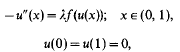
where λ> 0 is a real bifurcation parameter, and f ∊ C2 satisfies (fl) f(0) < 0, (f2) f′(s) > 0 for s > 0, (f3) f″(s) < 0 for s > 0 and (f4) limS→+∞f(s) = M where 0 < M ≦+∞. This problem has been studied by Casto and Shivaji under two additional hypotheses (f5) lims→+∞sf′(s) = 0, and (f6)f(θ)/θ < f′(θ), where θ is a positive number satisfying
 Assuming (fl)−(f6), Castro and Shivaji obtain some existence and nonexistence results and hence partial information on the bifurcation diagram, and they conjecture that this problem has at most two positive solutions. We prove this conjecture. Furthermore, we are able to generalise and improve their results under hypotheses (fl)−(f4). As a corollary, we show that there exists μ1 > 0 such that there exist no positive solutions for 0 <λ <μ1 and at most two positive solutions for μ1≦λ< + ∞, which improves a result of Brunovsky and Chow.
 Assuming (fl)−(f6), Castro and Shivaji obtain some existence and nonexistence results and hence partial information on the bifurcation diagram, and they conjecture that this problem has at most two positive solutions. We prove this conjecture. Furthermore, we are able to generalise and improve their results under hypotheses (fl)−(f4). As a corollary, we show that there exists μ
The Hausdorff dimension of systems of simultaneously small linear forms
- Part of
-
- Journal:
- Mathematika / Volume 40 / Issue 2 / December 1993
- Published online by Cambridge University Press:
- 26 February 2010, pp. 367-374
- Print publication:
- December 1993
-
- Article
- Export citation
-
In this paper the Hausdorff dimension of systems of real linear forms which are simultaneously small for infinitely many integer vectors is determined. A system of real linear forms,

where ai, xij∈ℝ, 1 ≤i≤m, 1≤j≤n will be denoted more concisely as

where a∈⇝m, X∈ℝmn and ℝmn is identified with Mm × n(ℝ), the set of real m × n matrices. The supremum norm
 of any vector in k dimensional Euclidean space, ℝk will be denoted by |v|. The distance of a point a from a set B, will be denoted by dist (a, B) = inf {|a − b|: b ∈ B}.
 of any vector in k dimensional Euclidean space, ℝ
Index to Volume 40
-
- Journal:
- Mathematika / Volume 40 / Issue 2 / December 1993
- Published online by Cambridge University Press:
- 26 February 2010, pp. 381-382
- Print publication:
- December 1993
-
- Article
- Export citation
Eccentric oscillations of a circular cylinder in a viscous fluid
- Part of
-
- Journal:
- Mathematika / Volume 40 / Issue 2 / December 1993
- Published online by Cambridge University Press:
- 26 February 2010, pp. 187-202
- Print publication:
- December 1993
-
- Article
- Export citation
Toeplitz and Hankel type operators on Bergman space
- Part of
-
- Journal:
- Mathematika / Volume 40 / Issue 2 / December 1993
- Published online by Cambridge University Press:
- 26 February 2010, pp. 345-356
- Print publication:
- December 1993
-
- Article
- Export citation
MTK volume 40 issue 2 Cover and Front matter
-
- Journal:
- Mathematika / Volume 40 / Issue 2 / December 1993
- Published online by Cambridge University Press:
- 26 February 2010, pp. f1-f2
- Print publication:
- December 1993
-
- Article
-
- You have access
- Export citation
Smooth bump functions and geomentry of Banach spaces
- Part of
-
- Journal:
- Mathematika / Volume 40 / Issue 2 / December 1993
- Published online by Cambridge University Press:
- 26 February 2010, pp. 305-321
- Print publication:
- December 1993
-
- Article
- Export citation
A variant of Moore's uniqueness of reciprocity laws
- Part of
-
- Journal:
- Mathematika / Volume 40 / Issue 2 / December 1993
- Published online by Cambridge University Press:
- 26 February 2010, pp. 246-255
- Print publication:
- December 1993
-
- Article
- Export citation
Central sets in commutative semigroups and partition regularity of systems of linear equations
- Part of
-
- Journal:
- Mathematika / Volume 40 / Issue 2 / December 1993
- Published online by Cambridge University Press:
- 26 February 2010, pp. 169-186
- Print publication:
- December 1993
-
- Article
- Export citation
-
Given a commutative semigroup (S, +) with identity 0 and u × v matrices A and B with nonnegative integers as entries, we show that if C = A – B satisfies Rado's columns condition over ℤ, then any central set in S contains solutions to the system of equations
 . In particular, the system of equations is then partition regular. Restricting our attention to the multiplicative semigroup of positive integers (so that coefficients become exponents) we show that the columns condition over ℤ is also necessary for the existence of solutions in any central set (while the distinct notion of the columns condition over Q is necessary and sufficient for partition regularity over ℕ\{1}).
 . In particular, the system of equations
 A sharp inequality related to Moser's inequality
- Part of
-
- Journal:
- Mathematika / Volume 40 / Issue 2 / December 1993
- Published online by Cambridge University Press:
- 26 February 2010, pp. 357-366
- Print publication:
- December 1993
-
- Article
- Export citation
-
In this paper we shall be concerned with the growth of functions in the class ℳp, where we write f ∈ ℳp 1 <p<∞, if:
(i) f is absolutely continuous on bounded subintervals of [0, ∞]);
(ii) f(0) = 0; and
(iii)
 .
.
 .
.About four-ball packings
- Part of
-
- Journal:
- Mathematika / Volume 40 / Issue 2 / December 1993
- Published online by Cambridge University Press:
- 26 February 2010, pp. 226-232
- Print publication:
- December 1993
-
- Article
- Export citation
Decomposition of sets of small or large boundary
- Part of
-
- Journal:
- Mathematika / Volume 40 / Issue 2 / December 1993
- Published online by Cambridge University Press:
- 26 February 2010, pp. 290-304
- Print publication:
- December 1993
-
- Article
- Export citation
-
We shall say that the sets A, B ⊂ Rk are equivalent, if they are equidecomposable using translations; that is, if there are finite decompositions
 and vectors x1,…, xd∈Rk such that Bj = Aj + xj, (j = 1,…,d). We shall denote this fact by
  In [3], Theorem 3 we proved that if A ⊂ Rk is a bounded measurable set of positive measure then A is equivalent to a cube provided that Δ(δA)<k where δA denotes the boundary of A and Δ(E) denotes the packing dimension (or box dimension or upper entropy index) of the bounded set E. This implies, in particular, that any bounded convex set of positive measure is equivalent to a cube. C. A. Rogers asked whether or not the set
 and vectors x
 In [3], Theorem 3 we proved that if A ⊂ R
The large values of the Riemann Zeta-function
- Part of
-
- Journal:
- Mathematika / Volume 40 / Issue 2 / December 1993
- Published online by Cambridge University Press:
- 26 February 2010, pp. 203-214
- Print publication:
- December 1993
-
- Article
- Export citation
-
Let |θ| < π/2 and
 . By refining Selberg's method, we study the large values of
  as t → ∞ For σ close to ½ we obtain Ω+ estimates that are as good as those obtained previously on the Riemann Hypothesis. In particular, we show that
and

Our results supplement those of Montgomery which are good when σ > ½ is fixed.
 . By refining Selberg's method, we study the large values of
  as t → ∞ For σ close to ½ we obtain Ω
Asymptotic behaviour of orthogonal polynomials relative to measures with mass points
- Part of
-
- Journal:
- Mathematika / Volume 40 / Issue 2 / December 1993
- Published online by Cambridge University Press:
- 26 February 2010, pp. 331-344
- Print publication:
- December 1993
-
- Article
- Export citation
Left orders in Abelian regular rings
-
- Journal:
- Mathematika / Volume 40 / Issue 2 / December 1993
- Published online by Cambridge University Press:
- 26 February 2010, pp. 256-274
- Print publication:
- December 1993
-
- Article
- Export citation
A. M. Anile, J. K. Hunter, P. Pantano and G. Russo. Ray methods for nonlinear waves in fluids and plasmas. Longman. 1993, 243pp., £39. - K. Arczewski and J. Pietrucha. Mathematical Modelling of Mechanical Complex Systems. Ellis Horwood. 1993, 293 pp., £45. - T. A. Bick. Elementary Boundary Value Problems. Marcel Dekker. 1993, 264 pp., $49.75. - P. Biler and T. Nadzieja. Problems and examples in differential equations. Marcel Dekker. 1992, 264 pp., $55. - W. C. Brown. Matrices over Commutative Rings. Marcel Dekker. 1993, 281pp., $115. - B. Choudhary. The Elements of Complex Analysis. 2nd Edition. Wiley Eastern. 1992, 325 pp., 85 Rupees. - J. R. Clay. Nearrings, Geneses and Applications. Oxford University Press. 1992, 469 pp., £55. - H. Davenport. The Higher Arithmetic. 6th Edition. Cambridge University Press. 1992, 217 pp., £12·95. - G. Evans. Practical Numerical Integration. Wiley. 1993, 328 pp., £37·95. - A. Fassler and E. Stiefel. Group Theoretical Methods and their Applications. Birkhauser. 1992, 296 pp., 98SFr. - J. Fauvel, R. Flood and R. Wilson, Editors. Möbius and his Band: Mathematics and Astronomy in Nineteenth Century Germany. Oxford University Press. 1993, 172 pp., £19·50. - G. H. Hardy. A Mathematician's Apology. Cambridge University Press. 1992, 153 pp., £4·95. - B. Makarov, M. G. Goluzina, A. A. Lodkin and A. N. Podkorytov. Selected Problems in Real Analysis. American Mathematical Society, 1992, 371 pp., £78. - J. E. Marsden. Lectures on Mechanics. Cambridge University Press. 1992, 254 pp., £19.95. - D. S. Mitrinovic, J. E. Pecaric and A. M. Fink. Classical and New Inequalities in Analysis. Kluwer Academic. 1993, 740 pp., £170·50. - K. W. Morton and M. J. Baines, Editors. Numerical Methods for Fluid Dynamics III. Clarendon Press. 1988, 529 pp., £50. - J. E. Munro. Discrete Mathematics. Chapman & Hall. 1992, 306 pp., £16·95. - C. Nash. Differential Topology and Quantum Field Theory. Academic Press. 1991, 386 pp., £27. - E. R. Pinch. Optimal Control and the Calculus of Variations. Oxford University Press. 1993, 234 pp., £35. - S. C. Power. Limit Algebras: an Introduction to Subalgebras of C*-algebras. Longman Scientific & Technical. 1992, 201 pp., £23. - C. Reutenauer. Free Lie Algebras. LMS Monographs New Series, No. 7. Clarendon Press. 1993, 269 pp., £55. - H. Triebel. Higher Analysis. J. A. Barth. 1992, 473 pp., DM 148. - N. E. Wegge-Olsen. K-Theory and C*-algebras, a friendly approach. Oxford University Press. 1993, 370 pp., £35. - G. C. Wen. Conformal Mappings and boundary value problems. American Mathematical Society. 1992, 303 pp., £68. - Yau Chuen Wong. Introductory Theory of Topological Vector Spaces. Marcel Dekker. 1992, 440 pp., $59·75.
-
- Journal:
- Mathematika / Volume 40 / Issue 2 / December 1993
- Published online by Cambridge University Press:
- 26 February 2010, pp. 375-380
- Print publication:
- December 1993
-
- Article
- Export citation
