Refine search
Actions for selected content:
26080 results in Abstract analysis
20 - The undisturbed damped oscillator does not explode
-
- Book:
- Fourier Analysis
- Published online:
- 05 June 2014
- Print publication:
- 28 January 1988, pp 79-82
-
- Chapter
- Export citation
90 - La Famille Picard va á Monte Carlo
-
- Book:
- Fourier Analysis
- Published online:
- 05 June 2014
- Print publication:
- 28 January 1988, pp 467-470
-
- Chapter
- Export citation
16 - Behaviour at points of discontinuity I
-
- Book:
- Fourier Analysis
- Published online:
- 05 June 2014
- Print publication:
- 28 January 1988, pp 59-61
-
- Chapter
- Export citation
26 - A non-linear oscillator III
-
- Book:
- Fourier Analysis
- Published online:
- 05 June 2014
- Print publication:
- 28 January 1988, pp 113-115
-
- Chapter
- Export citation
Contents
-
- Book:
- Fourier Analysis
- Published online:
- 05 June 2014
- Print publication:
- 28 January 1988, pp vii-x
-
- Chapter
- Export citation
73 - Instability
-
- Book:
- Fourier Analysis
- Published online:
- 05 June 2014
- Print publication:
- 28 January 1988, pp 368-371
-
- Chapter
- Export citation
70 - The central limit theorem I
-
- Book:
- Fourier Analysis
- Published online:
- 05 June 2014
- Print publication:
- 28 January 1988, pp 349-356
-
- Chapter
- Export citation
17 - Behaviour at points of discontinuity II
-
- Book:
- Fourier Analysis
- Published online:
- 05 June 2014
- Print publication:
- 28 January 1988, pp 62-66
-
- Chapter
- Export citation
13 - Monte Carlo methods
-
- Book:
- Fourier Analysis
- Published online:
- 05 June 2014
- Print publication:
- 28 January 1988, pp 46-49
-
- Chapter
- Export citation
On perturbations of a translationally-invariant differential equation
-
- Journal:
- Proceedings of the Royal Society of Edinburgh. Section A: Mathematics / Volume 110 / Issue 1-2 / 1988
- Published online by Cambridge University Press:
- 14 November 2011, pp. 1-25
- Print publication:
- 1988
-
- Article
- Export citation
Amenability of weighted discrete convolution algebras on cancellative semigroups
-
- Journal:
- Proceedings of the Royal Society of Edinburgh. Section A: Mathematics / Volume 110 / Issue 3-4 / 1988
- Published online by Cambridge University Press:
- 14 November 2011, pp. 351-360
- Print publication:
- 1988
-
- Article
- Export citation
PRM volume 108 issue 3-4 Cover and Back matter
-
- Journal:
- Proceedings of the Royal Society of Edinburgh. Section A: Mathematics / Volume 108 / Issue 3-4 / 1988
- Published online by Cambridge University Press:
- 14 November 2011, pp. b1-b4
- Print publication:
- 1988
-
- Article
-
- You have access
- Export citation
An expansion theory for non-self-adjoint boundary-value problems
-
- Journal:
- Proceedings of the Royal Society of Edinburgh. Section A: Mathematics / Volume 108 / Issue 1-2 / 1988
- Published online by Cambridge University Press:
- 14 November 2011, pp. 11-26
- Print publication:
- 1988
-
- Article
- Export citation
Radicals and one-sided ideals: an addendum
-
- Journal:
- Proceedings of the Royal Society of Edinburgh. Section A: Mathematics / Volume 108 / Issue 1-2 / 1988
- Published online by Cambridge University Press:
- 14 November 2011, pp. 89-90
- Print publication:
- 1988
-
- Article
- Export citation
PRM volume 108 issue 1-2 Cover and Front matter
-
- Journal:
- Proceedings of the Royal Society of Edinburgh. Section A: Mathematics / Volume 108 / Issue 1-2 / 1988
- Published online by Cambridge University Press:
- 14 November 2011, pp. f1-f2
- Print publication:
- 1988
-
- Article
-
- You have access
- Export citation
On the solutions of the first boundary value problem for the linear parabolic equations
-
- Journal:
- Proceedings of the Royal Society of Edinburgh. Section A: Mathematics / Volume 108 / Issue 3-4 / 1988
- Published online by Cambridge University Press:
- 14 November 2011, pp. 339-355
- Print publication:
- 1988
-
- Article
- Export citation
On a quasilinear wave equation with nonlinear damping
-
- Journal:
- Proceedings of the Royal Society of Edinburgh. Section A: Mathematics / Volume 110 / Issue 3-4 / 1988
- Published online by Cambridge University Press:
- 14 November 2011, pp. 227-239
- Print publication:
- 1988
-
- Article
- Export citation
-
We prove the global existence and uniqueness of the solution of the initial and boundary value problem for the equation

by using the classical Galerkin method when the forcing term and the initial data are in some sense small. The asymptotic behaviour of the solution as t → ∞ is also considered.
Non-negative solutions for a class of non-positone problems
-
- Journal:
- Proceedings of the Royal Society of Edinburgh. Section A: Mathematics / Volume 108 / Issue 3-4 / 1988
- Published online by Cambridge University Press:
- 14 November 2011, pp. 291-302
- Print publication:
- 1988
-
- Article
- Export citation
-
In the recent past many results have been established on non-negative solutions to boundary value problems of the form
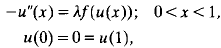
where λ>0, f(0)>0 (positone problems). In this paper we consider the impact on the non-negative solutions when f(0)<0. We find that we need f(u) to be convex to guarantee uniqueness of positive solutions, and f(u) to be appropriately concave for multiple positive solutions. This is in contrast to the case of positone problems, where the roles of convexity and concavity were interchanged to obtain similar results. We further establish the existence of non-negative solutions with interior zeros, which did not exist in positone problems.
Dynamics near a symmetric Hopf bifurcation
-
- Journal:
- Proceedings of the Royal Society of Edinburgh. Section A: Mathematics / Volume 108 / Issue 3-4 / 1988
- Published online by Cambridge University Press:
- 14 November 2011, pp. 249-267
- Print publication:
- 1988
-
- Article
- Export citation
The critical Sobolev exponent in two dimensions
-
- Journal:
- Proceedings of the Royal Society of Edinburgh. Section A: Mathematics / Volume 109 / Issue 1-2 / 1988
- Published online by Cambridge University Press:
- 14 November 2011, pp. 1-15
- Print publication:
- 1988
-
- Article
- Export citation
-
The object of the paper is to investigate solutions of equations of the form

with

and in particular to look at the asymptotic behaviour of these solutions as γ ↑∞. It is found that, if tγ is the first zero of ϑ, then

while tγ is bounded below if p < 2. This answers questions raised by Brezis concerning solutions of −Δu = eup in R2

