Refine search
Actions for selected content:
26077 results in Abstract analysis
Bounded solutions of linear periodic abstract parabolic equations
-
- Journal:
- Proceedings of the Royal Society of Edinburgh. Section A: Mathematics / Volume 110 / Issue 1-2 / 1988
- Published online by Cambridge University Press:
- 14 November 2011, pp. 135-159
- Print publication:
- 1988
-
- Article
- Export citation
Asymptotic stability criteria for delay-differential equations
-
- Journal:
- Proceedings of the Royal Society of Edinburgh. Section A: Mathematics / Volume 110 / Issue 1-2 / 1988
- Published online by Cambridge University Press:
- 14 November 2011, pp. 31-44
- Print publication:
- 1988
-
- Article
- Export citation
On the instability of non-semi-Fredholm closed operators under compact perturbations with applications to ordinary differential operators
-
- Journal:
- Proceedings of the Royal Society of Edinburgh. Section A: Mathematics / Volume 109 / Issue 1-2 / 1988
- Published online by Cambridge University Press:
- 14 November 2011, pp. 97-108
- Print publication:
- 1988
-
- Article
- Export citation
PRM volume 110 issue 1-2 Cover and Back matter
-
- Journal:
- Proceedings of the Royal Society of Edinburgh. Section A: Mathematics / Volume 110 / Issue 1-2 / 1988
- Published online by Cambridge University Press:
- 14 November 2011, pp. b1-b2
- Print publication:
- 1988
-
- Article
-
- You have access
- Export citation
On the effective elasticity of a two-dimensional homogenised incompressible elastic composite
-
- Journal:
- Proceedings of the Royal Society of Edinburgh. Section A: Mathematics / Volume 110 / Issue 1-2 / 1988
- Published online by Cambridge University Press:
- 14 November 2011, pp. 45-61
- Print publication:
- 1988
-
- Article
- Export citation
Existence and uniqueness of heteroclinic orbits for the equation λu‴ + u′ = f(u)
-
- Journal:
- Proceedings of the Royal Society of Edinburgh. Section A: Mathematics / Volume 109 / Issue 1-2 / 1988
- Published online by Cambridge University Press:
- 14 November 2011, pp. 23-36
- Print publication:
- 1988
-
- Article
- Export citation
Almost-everywhere injectivity in nonlinear elasticity
-
- Journal:
- Proceedings of the Royal Society of Edinburgh. Section A: Mathematics / Volume 109 / Issue 1-2 / 1988
- Published online by Cambridge University Press:
- 14 November 2011, pp. 79-95
- Print publication:
- 1988
-
- Article
- Export citation
-
This paper gives a sufficient condition for almost-everywhere injectivity for nonlinear three dimensional elasticity similar to that of Claret-Necas [8], namely.

We prove that this relation is maintained under the weak convergence of minimising sequences for nonlinear elasticity problems. The existence and partial regularity of an “inverse” function are proved.
PRM volume 108 issue 1-2 Cover and Back matter
-
- Journal:
- Proceedings of the Royal Society of Edinburgh. Section A: Mathematics / Volume 108 / Issue 1-2 / 1988
- Published online by Cambridge University Press:
- 14 November 2011, pp. b1-b2
- Print publication:
- 1988
-
- Article
-
- You have access
- Export citation
Uniqueness and non-uniqueness of normal forms for vector fields
-
- Journal:
- Proceedings of the Royal Society of Edinburgh. Section A: Mathematics / Volume 108 / Issue 1-2 / 1988
- Published online by Cambridge University Press:
- 14 November 2011, pp. 27-33
- Print publication:
- 1988
-
- Article
- Export citation
Some triple trigonometric series
-
- Journal:
- Proceedings of the Royal Society of Edinburgh. Section A: Mathematics / Volume 110 / Issue 3-4 / 1988
- Published online by Cambridge University Press:
- 14 November 2011, pp. 255-261
- Print publication:
- 1988
-
- Article
- Export citation
Examples for obstructions to action-angle coordinates
-
- Journal:
- Proceedings of the Royal Society of Edinburgh. Section A: Mathematics / Volume 110 / Issue 1-2 / 1988
- Published online by Cambridge University Press:
- 14 November 2011, pp. 27-30
- Print publication:
- 1988
-
- Article
- Export citation
Decomposition matrices for spin characters of symmetric groups
-
- Journal:
- Proceedings of the Royal Society of Edinburgh. Section A: Mathematics / Volume 108 / Issue 1-2 / 1988
- Published online by Cambridge University Press:
- 14 November 2011, pp. 145-164
- Print publication:
- 1988
-
- Article
- Export citation
Index to Volume 109
-
- Journal:
- Proceedings of the Royal Society of Edinburgh. Section A: Mathematics / Volume 109 / Issue 3-4 / 1988
- Published online by Cambridge University Press:
- 14 November 2011, pp. v-vi
- Print publication:
- 1988
-
- Article
- Export citation
Steady symmetric vortex pairs and rearrangements
-
- Journal:
- Proceedings of the Royal Society of Edinburgh. Section A: Mathematics / Volume 108 / Issue 3-4 / 1988
- Published online by Cambridge University Press:
- 14 November 2011, pp. 269-290
- Print publication:
- 1988
-
- Article
- Export citation
-
We prove an existence theorem for a steady planar flow of an ideal fluid, containing a bounded symmetric pair of vortices, and approaching a uniform flow at infinity. The data prescribed are the rearrangement class of the vorticity field, and either the momentum impulse of the vortex pair, or the velocity of the vortex pair relative to the fluid at infinity. The stream function ψ for the flow satisfies the semilinear elliptic equation
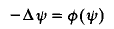
in a half-plane bounded by the line of symmetry, where φ is an increasing function that is unknown a priori. The results are proved by maximising the kinetic energy over all flows whose vorticity fields are rearrangements of a specified function.
Non-immersibility of a space form as a totally umbilical hypersurface
-
- Journal:
- Proceedings of the Royal Society of Edinburgh. Section A: Mathematics / Volume 109 / Issue 1-2 / 1988
- Published online by Cambridge University Press:
- 14 November 2011, pp. 17-21
- Print publication:
- 1988
-
- Article
- Export citation
Index to Volume 110
-
- Journal:
- Proceedings of the Royal Society of Edinburgh. Section A: Mathematics / Volume 110 / Issue 3-4 / 1988
- Published online by Cambridge University Press:
- 14 November 2011, pp. i-ii
- Print publication:
- 1988
-
- Article
- Export citation
Oscillation criteria of Nehari-type for Sturm–Liouville operators and elliptic differential operators of second order and the lower spectrum
-
- Journal:
- Proceedings of the Royal Society of Edinburgh. Section A: Mathematics / Volume 109 / Issue 1-2 / 1988
- Published online by Cambridge University Press:
- 14 November 2011, pp. 127-144
- Print publication:
- 1988
-
- Article
- Export citation
PRM volume 109 issue 3-4 Cover and Back matter
-
- Journal:
- Proceedings of the Royal Society of Edinburgh. Section A: Mathematics / Volume 109 / Issue 3-4 / 1988
- Published online by Cambridge University Press:
- 14 November 2011, pp. b1-b4
- Print publication:
- 1988
-
- Article
-
- You have access
- Export citation
A note on a paper of Atkinson concerning the asymptotics of an eigenvalue problem with interior singularity
-
- Journal:
- Proceedings of the Royal Society of Edinburgh. Section A: Mathematics / Volume 110 / Issue 1-2 / 1988
- Published online by Cambridge University Press:
- 14 November 2011, pp. 63-71
- Print publication:
- 1988
-
- Article
- Export citation
-
In [2] Atkinson considers the asymptotic form of the eigenvalues of the linear differentialequation

where a < 0 < b and y satisfies appropriate conditions at a andb. In particular Atkinson considers where q is singular at 0. In this case q(x) = xK, his results cover the case l ≦ K <
 . We extend Atkinson's results to cover more singular q, in the power case 1 ≦K <
 . We extend Atkinson's results to cover more singular q, in the power case 1 ≦K <
A system of order 2 in which small sub-harmonics and large sub-harmonics coexist
-
- Journal:
- Proceedings of the Royal Society of Edinburgh. Section A: Mathematics / Volume 108 / Issue 1-2 / 1988
- Published online by Cambridge University Press:
- 14 November 2011, pp. 35-44
- Print publication:
- 1988
-
- Article
- Export citation
-
This paper establishes the coexistence of small and large subharmonics in a special case of the ordinary non-linear differential equation

of order 2, where κ, ε are small parameters, λ>0 is a parameter independent of κ, ε, h(t) has the least period 2π and

It is divided into three sections. In Section 1 a general analysis of the periodic solutions of (.), classified into small, medium or large, is given. In Section 2 the general theory of Section 1 is applied to the special form of (.) where k = vε1+s, v>0, s>0 constants, to obtain results from which we extract in Section 2 a theorem (Section 3) on the coexistence of a small periodic solution of order 1, several small sub-harmonics and several large sub-harmonics of the special case

of (.), where Q≧1 is an integer.
