Refine search
Actions for selected content:
26078 results in Abstract analysis
Chapter III - Sub – and supermartingale convergence theorems
-
- Book:
- Stopping Time Techniques for Analysts and Probabilists
- Published online:
- 20 March 2010
- Print publication:
- 27 September 1984, pp 69-96
-
- Chapter
- Export citation
Chapter IX - Closing remarks
-
- Book:
- Stopping Time Techniques for Analysts and Probabilists
- Published online:
- 20 March 2010
- Print publication:
- 27 September 1984, pp 320-332
-
- Chapter
- Export citation
Frontmatter
-
- Book:
- An F-space Sampler
- Published online:
- 05 October 2013
- Print publication:
- 27 September 1984, pp i-iv
-
- Chapter
- Export citation
The average orders of Hooley's Δr-functions
-
- Journal:
- Mathematika / Volume 31 / Issue 1 / June 1984
- Published online by Cambridge University Press:
- 26 February 2010, pp. 98-109
- Print publication:
- June 1984
-
- Article
- Export citation
-
In this paper we are concerned with upper bounds for the sums
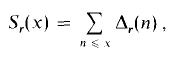
where

and Δ2(n) is written simply as Δ(n). These functions were introduced by Hooley [4] and applied in a novel way to problems related to Waring's, and in Diophantine approximation. Thus Hooley deduced from his result about S2(x) that for any irrational θ, real γ, and fixed ε > 0, the inequality

holds for infinitely many n. His result for S3(x) led to a proof that

where r8(n) denotes the number of representations of n as the sum of eight positive cubes.
The divisor function at consecutive integers
-
- Journal:
- Mathematika / Volume 31 / Issue 1 / June 1984
- Published online by Cambridge University Press:
- 26 February 2010, pp. 141-149
- Print publication:
- June 1984
-
- Article
- Export citation
Some relations connecting measures of convergence for series with non-increasing terms
- Part of
-
- Journal:
- Mathematika / Volume 31 / Issue 1 / June 1984
- Published online by Cambridge University Press:
- 26 February 2010, pp. 17-24
- Print publication:
- June 1984
-
- Article
- Export citation
-
Let an be a non-increasing real sequence such that
 converges; then clearly an ↓ 0. We shall ignore the trivial case where an = 0 for all large n, and so we assume that an > 0 for all n, from now onwards. In [1] J. B. Wilker introduced certain new sequences associated with the rate of convergence of , and obtained various relations between them, in order to investigate packing problems in convex geometry. Let us define
We write P, Q and T respectively for the inferior limits of pn, qn and tn, and P1, Q1 and T1 for the corresponding superior limits. Further, we put

It is immediately clear from these definitions and our assumptions about an that

the latter since nan → 0 by Olivier's theorem [2, p. 124].
 converges; then clearly a
An application of Siegel's formula over quaternion orders
-
- Journal:
- Mathematika / Volume 31 / Issue 1 / June 1984
- Published online by Cambridge University Press:
- 26 February 2010, pp. 12-16
- Print publication:
- June 1984
-
- Article
- Export citation
-
Let Φ : L → ℤ be a positive definite even unimodular quadratic form, L ≅ ℤn; we put f(x) = Φ(x)/2 and call (L, f) a lattice, for short. Let min f be the minimum of the numbers f(x) ≠ 0. Fixing n (a multiple of 8), one is interested in the largest possible minimum. It follows from the theory of modular forms (cf. Sloane [6]) that

On some exponential sums connected with Ramanujan's τ-function
-
- Journal:
- Mathematika / Volume 31 / Issue 1 / June 1984
- Published online by Cambridge University Press:
- 26 February 2010, pp. 150-158
- Print publication:
- June 1984
-
- Article
- Export citation
-
In a recent paper, Parson and Sheingorn [11[ gave some estimates for certain exponential sums associated with Ramanujan's τ-function and, in general, with the Fourier coefficients of the cusp forms for the full modular group which are eigenfunctions for the Hecke operators. The exponential sums considered in that paper are closely connected with the exponential sum

where α ∈ ℝ and e(θ) = e2πiθ, and the methods used in [11] go back essentially to Hardy-Littlewood [5], Hardy [4], Hecke [6], Wilton [19] and Walfisz [18].
Approximations to the temperature in a heated thermoelastic fluid
- Part of
-
- Journal:
- Mathematika / Volume 31 / Issue 1 / June 1984
- Published online by Cambridge University Press:
- 26 February 2010, pp. 47-64
- Print publication:
- June 1984
-
- Article
- Export citation
On mean values of the zeta-function
-
- Journal:
- Mathematika / Volume 31 / Issue 1 / June 1984
- Published online by Cambridge University Press:
- 26 February 2010, pp. 159-161
- Print publication:
- June 1984
-
- Article
- Export citation
-
Let
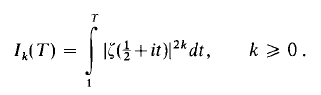
It is conjectured that for any k,
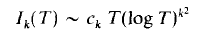
for some constant ck. It is well known that (2) holds for k = 0, 1 and 2 with c0 = 1, C1 = 1, and c2 = (2π2)-1, but there is not even a conjectural value of ck for any other k. However, it is known that the Riemann hypothesis implies
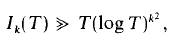
for all k ≥ 0 (see Ramachandra [2] and Heath-Brown [1]).
K-analytic sets: corrigenda et addenda
- Part of
-
- Journal:
- Mathematika / Volume 31 / Issue 1 / June 1984
- Published online by Cambridge University Press:
- 26 February 2010, pp. 28-32
- Print publication:
- June 1984
-
- Article
- Export citation
The Hausdorff distance between compact convex sets
- Part of
-
- Journal:
- Mathematika / Volume 31 / Issue 1 / June 1984
- Published online by Cambridge University Press:
- 26 February 2010, pp. 76-82
- Print publication:
- June 1984
-
- Article
- Export citation
-
It is shown that every compact convex set in
 with mean width equal to that of a line segment of length 2 and with Steiner point at the origin is contained in the unit ball. As a consequence, the diameter with respect to the Hausdorff metric of the space of all such sets is 1. There also results a sharp bound for the Hausdorff distance between any two compact convex sets.
 with mean width equal to that of a line segment of length 2 and with Steiner point at the origin is contained in the unit ball. As a consequence, the diameter with respect to the Hausdorff metric of the space of all such sets is 1. There also results a sharp bound for the Hausdorff distance between any two compact convex sets.
Two-dimensional Stokes flows with cylinders and line singularities
- Part of
-
- Journal:
- Mathematika / Volume 31 / Issue 1 / June 1984
- Published online by Cambridge University Press:
- 26 February 2010, pp. 65-75
- Print publication:
- June 1984
-
- Article
- Export citation
On certain infinite products II
-
- Journal:
- Mathematika / Volume 31 / Issue 1 / June 1984
- Published online by Cambridge University Press:
- 26 February 2010, pp. 1-11
- Print publication:
- June 1984
-
- Article
- Export citation
-
Given a sequence a(l), a(2), a(3), … of complex numbers such that a(n) ≤ 0(nc) for some c > 0, we define, for Im(z) > 0,

where q(λ) = exp (2πiz/λ), λ > 0 and a is a real number. Throughout this paper, for complex numbers x, w with x ≠ 0, xw = exp (w log x) and the principal branch is taken for the logarithm. Then it is easily verified that the infinite product converges absolutely and uniformly in every compact subset of the upper half plane H. Hence f(z) is holomorphic in H. The aim of this paper is to determine holomorphic functions in H defined by (1) which satisfy the special transformation formula

for some real number k under certain assumptions.
A construction of integral lattices
-
- Journal:
- Mathematika / Volume 31 / Issue 1 / June 1984
- Published online by Cambridge University Press:
- 26 February 2010, pp. 137-140
- Print publication:
- June 1984
-
- Article
- Export citation
MTK volume 31 issue 1 Front matter
-
- Journal:
- Mathematika / Volume 31 / Issue 1 / June 1984
- Published online by Cambridge University Press:
- 26 February 2010, pp. f1-f2
- Print publication:
- June 1984
-
- Article
-
- You have access
- Export citation
A non-Schlegelian polyhedral map on the torus
- Part of
-
- Journal:
- Mathematika / Volume 31 / Issue 1 / June 1984
- Published online by Cambridge University Press:
- 26 February 2010, pp. 83-88
- Print publication:
- June 1984
-
- Article
- Export citation
Sausage-skin problems for finite coverings
-
- Journal:
- Mathematika / Volume 31 / Issue 1 / June 1984
- Published online by Cambridge University Press:
- 26 February 2010, pp. 117-136
- Print publication:
- June 1984
-
- Article
- Export citation
-
Let
 denote the set of convex bodies of Ed, i.e. the set of all compact convex subsets of Ed. Let Bi be the unit i-ball, ωi its volume and Si-1 the unit sphere bd Bi. For an arbitrary
  denote the j-th quermassintegral (for definition and properties compare [7]). A different normalization of the functionals Wo, …, Wd leads to the intrinsic volumes Vj (which were introduced in [9]) defined by
  The intrinsic volumes are independent of the dimension of the space in which K is embedded. In particular, V0(K) = 1, Vd-1 (K) is half the surface area of K and Vd{K) = V(K) is its volume.
 denote the set of convex bodies of E
 denote the j-th quermassintegral (for definition and properties compare [7]). A different normalization of the functionals W
 The intrinsic volumes are independent of the dimension of the space in which K is embedded. In particular, V
Rings of fractional dimension
- Part of
-
- Journal:
- Mathematika / Volume 31 / Issue 1 / June 1984
- Published online by Cambridge University Press:
- 26 February 2010, pp. 25-27
- Print publication:
- June 1984
-
- Article
- Export citation
-
We define s-dimensional Hausdorff outer measure on subsets of ℝn by

Here | | denotes the diameter of a set. The Souslin sets, which include the Borel sets, are Hs-measurable for any s ≥ 0.
Sums of distances between points on a sphere — an application of the theory of irregularities of distribution to discrete Geometry
- Part of
-
- Journal:
- Mathematika / Volume 31 / Issue 1 / June 1984
- Published online by Cambridge University Press:
- 26 February 2010, pp. 33-41
- Print publication:
- June 1984
-
- Article
- Export citation
