Refine search
Actions for selected content:
26078 results in Abstract analysis
Singular first order perturbations of the heat equation
-
- Journal:
- Proceedings of the Royal Society of Edinburgh. Section A: Mathematics / Volume 96 / Issue 3-4 / 1984
- Published online by Cambridge University Press:
- 14 November 2011, pp. 317-321
- Print publication:
- 1984
-
- Article
- Export citation
-
We exhibit dimension-independent conditions under which the formal operator A = −Δ + a.∇ + V can be defined on
 such that its closure Ā in L2(Rs, dx) is quasi-m-accretive. Here, a is real so that Ā is nonselfadjoint. the method of proof is a generalized version of the argument employed in the portion of the author's thesis where term a.∇ was originally considered. Specifically, we construct exp (−tĀ) as a limit of approximating semigroups. Since the thesis appeared, Kato has also dealt with the term a. ∇ his conditions on a and V are similar to, but more general than, the conditions that appear here; in addition, he considers magnetic vector potentials. Of interest here is the semigroup method itself, the conciseness of the arguments thereby produced, and a relaxed condition on div a.
 such that its closure Ā in L
On normal families and a result of Drasin
-
- Journal:
- Proceedings of the Royal Society of Edinburgh. Section A: Mathematics / Volume 98 / Issue 3-4 / 1984
- Published online by Cambridge University Press:
- 14 November 2011, pp. 385-393
- Print publication:
- 1984
-
- Article
- Export citation
-
We prove the following: suppose that a and b are complex numbers, with a non-zero, and that n is an integer not less than 5. Then, if F is a family of functions meromorphic in a plane domain Dsuch that, for each f in F, the equation
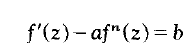
has no solutions in D, then F is normal in D.
The accelerated convergence of heat transfer series in high frequency oscillating boundary layer flows of compressible fluids
-
- Journal:
- Proceedings of the Royal Society of Edinburgh. Section A: Mathematics / Volume 98 / Issue 3-4 / 1984
- Published online by Cambridge University Press:
- 14 November 2011, pp. 271-280
- Print publication:
- 1984
-
- Article
- Export citation
Index to Volume 98
-
- Journal:
- Proceedings of the Royal Society of Edinburgh. Section A: Mathematics / Volume 98 / Issue 3-4 / 1984
- Published online by Cambridge University Press:
- 14 November 2011, p. v
- Print publication:
- 1984
-
- Article
- Export citation
Lower bounds for the spectrum of a second order linear differential equation with a coefficient whose negative part is p-integrable
-
- Journal:
- Proceedings of the Royal Society of Edinburgh. Section A: Mathematics / Volume 97 / 1984
- Published online by Cambridge University Press:
- 14 November 2011, pp. 105-107
- Print publication:
- 1984
-
- Article
- Export citation
Asymptotics of Sturm-Liouville eigenvalues for problems on a finite interval with one limit-circle singularity, I*
-
- Journal:
- Proceedings of the Royal Society of Edinburgh. Section A: Mathematics / Volume 99 / Issue 1-2 / 1984
- Published online by Cambridge University Press:
- 14 November 2011, pp. 51-70
- Print publication:
- 1984
-
- Article
- Export citation
Finite projective double Stone algebras
-
- Journal:
- Proceedings of the Royal Society of Edinburgh. Section A: Mathematics / Volume 96 / Issue 1-2 / 1984
- Published online by Cambridge University Press:
- 14 November 2011, pp. 65-67
- Print publication:
- 1984
-
- Article
- Export citation
Resolution of a semilinear equation in L1
-
- Journal:
- Proceedings of the Royal Society of Edinburgh. Section A: Mathematics / Volume 96 / Issue 3-4 / 1984
- Published online by Cambridge University Press:
- 14 November 2011, pp. 275-288
- Print publication:
- 1984
-
- Article
- Export citation
-
Let Ω = ℝN or Ω be a bounded regular open set of ℝN and let γ(x, S): Ω × ℝ → ℝ be a continuous nondecreasing function in s, measurable in x, such that γ(x, 0) = 0 almost everywhere. We solve, for f ∈ L1(Ω), the problem (P): −Δu + γ(., u) = f in Ω, u = 0 on ∂Ω. (In fact, for this result, instead of assuming that γ is nondecreasing in s we need only that γ(x, s)s≧0.) We deduce an ‘almost’ necessary and sufficient condition on
 , in order that (P) has a solution. Roughly speaking, this condition is f = −ΔV + g, with g ∈ L1(Ω) and γ(., V) ∈ L1(Ω)
 , in order that (P) has a solution. Roughly speaking, this condition is f = −ΔV + g, with g ∈ L
On the Spectrum of a one-dimensional Schrödinger operator whose potential is a limit of finite-zone potentials
-
- Journal:
- Proceedings of the Royal Society of Edinburgh. Section A: Mathematics / Volume 97 / 1984
- Published online by Cambridge University Press:
- 14 November 2011, pp. 177-183
- Print publication:
- 1984
-
- Article
- Export citation
-
Denote by (αj, βj), j = 1, 2, … an infinite set of disjoint open intervals on the half-line (0, ∞). Suppose that the following conditions are fulfilled:


With the aid of the first two trace formula presented earlier by the author, we prove in this paper that there exists a function q, defined on the whole real line, such that for the Schrödinger equation −y″ + q(x)y = λy (−∞<x<∞), the intervals (αj, βj) are spectrum lacunae. As an example, we consider the case when the intervals (αj, βj) are adjacent intervals of the Cantor trinary perfect set.
PRM volume 96 issue 3-4 Cover and Front matter
-
- Journal:
- Proceedings of the Royal Society of Edinburgh. Section A: Mathematics / Volume 96 / Issue 3-4 / 1984
- Published online by Cambridge University Press:
- 14 November 2011, pp. f1-f2
- Print publication:
- 1984
-
- Article
-
- You have access
- Export citation
Multiparameter Sturm theory
-
- Journal:
- Proceedings of the Royal Society of Edinburgh. Section A: Mathematics / Volume 99 / Issue 1-2 / 1984
- Published online by Cambridge University Press:
- 14 November 2011, pp. 173-184
- Print publication:
- 1984
-
- Article
- Export citation
-
Let Sturm–Liouville problems

with continuous coefficients and appropriate boundary conditions, be coupled by the eigenvalue λ = (λ1, … λk). When k = 1, there are various oscillation, perturbation and comparison theorems concerning existence and continuous or monotonic dependence of eigenvalues, eigenfunctions and their zeros (i.e. focal points).
We attempt a unified theory for such results, valid for general fc, under conditions known as "left" and “right” definiteness. A representative result may be stated loosely as follows: if LD holds then (elementwise) monotonic dependence of p, q and the matrix [ars] forces monotonic dependence of λ. LD is a generalisation of the “polar” case for k = 1, and was originally conceived for a quite different purpose, viz. completeness of eigenfunctions via elliptic partial differential equation theory.
Asymptotic behaviour of solutions of some general nonlinear differential equations and integral inequalities
-
- Journal:
- Proceedings of the Royal Society of Edinburgh. Section A: Mathematics / Volume 98 / Issue 1-2 / 1984
- Published online by Cambridge University Press:
- 14 November 2011, pp. 49-67
- Print publication:
- 1984
-
- Article
- Export citation
-
We deal with the asymptotic behaviour, as t→∞, of complex-valued solutions of nonlinear differential equations

Upper bounds for ∣x(l)(t)∣, 0≦j≦n, are obtained by obtaining upper bounds for solutions u(t) of Bihari-type integral inequalities of the form

L∞-continuity of Henkin operators solving
 in certain weakly pseudoconvex domains of ℂ2
-
- Journal:
- Proceedings of the Royal Society of Edinburgh. Section A: Mathematics / Volume 99 / Issue 1-2 / 1984
- Published online by Cambridge University Press:
- 14 November 2011, pp. 25-33
- Print publication:
- 1984
-
- Article
- Export citation
-
Let ψ ∈ C2[0,1] be a positive function on (0, 1]. Under certain assumptions on ψ, the set

is a pseudoconvex domain with C2-boundary, for which it is possible to construct a Henkin-type operator Hψ = Kψ + Bψ solving
in Dψ. The operator Bψ, is L∞-continuous because it has a Riesz potential type kernel, while the L∞-continuity of Kψ depends on the flatness of ψ at 0. Our main result states that Kψ is continuous from L∞(∂Dψ) into L∞(Dψ) if and only if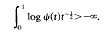
 in certain weakly pseudoconvex domains of ℂ
PRM volume 97 Cover and Back matter
-
- Journal:
- Proceedings of the Royal Society of Edinburgh. Section A: Mathematics / Volume 97 / 1984
- Published online by Cambridge University Press:
- 14 November 2011, pp. b1-b2
- Print publication:
- 1984
-
- Article
-
- You have access
- Export citation
Uniqueness of positive solutions of some semilinear Sturm–Liouville problems on the half line
-
- Journal:
- Proceedings of the Royal Society of Edinburgh. Section A: Mathematics / Volume 97 / 1984
- Published online by Cambridge University Press:
- 14 November 2011, pp. 259-263
- Print publication:
- 1984
-
- Article
- Export citation
-
This note gives a simple proof of uniqueness for positive solutions of certain non-linear boundary value problems on ℝ+ which are typified by the equation

with boundary conditions u′(0) = u(+∞) = 0. In the autonomous case (r ≡ 1), this is easy to see, by quadrature. The proof here supposes r to be non-increasing on ℝ+.
PRM volume 96 issue 1-2 Cover and Back matter
-
- Journal:
- Proceedings of the Royal Society of Edinburgh. Section A: Mathematics / Volume 96 / Issue 1-2 / 1984
- Published online by Cambridge University Press:
- 14 November 2011, pp. b1-b2
- Print publication:
- 1984
-
- Article
-
- You have access
- Export citation
Boundary value conditions for wave fronts in reaction-diffusion systems
-
- Journal:
- Proceedings of the Royal Society of Edinburgh. Section A: Mathematics / Volume 99 / Issue 1-2 / 1984
- Published online by Cambridge University Press:
- 14 November 2011, pp. 127-136
- Print publication:
- 1984
-
- Article
- Export citation
PRM volume 99 issue 1-2 Cover and Back matter
-
- Journal:
- Proceedings of the Royal Society of Edinburgh. Section A: Mathematics / Volume 99 / Issue 1-2 / 1984
- Published online by Cambridge University Press:
- 14 November 2011, pp. b1-b2
- Print publication:
- 1984
-
- Article
-
- You have access
- Export citation
A note on concentration functions
-
- Journal:
- Proceedings of the Royal Society of Edinburgh. Section A: Mathematics / Volume 96 / Issue 3-4 / 1984
- Published online by Cambridge University Press:
- 14 November 2011, pp. 181-184
- Print publication:
- 1984
-
- Article
- Export citation
The Dirichlet index under minimal conditions
-
- Journal:
- Proceedings of the Royal Society of Edinburgh. Section A: Mathematics / Volume 96 / Issue 3-4 / 1984
- Published online by Cambridge University Press:
- 14 November 2011, pp. 303-316
- Print publication:
- 1984
-
- Article
- Export citation
