Refine search
Actions for selected content:
26078 results in Abstract analysis
Inverse semigroups generated by a pair of subgroups†*
-
- Journal:
- Proceedings of the Royal Society of Edinburgh. Section A: Mathematics / Volume 77 / Issue 1-2 / 1977
- Published online by Cambridge University Press:
- 14 February 2012, pp. 9-22
- Print publication:
- 1977
-
- Article
- Export citation
PRM volume 79 issue 1-2 Cover and Front matter
-
- Journal:
- Proceedings of the Royal Society of Edinburgh. Section A: Mathematics / Volume 79 / Issue 1-2 / 1977
- Published online by Cambridge University Press:
- 14 February 2012, pp. f1-f2
- Print publication:
- 1977
-
- Article
-
- You have access
- Export citation
Related singular problems and the generalized Hilbert transform
-
- Journal:
- Proceedings of the Royal Society of Edinburgh. Section A: Mathematics / Volume 79 / Issue 1-2 / 1977
- Published online by Cambridge University Press:
- 14 February 2012, pp. 173-182
- Print publication:
- 1977
-
- Article
- Export citation
Small solutions of a non-linear equation in Banach space for a degenerate case
-
- Journal:
- Proceedings of the Royal Society of Edinburgh. Section A: Mathematics / Volume 79 / Issue 1-2 / 1977
- Published online by Cambridge University Press:
- 14 February 2012, pp. 35-49
- Print publication:
- 1977
-
- Article
- Export citation
The breadth of finite p-groups, I*
-
- Journal:
- Proceedings of the Royal Society of Edinburgh. Section A: Mathematics / Volume 78 / Issue 1-2 / 1977
- Published online by Cambridge University Press:
- 14 February 2012, pp. 31-39
- Print publication:
- 1977
-
- Article
- Export citation
On two inequalities of Brodlie and Everitt*
-
- Journal:
- Proceedings of the Royal Society of Edinburgh. Section A: Mathematics / Volume 77 / Issue 3-4 / 1977
- Published online by Cambridge University Press:
- 14 February 2012, pp. 329-333
- Print publication:
- 1977
-
- Article
- Export citation
On the essential self-adjointness of powers of Schrödinger-type operators
-
- Journal:
- Proceedings of the Royal Society of Edinburgh. Section A: Mathematics / Volume 79 / Issue 1-2 / 1977
- Published online by Cambridge University Press:
- 14 February 2012, pp. 61-77
- Print publication:
- 1977
-
- Article
- Export citation
-
Let T be the formally self-adjoint second-order elliptic differential expression
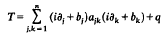
in ℝn, where the coefficients bj, ajk, q are real-valued and ajk ≈ akj. In this paper sufficient conditions for all positive integer powers Tm of T to be essentially self-adjoint on
 are obtained.
 are obtained.
Transformations between second order linear differential equations and a reinterpretation of recurrence relations between Bessel functions with algebraic coefficients
-
- Journal:
- Proceedings of the Royal Society of Edinburgh. Section A: Mathematics / Volume 79 / Issue 1-2 / 1977
- Published online by Cambridge University Press:
- 14 February 2012, pp. 87-105
- Print publication:
- 1977
-
- Article
- Export citation
On two integral inequalities*
-
- Journal:
- Proceedings of the Royal Society of Edinburgh. Section A: Mathematics / Volume 77 / Issue 3-4 / 1977
- Published online by Cambridge University Press:
- 14 February 2012, pp. 325-328
- Print publication:
- 1977
-
- Article
- Export citation
-
In 1932, Hardy and Littlewood [1] proved the inequality

The constant 4 is best possible; equality occurs when f(x) = A Y(Bx), where
y(x) = e−½x sin (x sin y−y) (y = ⅓π), (x ≧ o)
and A and B (>0) are constants. In [2], three proofs are given. The inequality has also been discussed in [3, 4]. A very elementary proof in which the function Y(x) emerges naturally is given in this paper.
Two-point boundary value problems with eigenvalue parameter contained in the boundary conditions
-
- Journal:
- Proceedings of the Royal Society of Edinburgh. Section A: Mathematics / Volume 77 / Issue 3-4 / 1977
- Published online by Cambridge University Press:
- 14 February 2012, pp. 293-308
- Print publication:
- 1977
-
- Article
- Export citation
The non-monotonicity of solutions in swirling flow*
-
- Journal:
- Proceedings of the Royal Society of Edinburgh. Section A: Mathematics / Volume 76 / Issue 3 / 1977
- Published online by Cambridge University Press:
- 14 February 2012, pp. 161-182
- Print publication:
- 1977
-
- Article
- Export citation
-
This paper studies the boundary-value problem arising from the behaviour of a fluid occupying the region 0 ≦ x ≧ 1 between two rotating discs, rotating about a common axis perpendicular to their planes, when the discs, are rotating in the same sense with speeds 0 ≦ Ω0<Ω1. The equations which describe the axially symmetric similarity solutions of this problem are
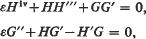
with the boundary conditions

where ε = v/2Ω1 and v is the kinematic viscosity.
The major result is: There is an ε0 such that for 0<ε≦ε0 there does not exist a solution 〈H(x,ε), G(x,ε)〉 with G′(x,ε)≧0.
Marginal series in groups*
-
- Journal:
- Proceedings of the Royal Society of Edinburgh. Section A: Mathematics / Volume 76 / Issue 2 / 1977
- Published online by Cambridge University Press:
- 14 February 2012, pp. 139-154
- Print publication:
- 1977
-
- Article
- Export citation
PRM volume 76 issue 2 Cover and Front matter
-
- Journal:
- Proceedings of the Royal Society of Edinburgh. Section A: Mathematics / Volume 76 / Issue 2 / 1977
- Published online by Cambridge University Press:
- 14 February 2012, pp. f1-f2
- Print publication:
- 1977
-
- Article
-
- You have access
- Export citation
On the Dirichlet problem for weakly non-linear elliptic partial differential equations
-
- Journal:
- Proceedings of the Royal Society of Edinburgh. Section A: Mathematics / Volume 76 / Issue 4 / 1977
- Published online by Cambridge University Press:
- 14 February 2012, pp. 283-300
- Print publication:
- 1977
-
- Article
- Export citation
Sturm-Liouville operators with an indefinite weight function
-
- Journal:
- Proceedings of the Royal Society of Edinburgh. Section A: Mathematics / Volume 78 / Issue 1-2 / 1977
- Published online by Cambridge University Press:
- 14 February 2012, pp. 161-191
- Print publication:
- 1977
-
- Article
- Export citation
-
Spectral properties of the singular Sturm-Liouville equation –(p−1y′)′ + qy = λry with an indefinite weight function r are studied in
 . The main tool is the theory of definitisable operators in spaces with an indefinite scalar product.
 . The main tool is the theory of definitisable operators in spaces with an indefinite scalar product.
The limit-point, limit-circle nature of rapidly oscillating potentials
-
- Journal:
- Proceedings of the Royal Society of Edinburgh. Section A: Mathematics / Volume 76 / Issue 3 / 1977
- Published online by Cambridge University Press:
- 14 February 2012, pp. 183-196
- Print publication:
- 1977
-
- Article
- Export citation
A note on the exterior problem for linear viscoelasticity*
-
- Journal:
- Proceedings of the Royal Society of Edinburgh. Section A: Mathematics / Volume 77 / Issue 3-4 / 1977
- Published online by Cambridge University Press:
- 14 February 2012, pp. 209-216
- Print publication:
- 1977
-
- Article
- Export citation
Application des méthodes de convexité et monotonie a l'étude de certaines équations quasi linéaires
-
- Journal:
- Proceedings of the Royal Society of Edinburgh. Section A: Mathematics / Volume 79 / Issue 1-2 / 1977
- Published online by Cambridge University Press:
- 14 February 2012, pp. 107-129
- Print publication:
- 1977
-
- Article
- Export citation
-
Using Hilbert space methods, existence and uniqueness are proved for the solution of some strongly non-linear partial differential equations of elliptic and parabolic type.
They are associated with quasi-linear operators of the form: -div(β(x, grad u)) + β0(x, u) where β (resp β0) is a maximal monotone subdifferential on ℝN(resp ℝ) depending smoothly on x in a bounded domain Ω of ℝN
These operators are shown to be the subdifierentials over Lp(Ω) of convex functional of the following type:

where j is a normal convex integrand over Ω×ℝN+1 satisfying a coerciveness condition.
This method avoids the theory of Sobolev-Orlicz spaces. An application is given also forthe gas-diffusion equation over ℝ+.
PRM volume 77 issue 3-4 Cover and Front matter
-
- Journal:
- Proceedings of the Royal Society of Edinburgh. Section A: Mathematics / Volume 77 / Issue 3-4 / 1977
- Published online by Cambridge University Press:
- 14 February 2012, pp. f1-f2
- Print publication:
- 1977
-
- Article
-
- You have access
- Export citation
An elliptic boundary value problem for strongly non-linear equations in unbounded domains
-
- Journal:
- Proceedings of the Royal Society of Edinburgh. Section A: Mathematics / Volume 77 / Issue 3-4 / 1977
- Published online by Cambridge University Press:
- 14 February 2012, pp. 217-230
- Print publication:
- 1977
-
- Article
- Export citation
