Refine search
Actions for selected content:
26078 results in Abstract analysis
Cubic primals in [4] with polar heptahedra*
-
- Journal:
- Proceedings of the Royal Society of Edinburgh. Section A: Mathematics / Volume 77 / Issue 1-2 / 1977
- Published online by Cambridge University Press:
- 14 February 2012, pp. 151-162
- Print publication:
- 1977
-
- Article
- Export citation
Index to volume 23
-
- Journal:
- Mathematika / Volume 23 / Issue 2 / December 1976
- Published online by Cambridge University Press:
- 26 February 2010, p. 228
- Print publication:
- December 1976
-
- Article
- Export citation
Bounded analytic functions with Hadamard gaps
-
- Journal:
- Mathematika / Volume 23 / Issue 2 / December 1976
- Published online by Cambridge University Press:
- 26 February 2010, pp. 142-146
- Print publication:
- December 1976
-
- Article
- Export citation
-
The object of the present note is to study functions f(z) which are bounded and analytic in |z| > 1, with Taylor expansion
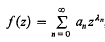
where the sequence {λn} of integers satisfies the Hadamard gap condition

The class number of pure fields of prime degree
-
- Journal:
- Mathematika / Volume 23 / Issue 2 / December 1976
- Published online by Cambridge University Press:
- 26 February 2010, pp. 220-226
- Print publication:
- December 1976
-
- Article
- Export citation
On a theorem of Davenport concerning continued fractions
-
- Journal:
- Mathematika / Volume 23 / Issue 2 / December 1976
- Published online by Cambridge University Press:
- 26 February 2010, pp. 136-141
- Print publication:
- December 1976
-
- Article
- Export citation
-
Several years ago, Davenport [2] noticed that for any real irrational number ξ and for any prime number p, one at least of the numbers
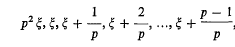
has infinitely many partial quotients larger than p – 2 in its continued fraction expansion.
On Minkowski reduction of positive quaternary quadratic forms
-
- Journal:
- Mathematika / Volume 23 / Issue 2 / December 1976
- Published online by Cambridge University Press:
- 26 February 2010, pp. 156-158
- Print publication:
- December 1976
-
- Article
- Export citation
-
§1. Let f(x) = x′Ax be a positive definite or semi–definite n-ary quadratic form with real symmetric matrix A. Then, f is Minkowski-reduced, if for all sets of integers m1, …, mn with gcd (mi, …, mn) = 1,

Incomplete Gauss sums
-
- Journal:
- Mathematika / Volume 23 / Issue 2 / December 1976
- Published online by Cambridge University Press:
- 26 February 2010, pp. 125-135
- Print publication:
- December 1976
-
- Article
- Export citation
-
Let N be a positive integer. We are concerned with the sum
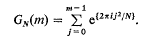
Thus GN(N) is the ordinary Gauss sum. Previous methods of estimating such exponential sums have not brought to light the peculiar behaviour of GN(m) for m < N/2, namely that, for almost all values of m, GN(m) is in the vicinity of the point
 . A sharp estimate is given for max |GN(m)|, depending on the residue of N modulo 4. The results were suggested by graphs of GN(m) made for N near 1000. The analysis employs the Fresnel integrals and the Cornu spiral whose curvature is proportional to its arc length.
 . A sharp estimate is given for max |G
Structure of analytic Hausdorff spaces
-
- Journal:
- Mathematika / Volume 23 / Issue 2 / December 1976
- Published online by Cambridge University Press:
- 26 February 2010, pp. 208-211
- Print publication:
- December 1976
-
- Article
- Export citation
Sprindžuk's theorem and Hausdorff dimension
-
- Journal:
- Mathematika / Volume 23 / Issue 2 / December 1976
- Published online by Cambridge University Press:
- 26 February 2010, pp. 184-197
- Print publication:
- December 1976
-
- Article
- Export citation
-
Let ζ be a complex number. For n = 1, 2 … we write ωn (ζ for the supremum of the numbers ω for which

for infinitely many polynomials P of degree ≦ n with integer coefficients (H (P) denotes the maximum of the absolute values of the coefficients of P).
Corrigendum to:“A lattice-point problem in hyperbolic space”
-
- Journal:
- Mathematika / Volume 23 / Issue 2 / December 1976
- Published online by Cambridge University Press:
- 26 February 2010, p. 227
- Print publication:
- December 1976
-
- Article
-
- You have access
- Export citation
Eine Erweiterung der Croftonschen Formeln für konvexe Körper
-
- Journal:
- Mathematika / Volume 23 / Issue 2 / December 1976
- Published online by Cambridge University Press:
- 26 February 2010, pp. 212-219
- Print publication:
- December 1976
-
- Article
- Export citation
Non-isomorphic projective sets
-
- Journal:
- Mathematika / Volume 23 / Issue 2 / December 1976
- Published online by Cambridge University Press:
- 26 February 2010, pp. 151-155
- Print publication:
- December 1976
-
- Article
- Export citation
The length of ray-images under starlike mappings
-
- Journal:
- Mathematika / Volume 23 / Issue 2 / December 1976
- Published online by Cambridge University Press:
- 26 February 2010, pp. 147-150
- Print publication:
- December 1976
-
- Article
- Export citation
-
Let w = f(z) be regular and schlicht for |z|, and f (0) = 0.
Suppose that f maps the unit disc {z : |z| < 1} onto a domain D starlike with respect to w = 0. Let C(r, θ) be the image in D of the ray joining z = 0 to z = reiθ, and let
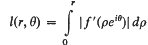
be its length. Sheil–Small [1] proved that l(r, θ) < (1 + log 4) | f (reiθ)|, and conjectured the following result, which it is my aim to prove in this paper.
Power free values of polynomials
-
- Journal:
- Mathematika / Volume 23 / Issue 2 / December 1976
- Published online by Cambridge University Press:
- 26 February 2010, pp. 159-183
- Print publication:
- December 1976
-
- Article
- Export citation
-
If an integer does not have a k-th power of a positive integer, other than 1, for a divisor, it is said to be k–free. Let f(n) be an irreducible polynomial, with rational integer coefficients, of degree g, having no fixed k-th power divisors other than 1. We define

i.e. Nk(x) is the number of positive integers n not exceeding x such that f(n) is k-free. One would expect that f(n) is square-free for infinitely many n and further that, given x sufficiently large, there is an n with x < n ≤ x + h, such that f(n) is square-free for h = 0(x2) where ε is any real number > 0. These conjectures, however, seem to be extraordinarily difficult to prove. We begin with a brief account of the best results that have been attained so far.
Uniform distribution in compact groups
-
- Journal:
- Mathematika / Volume 23 / Issue 2 / December 1976
- Published online by Cambridge University Press:
- 26 February 2010, pp. 198-207
- Print publication:
- December 1976
-
- Article
- Export citation
-
In a compact group G, a sequence (Fn) of finite sets is uniformly distributed if the averaging operators

are uniformly convergent to the mean for continuous complex-valued functions f. In any compact metric group, there are uniformly distributed sequences of finite sets which are determined by a metric for the group. In some compact groups, there are uniformly distributed sequences of finite sets which are determined by the algebraic structure. A necessary and sufficient condition for a sequence of finite sets to be uniformly distributed in a compact metric group is that for any metric d for G and each εG, there is a sequence of one-to-one maps pn: Fn→ Fn such that

MTK volume 23 issue 2 Front matter
-
- Journal:
- Mathematika / Volume 23 / Issue 2 / December 1976
- Published online by Cambridge University Press:
- 26 February 2010, pp. f1-f2
- Print publication:
- December 1976
-
- Article
-
- You have access
- Export citation
Electrostatic sieve
-
- Journal:
- Mathematika / Volume 23 / Issue 1 / June 1976
- Published online by Cambridge University Press:
- 26 February 2010, pp. 51-56
- Print publication:
- June 1976
-
- Article
- Export citation
On approximation with algebraic numbers of bounded degree
-
- Journal:
- Mathematika / Volume 23 / Issue 1 / June 1976
- Published online by Cambridge University Press:
- 26 February 2010, pp. 18-31
- Print publication:
- June 1976
-
- Article
- Export citation
-
In this paper we are interested in two related measures of the degree of approximation of a complex number ζ by algebraic numbers. For a given integer n ≥ 1, write wn(ζ) for the supremum of the exponents w for which

for infinitely many polynomials
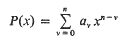
in Z[x] of height H(P) = max |av|. Clearly 0 ≤ w1 (ζ) ≤ w2 (ζ) ≤ …. On the other hand, write
 for the supremum of the exponents w for which
for infinitely many algebraic numbers α of degree at most n.
 for the supremum of the exponents w for which
On a problem of hardy and ramanujan
-
- Journal:
- Mathematika / Volume 23 / Issue 1 / June 1976
- Published online by Cambridge University Press:
- 26 February 2010, pp. 10-17
- Print publication:
- June 1976
-
- Article
- Export citation
-
Some sixty years ago Hardy and Ramanujan [6]introduced the notion of normal order of an arithmetic function.
A real-valued arithmetic function f)n) is said to have a normal order if there is a function g(n), which is non-negative and non-decreasing for all sufficiently large integers n, so that, for each fixed ε > 0, the integers n, for which the inequality

is satisfied, have asymptotic density zero. Thus, in this certain sense, f(n) behaves almost surely like g(n). We say that f(n) has the normal order g(n). In their original paper Hardy and Ramanujan asked that the function g(n) be “elementary”, but this is a requirement that subsequent researchers have dropped.
On the distribution of primes in short intervals
-
- Journal:
- Mathematika / Volume 23 / Issue 1 / June 1976
- Published online by Cambridge University Press:
- 26 February 2010, pp. 4-9
- Print publication:
- June 1976
-
- Article
-
- You have access
- Export citation
