Refine search
Actions for selected content:
26078 results in Abstract analysis
23.—The Linear Transport Equation. The Degenerate Case c = 1. II. Half-range Theory
-
- Journal:
- Proceedings of the Royal Society of Edinburgh. Section A: Mathematics / Volume 75 / Issue 4 / 1976
- Published online by Cambridge University Press:
- 14 February 2012, pp. 283-295
- Print publication:
- 1976
-
- Article
- Export citation
20.—Functional Differential Equations and Non-linear Evolution Operators*
-
- Journal:
- Proceedings of the Royal Society of Edinburgh. Section A: Mathematics / Volume 75 / Issue 3 / 1976
- Published online by Cambridge University Press:
- 14 February 2012, pp. 223-234
- Print publication:
- 1976
-
- Article
- Export citation
-
The abstract non-linear non-autonomous functional differential equation

is considered. An evolution operator is associated with the solutions of this equation and existence and stability results are obtained.
14.—Global Non-existence of Solutions to Ladyzhenskaya's Variants of the Navier-Stokes Equations Backward in Time
-
- Journal:
- Proceedings of the Royal Society of Edinburgh. Section A: Mathematics / Volume 75 / Issue 2 / 1976
- Published online by Cambridge University Press:
- 14 February 2012, pp. 165-170
- Print publication:
- 1976
-
- Article
- Export citation
PRM volume 75 issue 1 Cover and Back matter
-
- Journal:
- Proceedings of the Royal Society of Edinburgh. Section A: Mathematics / Volume 75 / Issue 1 / 1976
- Published online by Cambridge University Press:
- 14 February 2012, pp. b1-b2
- Print publication:
- 1976
-
- Article
-
- You have access
- Export citation
11.— A Left Definite Multiparameter Eigenvalue Problem in Ordinary Differential Equations*
-
- Journal:
- Proceedings of the Royal Society of Edinburgh. Section A: Mathematics / Volume 74 / 1976
- Published online by Cambridge University Press:
- 14 February 2012, pp. 145-155
- Print publication:
- 1976
-
- Article
- Export citation
-
The main result of this paper is to establish the completeness of the eigenfunctions for the multiparameter eigenvalue problem defined by the system of ordinary differential equations

0 ≤ x, ≤ 1, r = 1, …, k, subject to the Sturm-Liouville boundary conditions
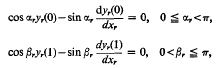
r = 1, …, k. In addition it is assumed that the coefficients ars of the spectral parameters λs, satisfy the ellipticity condition
 , s = 1, …, k, for all xrɛ[0, 1], r = 1, …, k, and some real k-tuple μ1, …, μk and where
  is the co-factor of asr in the determinant
  . The theory developed here contrasts with the results known when …k is assumed non-vanishing for all xrɛ[0,1].
 , s = 1, …, k, for all x
 is the co-factor of a
 . The theory developed here contrasts with the results known when …
21.—On Expansive Free Interactions in Boundary Layers
-
- Journal:
- Proceedings of the Royal Society of Edinburgh. Section A: Mathematics / Volume 74 / 1976
- Published online by Cambridge University Press:
- 14 February 2012, pp. 271-283
- Print publication:
- 1976
-
- Article
- Export citation
9.—Bivariational Bounds associated with Non-self-adjoint Linear Operators
-
- Journal:
- Proceedings of the Royal Society of Edinburgh. Section A: Mathematics / Volume 75 / Issue 2 / 1976
- Published online by Cambridge University Press:
- 14 February 2012, pp. 109-118
- Print publication:
- 1976
-
- Article
- Export citation
4.—Perturbations of Non-linear Integral Operators
-
- Journal:
- Proceedings of the Royal Society of Edinburgh. Section A: Mathematics / Volume 74 / 1976
- Published online by Cambridge University Press:
- 14 February 2012, pp. 55-70
- Print publication:
- 1976
-
- Article
- Export citation
19.—Propagation of Weak Discontinuities in a Layered Hyperelastic Half-space
-
- Journal:
- Proceedings of the Royal Society of Edinburgh. Section A: Mathematics / Volume 75 / Issue 3 / 1976
- Published online by Cambridge University Press:
- 14 February 2012, pp. 209-221
- Print publication:
- 1976
-
- Article
- Export citation
1.—On Square-integrable Solutions of Symmetric Systems of Differential Equations of Arbitrary Order.*
-
- Journal:
- Proceedings of the Royal Society of Edinburgh. Section A: Mathematics / Volume 74 / 1976
- Published online by Cambridge University Press:
- 14 February 2012, pp. 5-40
- Print publication:
- 1976
-
- Article
- Export citation
PRM volume 75 issue 2 Cover and Back matter
-
- Journal:
- Proceedings of the Royal Society of Edinburgh. Section A: Mathematics / Volume 75 / Issue 2 / 1976
- Published online by Cambridge University Press:
- 14 February 2012, pp. b1-b2
- Print publication:
- 1976
-
- Article
-
- You have access
- Export citation
17.—A New Class of Bessel Function Inequality useful for investigating the Roots of a Class of Transcendental Equation involving Bessel Functions*
-
- Journal:
- Proceedings of the Royal Society of Edinburgh. Section A: Mathematics / Volume 74 / 1976
- Published online by Cambridge University Press:
- 14 February 2012, pp. 231-238
- Print publication:
- 1976
-
- Article
- Export citation
24.—Mean-square Convergence of Non-harmonic Trigonometrical Series
-
- Journal:
- Proceedings of the Royal Society of Edinburgh. Section A: Mathematics / Volume 75 / Issue 4 / 1976
- Published online by Cambridge University Press:
- 14 February 2012, pp. 297-323
- Print publication:
- 1976
-
- Article
- Export citation
-
The series considered are of the form
 , where Σ | cn |2 is convergent and the real numbers λn (the exponents) are distinct. It is known that if the exponents are integers, the series is the Fourier series of a periodic function of locally integrable square (the Riesz-Fischer theorem); and more generally that if the exponents are not necessarily integers but are such that the difference between any pair exceeds a fixed positive number, the series is the Fourier series of a function of the Stepanov class, S2, of almost periodic functions.
We consider in this paper cases where the exponents are subject to less stringent conditions (depending on the coefficients cn). Some of the theorems included here are known but had been proved by other methods. A fuller account of the contents of the paper is given in Sections 1-5.
 , where Σ | c
PRM volume 74 Cover and Back matter
-
- Journal:
- Proceedings of the Royal Society of Edinburgh. Section A: Mathematics / Volume 74 / 1976
- Published online by Cambridge University Press:
- 14 February 2012, pp. b1-b3
- Print publication:
- 1976
-
- Article
-
- You have access
- Export citation
5.—The Uniform Asymptotic Stability of Certain Linear Differential-difference Equations
-
- Journal:
- Proceedings of the Royal Society of Edinburgh. Section A: Mathematics / Volume 74 / 1976
- Published online by Cambridge University Press:
- 14 February 2012, pp. 71-79
- Print publication:
- 1976
-
- Article
- Export citation
22.—A Critical Class of Examples concerning the Integrable-square Classification of Ordinary Differential Equations*
-
- Journal:
- Proceedings of the Royal Society of Edinburgh. Section A: Mathematics / Volume 74 / 1976
- Published online by Cambridge University Press:
- 14 February 2012, pp. 285-297
- Print publication:
- 1976
-
- Article
- Export citation
-
Let the coefficient q be real-valued on the half-line [0, ∞) and let q′ be locally absolutely continuous on [0, ∞). The ordinary symmetric differential expressions M and M2 are determined by

It has been shown in a previous paper by the authors that if for non-negative numbers k and X the coefficient q satisfies the condition

then M is limit-point and M2 is limit–2 at ∞.
This paper is concerned with showing that for powers of the independent variable x the condition (*) is best possible in order that both M and M2 should have the classification at ∞ given above.
25.—On the Eigenfunction Expansion associated with a Singular Complex-valued Fourth-order Differential Equation*
-
- Journal:
- Proceedings of the Royal Society of Edinburgh. Section A: Mathematics / Volume 75 / Issue 4 / 1976
- Published online by Cambridge University Press:
- 14 February 2012, pp. 325-332
- Print publication:
- 1976
-
- Article
- Export citation
On stabilisation of solutions of the Cauchy problem for parabolic equations
-
- Journal:
- Proceedings of the Royal Society of Edinburgh. Section A: Mathematics / Volume 76 / Issue 1 / 1976
- Published online by Cambridge University Press:
- 14 February 2012, pp. 43-53
- Print publication:
- 1976
-
- Article
- Export citation
-
The author considers the solution of the Cauchy problem for an equation

giving necessary and sufficient conditions for the existence of


9.—Development and Separation of a Laminar Boundary Layer, under the Action of a Very Sharp Constant Adverse Pressure Gradient*
-
- Journal:
- Proceedings of the Royal Society of Edinburgh. Section A: Mathematics / Volume 74 / 1976
- Published online by Cambridge University Press:
- 14 February 2012, pp. 119-134
- Print publication:
- 1976
-
- Article
- Export citation
-
This paper, following Stratford [9], considers a boundary layer developing with uniform pressure when x < x0, and with
 large and constant when x > x0. The analysis improves or extends the work of Stratford as follows.
(a) For large values of
 inner and outer asymptotic expansions are derived and matched—Stratford considered only the inner solution, his outer boundary condition being determined by physical arguments.
(b) The skin-friction is determined as a series in powers of
 , whereas Stratford's, solution was obtained by approximate methods. In the limit as λ→∞ the predicted separation position, ξ = 0.09766, is probably correct to3 significant figures, at least, and differs little from Stratford's value.
(c) This solution further shows that for finite λ, separation occurs when
ξ = 0.09766-0.00014λ−3.
Although the coefficient 0.00014 is not wholly reliable, clearly the position of separation varies little with λ unless λ−3 is very much greater than unity.
(d) The present solution also yields the displacement and momentum thicknesses. When x > x0 the displacement thickness is

where B1(ξ) is given as a slowly converging seriesin powers of ξ. It is shown how to improve convergence, using certain properties of the flow close to the separation position, and thus to sum the series.
Likewise
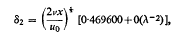
so that when λ is large the momentum thickness changes even less than does the displacement thickness.
 large and constant when x > x
 inner and outer asymptotic expansions are derived and matched—Stratford considered only the inner solution, his outer boundary condition being determined by physical arguments.
 , whereas Stratford's, solution was obtained by approximate methods. In the limit as λ→∞ the predicted separation position, ξ = 0.09766, is probably correct to3 significant figures, at least, and differs little from Stratford's value.
2.—The Matrix Functional Differential Equation y′(x) = Ay(λx) + By(x)*
-
- Journal:
- Proceedings of the Royal Society of Edinburgh. Section A: Mathematics / Volume 75 / Issue 1 / 1976
- Published online by Cambridge University Press:
- 14 February 2012, pp. 5-22
- Print publication:
- 1976
-
- Article
- Export citation
