Refine search
Actions for selected content:
26078 results in Abstract analysis
A property of polynomials over a finite field
-
- Journal:
- Mathematika / Volume 22 / Issue 2 / December 1975
- Published online by Cambridge University Press:
- 26 February 2010, pp. 151-153
- Print publication:
- December 1975
-
- Article
- Export citation
-
Let q be a power of an odd prime, [q] denote the Galois field GF(q) and write X(x) = xq − x. Let f(x) be a polynomial, having no linear factors, over [q], of positive degree, and write
 . Consider the continued fraction expansions
and

where the Ai(x) and aj,(x) are polynomials over [q] of degree ≥ 1 (if i ≥ 1, j ≥ 1). Plainly A0(x) = ao(x). Suppose that n = nf is the integer denned uniquely as the largest m such that

 . Consider the continued fraction expansions
On the two-dimensional inviscid flow from symmetric slowly varying nozzles
- Part of
-
- Journal:
- Mathematika / Volume 22 / Issue 2 / December 1975
- Published online by Cambridge University Press:
- 26 February 2010, pp. 135-140
- Print publication:
- December 1975
-
- Article
- Export citation
The existence of a centrally symmetric convex body with central sections that are unexpectedly small
- Part of
-
- Journal:
- Mathematika / Volume 22 / Issue 2 / December 1975
- Published online by Cambridge University Press:
- 26 February 2010, pp. 164-175
- Print publication:
- December 1975
-
- Article
- Export citation
-
Let K, K′ be two centrally symmetric convex bodies in En, with their centres at the origin o. Let Vr denote the r-dimensional volume function. A problem of H. Busemann and C. M. Petty [1], see also, H. Busemann [2] asks:—
“If, for each (n − 1)-dimensional subspace L of En,

does it follow that

If n = 2 or, if K is an ellipsoid, then Busemann [3] shows that it does follow. However we will show that, at least for n ≥ 12, the result does not hold for general centrally symmetric convex bodies K, even if K′ is an ellipsoid. We do not construct the counter example explicitly; instead we use a probabilistic argument to establish its existence.
Absolutely non-measurable and singular co-analytic set
- Part of
-
- Journal:
- Mathematika / Volume 22 / Issue 2 / December 1975
- Published online by Cambridge University Press:
- 26 February 2010, pp. 161-163
- Print publication:
- December 1975
-
- Article
- Export citation
Spira's theorems on complete linear proofs of systems of linear inequalities
-
- Journal:
- Mathematika / Volume 22 / Issue 2 / December 1975
- Published online by Cambridge University Press:
- 26 February 2010, pp. 112-121
- Print publication:
- December 1975
-
- Article
- Export citation
Discrete parabolic representations of link groups
-
- Journal:
- Mathematika / Volume 22 / Issue 2 / December 1975
- Published online by Cambridge University Press:
- 26 February 2010, pp. 141-150
- Print publication:
- December 1975
-
- Article
- Export citation
-
Let k be a knot of type K and with group πK. Let θ: nK → PSL(ℂ) = PSL (2, ℂ) be a parabolic representation (p-rep) as defined in [14]. We shall call the representation discrete when its image πKθ is a discrete subgroup of PSL(ℂ). It is known that PSL(ℂ) can be identified with the group of orientation preserving isometries of hyperbolic 3-space
 , and that each discrete subgroup of PSL(ℂ) acts discontinuously on . Hence each discrete p-rep θ has an associated orbit space
  . The present paper is a study of the general relations between the algebraic properties of a discrete image πKθ and the geometric properties of its orbit space.
 , and that each discrete subgroup of PSL(ℂ) acts discontinuously on
  . The present paper is a study of the general relations between the algebraic properties of a discrete image πKθ and the geometric properties of its orbit space.
A set of infinite measure whose ratio set does not contain a given sequence
- Part of
-
- Journal:
- Mathematika / Volume 22 / Issue 2 / December 1975
- Published online by Cambridge University Press:
- 26 February 2010, pp. 195-201
- Print publication:
- December 1975
-
- Article
- Export citation
Short surface waves due to a heaving torus
- Part of
-
- Journal:
- Mathematika / Volume 22 / Issue 2 / December 1975
- Published online by Cambridge University Press:
- 26 February 2010, pp. 122-134
- Print publication:
- December 1975
-
- Article
- Export citation
Index to volume 22
-
- Journal:
- Mathematika / Volume 22 / Issue 2 / December 1975
- Published online by Cambridge University Press:
- 26 February 2010, p. 212
- Print publication:
- December 1975
-
- Article
- Export citation
On the periods of Abelian functions in two variables
-
- Journal:
- Mathematika / Volume 22 / Issue 2 / December 1975
- Published online by Cambridge University Press:
- 26 February 2010, pp. 97-107
- Print publication:
- December 1975
-
- Article
- Export citation
-
Let Λ be a lattice in Cn such that the field
 of Abelian functions on the quotient space Cn/Λ is of transcendence degree n. This implies that is an algebraic extension of a field o of pure transcendence degree n. Thus there exists a vector A = (A1 …, An) of algebraically independent functions of the variable z = (z1, …, zn) and a function B = B(z), algebraic over
such that

 of Abelian functions on the quotient space C
A lattice-point problem in hyperbolic space
-
- Journal:
- Mathematika / Volume 22 / Issue 1 / June 1975
- Published online by Cambridge University Press:
- 26 February 2010, pp. 81-88
- Print publication:
- June 1975
-
- Article
- Export citation
-
In this paper we shall discuss the following problem. Let G be a Fuchsian group of the first kind acting on the upper half-plane H. For z1, z2 ∈ H we set

Dense primitive polynomial sequences
-
- Journal:
- Mathematika / Volume 22 / Issue 1 / June 1975
- Published online by Cambridge University Press:
- 26 February 2010, pp. 89-91
- Print publication:
- June 1975
-
- Article
- Export citation
Index to volume 22
-
- Journal:
- Mathematika / Volume 22 / Issue 1 / June 1975
- Published online by Cambridge University Press:
- 26 February 2010, p. i
- Print publication:
- June 1975
-
- Article
- Export citation
One-class genera of positive ternary quadratic forms—II
-
- Journal:
- Mathematika / Volume 22 / Issue 1 / June 1975
- Published online by Cambridge University Press:
- 26 February 2010, pp. 1-11
- Print publication:
- June 1975
-
- Article
- Export citation
-
Let f be a positive-definite ternary quadratic form with integer coefficients; by c(f), the class-number of f, is meant the number of classes in the genus of f. The object of this paper is to find all the f with c(f) = 1; these f are the ones for which
 , where f′ is an arbitrary ternary form and ∼,
  denote equivalence and semi-equivalence respectively. Trivially, it suffices to find the primitive f with c(f) = 1.
 , where f′ is an arbitrary ternary form and ∼,
  denote equivalence and semi-equivalence respectively. Trivially, it suffices to find the primitive f with c(f) = 1.
An Ω-result for the coefficients of cusp forms
-
- Journal:
- Mathematika / Volume 22 / Issue 1 / June 1975
- Published online by Cambridge University Press:
- 26 February 2010, pp. 12-19
- Print publication:
- June 1975
-
- Article
- Export citation
-
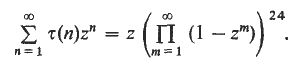
In a recent paper [1], R. A. Rankin proved that

where τ(n) is Ramanujan's arithmetical function,
On the theory of stress concentration for shear-strained prismatical bodies with a non-linear stress-strain law
-
- Journal:
- Mathematika / Volume 22 / Issue 1 / June 1975
- Published online by Cambridge University Press:
- 26 February 2010, pp. 34-42
- Print publication:
- June 1975
-
- Article
- Export citation
On the first end invariant of an exact sequence
-
- Journal:
- Mathematika / Volume 22 / Issue 1 / June 1975
- Published online by Cambridge University Press:
- 26 February 2010, pp. 60-70
- Print publication:
- June 1975
-
- Article
- Export citation
A note on universal sets for classes of countable Gδ'S
-
- Journal:
- Mathematika / Volume 22 / Issue 1 / June 1975
- Published online by Cambridge University Press:
- 26 February 2010, pp. 43-45
- Print publication:
- June 1975
-
- Article
- Export citation
On waves in a thin rotating spherical shell of slightly viscous fluid
-
- Journal:
- Mathematika / Volume 22 / Issue 1 / June 1975
- Published online by Cambridge University Press:
- 26 February 2010, pp. 46-59
- Print publication:
- June 1975
-
- Article
- Export citation
Zero-free regions for ζ(s)
-
- Journal:
- Mathematika / Volume 22 / Issue 1 / June 1975
- Published online by Cambridge University Press:
- 26 February 2010, pp. 92-96
- Print publication:
- June 1975
-
- Article
- Export citation
-
Hitherto, little use has been made of the well-known representation

of the Riemann zeta-function, ζ(s), within the critical strip l = {s:s = σ + it, 0 < σ < 1}. Certain variants of (1) have been used to deduce the functional equation of ζ(s), while a simple consequence of (1) itself is that ζ(s) does not vanish on the positive real axis.
