Refine search
Actions for selected content:
26078 results in Abstract analysis
4.—An Algorithm for the Construction of all Disconjugate Operators.*†
-
- Journal:
- Proceedings of the Royal Society of Edinburgh. Section A: Mathematics / Volume 75 / Issue 1 / 1976
- Published online by Cambridge University Press:
- 14 February 2012, pp. 33-40
- Print publication:
- 1976
-
- Article
- Export citation
18.—Asymptotic Estimates for the Lengths of the Gaps in the Essential Spectrum of Self-adjoint Differential Operators
-
- Journal:
- Proceedings of the Royal Society of Edinburgh. Section A: Mathematics / Volume 74 / 1976
- Published online by Cambridge University Press:
- 14 February 2012, pp. 239-252
- Print publication:
- 1976
-
- Article
- Export citation
-
The paper gives asymptotic estimates of the form

as λ→∞ for the length l(μ)of a gap, centre μ in the essential spectrum associated with second-order singular differential operators. The integer r will be shown to depend on the differentiability properties of the coefficients in the operators and, in fact, r increases with the increasing differentiability of the coefficients. The results extend to all r ≧ – 2 the long-standing ones of Hartman and Putnam [10], who dealt with r = 0, 1, 2.
19.—Asymptotic Stability for Some Functional Differential Equations
-
- Journal:
- Proceedings of the Royal Society of Edinburgh. Section A: Mathematics / Volume 74 / 1976
- Published online by Cambridge University Press:
- 14 February 2012, pp. 253-255
- Print publication:
- 1976
-
- Article
- Export citation
12.—Sequences of Deficiency Indices*
-
- Journal:
- Proceedings of the Royal Society of Edinburgh. Section A: Mathematics / Volume 74 / 1976
- Published online by Cambridge University Press:
- 14 February 2012, pp. 157-164
- Print publication:
- 1976
-
- Article
- Export citation
26.—On Shapiro's Cyclic Inequality
-
- Journal:
- Proceedings of the Royal Society of Edinburgh. Section A: Mathematics / Volume 75 / Issue 4 / 1976
- Published online by Cambridge University Press:
- 14 February 2012, pp. 333-338
- Print publication:
- 1976
-
- Article
- Export citation
-
The inequality, for suitable sets of non-negative numbers x1, x2, …, xn,
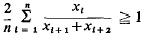
is undecided in the cases n = 11, 12, 13, 15, 17, 19, 21 and 23. In this note we present the results of numerical analysis supporting the conjecture that the inequality is valid in these cases. A new counter–example for n = 25 and a new elementary proof when n = 7 are given.
1.—An Algorithm for the Construction of Limit Circle Expressions*†
-
- Journal:
- Proceedings of the Royal Society of Edinburgh. Section A: Mathematics / Volume 75 / Issue 1 / 1976
- Published online by Cambridge University Press:
- 14 February 2012, pp. 1-3
- Print publication:
- 1976
-
- Article
- Export citation
-
Consider the differential expression

It is shown here that given pn > 0 with pn ∈ C2n(0, ∞) there exist coefficients

such that all solutions of the equation Ry = 0 are in L2(0,∞). The pi for i<n can be explicitly obtained in terms of pn and a parameter function.

6.—Rationally Convex Hulls and Potential Theory.*
-
- Journal:
- Proceedings of the Royal Society of Edinburgh. Section A: Mathematics / Volume 74 / 1976
- Published online by Cambridge University Press:
- 14 February 2012, pp. 81-89
- Print publication:
- 1976
-
- Article
- Export citation
-
Let S be a compact subset of the open unit disc in C. Associate to S the set

Let R(X) be the uniform algebra on X generated by the rational functions which are holomorphic near X. It is shown that the spectrum of R(X) is determined in a simple wayby the potential-theoretic properties of S. In particular, the spectrum of R(X) is X if and only if the functions harmonic near S are uniformly dense in the continuous functions on S. Similar results can be obtained for other subsets of C2 constructed from compact subsets of C.
8.—Constructive Methods for Solving the Exterior Neumann Problem for the Reduced Wave Equation in a Spherically Symmetric Medium*
-
- Journal:
- Proceedings of the Royal Society of Edinburgh. Section A: Mathematics / Volume 75 / Issue 2 / 1976
- Published online by Cambridge University Press:
- 14 February 2012, pp. 97-107
- Print publication:
- 1976
-
- Article
- Export citation
7.—Elliptic Singular Perturbations of First-order Operators with Critical Points
-
- Journal:
- Proceedings of the Royal Society of Edinburgh. Section A: Mathematics / Volume 74 / 1976
- Published online by Cambridge University Press:
- 14 February 2012, pp. 91-113
- Print publication:
- 1976
-
- Article
- Export citation
-
We study the asymptotic behaviour for ɛ→+0 of the solution Φ of the elliptic boundary value problem

 is a bounded domain in ℝ2,
  2 is asecond-order uniformly elliptic operator, 1 is a first-order operator, which has critical points in the interior of , i.e. points at which the coefficients of the first derivatives vanish, ɛ and μ are real parameters and h is a smooth function on . We construct firstorder approximations to Φ for all types of nondegenerate critical points of 1 and prove their validity under some restriction on the range of μ.
In a number of cases we get internal layers of nonuniformity (which extend to the boundary in the saddle-point case) near the critical points; this depends on the position of the characteristics of
1 and their direction. At special values of the parameter μ outside the range in which we could prove validity we observe ‘resonance’, a sudden displacement of boundary layers; these points are connected with the spectrum of the operator ɛ2 + 1 subject to boundary conditions of Dirichlet type.
 is a bounded domain in ℝ
Development of a laminar boundary layer under conditions of continuous incipient separation*
-
- Journal:
- Proceedings of the Royal Society of Edinburgh. Section A: Mathematics / Volume 76 / Issue 1 / 1976
- Published online by Cambridge University Press:
- 14 February 2012, pp. 55-66
- Print publication:
- 1976
-
- Article
- Export citation
-
This paper, extending the work of Stratford [6] considers a boundary layer with uniform pressure when x < x0, and with the pressure in x > x0 so chosen that the layer is just on the point of separation for all x >x0. The required pressure distribution is shown to be

The displacement and momentum thicknesses are also derived as series in powers of ξ (and log ξ), and the shape parameter H then obtained as a similar series. The continuous change in H from the Blasius value (when ξ = 0) towards the Falkner-Skan [3] separation value is convincingly demonstrated, with the aid of the leading terms of an asymptomatic expansion for large ξ.

6.—Oscillation Theory for Semilinear Schrödinger Equations and Inequalities
-
- Journal:
- Proceedings of the Royal Society of Edinburgh. Section A: Mathematics / Volume 75 / Issue 1 / 1976
- Published online by Cambridge University Press:
- 14 February 2012, pp. 67-81
- Print publication:
- 1976
-
- Article
- Export citation
PRM volume 75 issue 3 Cover and Front matter
-
- Journal:
- Proceedings of the Royal Society of Edinburgh. Section A: Mathematics / Volume 75 / Issue 3 / 1976
- Published online by Cambridge University Press:
- 14 February 2012, pp. f1-f2
- Print publication:
- 1976
-
- Article
-
- You have access
- Export citation
18.—An Inequality of C. R. Putnam involving a Dirichlet Functional
-
- Journal:
- Proceedings of the Royal Society of Edinburgh. Section A: Mathematics / Volume 75 / Issue 3 / 1976
- Published online by Cambridge University Press:
- 14 February 2012, pp. 199-207
- Print publication:
- 1976
-
- Article
- Export citation
15.—The Inversion of an Augmented Information Matrix occurring in Factor Analysis*
-
- Journal:
- Proceedings of the Royal Society of Edinburgh. Section A: Mathematics / Volume 75 / Issue 2 / 1976
- Published online by Cambridge University Press:
- 14 February 2012, pp. 171-178
- Print publication:
- 1976
-
- Article
- Export citation
11.—Equations d'Evolution du Second Ordre Associées à des Operateurs Maximaux Monotones
-
- Journal:
- Proceedings of the Royal Society of Edinburgh. Section A: Mathematics / Volume 75 / Issue 2 / 1976
- Published online by Cambridge University Press:
- 14 February 2012, pp. 131-147
- Print publication:
- 1976
-
- Article
- Export citation
16.—On Uniqueness of Topological Degree for Set-valued Mappings*
-
- Journal:
- Proceedings of the Royal Society of Edinburgh. Section A: Mathematics / Volume 74 / 1976
- Published online by Cambridge University Press:
- 14 February 2012, pp. 225-229
- Print publication:
- 1976
-
- Article
- Export citation
13.—Some Integral Inequalities*
-
- Journal:
- Proceedings of the Royal Society of Edinburgh. Section A: Mathematics / Volume 75 / Issue 2 / 1976
- Published online by Cambridge University Press:
- 14 February 2012, pp. 157-164
- Print publication:
- 1976
-
- Article
- Export citation
2.—On Weyl's Function m(λ).*
-
- Journal:
- Proceedings of the Royal Society of Edinburgh. Section A: Mathematics / Volume 74 / 1976
- Published online by Cambridge University Press:
- 14 February 2012, pp. 41-48
- Print publication:
- 1976
-
- Article
- Export citation
8.—A Rule relating the Deficiency Indices of Lj to those of Lk.*
-
- Journal:
- Proceedings of the Royal Society of Edinburgh. Section A: Mathematics / Volume 74 / 1976
- Published online by Cambridge University Press:
- 14 February 2012, pp. 115-118
- Print publication:
- 1976
-
- Article
- Export citation
PRM volume 75 issue 4 Cover and Front matter
-
- Journal:
- Proceedings of the Royal Society of Edinburgh. Section A: Mathematics / Volume 75 / Issue 4 / 1976
- Published online by Cambridge University Press:
- 14 February 2012, pp. f1-f6
- Print publication:
- 1976
-
- Article
-
- You have access
- Export citation
