Refine search
Actions for selected content:
26078 results in Abstract analysis
2 - Intertwining operators
-
- Book:
- Automatic Continuity of Linear Operators
- Published online:
- 16 March 2010
- Print publication:
- 19 February 1976, pp 19-31
-
- Chapter
- Export citation
Forced oscillations of the feedback control equation
-
- Journal:
- Proceedings of the Royal Society of Edinburgh. Section A: Mathematics / Volume 76 / Issue 1 / 1976
- Published online by Cambridge University Press:
- 14 February 2012, pp. 31-42
- Print publication:
- 1976
-
- Article
- Export citation
Disconjugacy and the limit-point condition for fourth-order operators*
-
- Journal:
- Proceedings of the Royal Society of Edinburgh. Section A: Mathematics / Volume 76 / Issue 1 / 1976
- Published online by Cambridge University Press:
- 14 February 2012, pp. 77-80
- Print publication:
- 1976
-
- Article
- Export citation
PRM volume 75 issue 1 Cover and Front matter
-
- Journal:
- Proceedings of the Royal Society of Edinburgh. Section A: Mathematics / Volume 75 / Issue 1 / 1976
- Published online by Cambridge University Press:
- 14 February 2012, pp. f1-f2
- Print publication:
- 1976
-
- Article
-
- You have access
- Export citation
22.—The Linear Transport Equation. The Degenerate Case c = 1. I. Full-range Theory
-
- Journal:
- Proceedings of the Royal Society of Edinburgh. Section A: Mathematics / Volume 75 / Issue 4 / 1976
- Published online by Cambridge University Press:
- 14 February 2012, pp. 259-282
- Print publication:
- 1976
-
- Article
- Export citation
10.—An Abstract Relation for Multiparameter Eigenvalue Problems*
-
- Journal:
- Proceedings of the Royal Society of Edinburgh. Section A: Mathematics / Volume 74 / 1976
- Published online by Cambridge University Press:
- 14 February 2012, pp. 135-143
- Print publication:
- 1976
-
- Article
- Export citation
-
Consider the multiparameter system

where ut is an element of a separable Hilbert space Hi, i = 1, …, n. The operators Sij are assumed to be bounded symmetric operators in Hi and Ai is assumed self-adjoint. In addition consider the operator equation

where B is densely defined and closed in a separable Hilbert space H and Tj, j = 1, …, n is a bounded operator in H. The problem treated in this paper is to seek an expression for a solution v of (**) in terms of the eigenfunctions of the system (*).
PRM volume 76 issue 1 Cover and Back matter
-
- Journal:
- Proceedings of the Royal Society of Edinburgh. Section A: Mathematics / Volume 76 / Issue 1 / 1976
- Published online by Cambridge University Press:
- 14 February 2012, pp. b1-b2
- Print publication:
- 1976
-
- Article
-
- You have access
- Export citation
17.—An Upper Bound for the Largest Zero of Hermite's Function with Applications to Subharmonic Functions
-
- Journal:
- Proceedings of the Royal Society of Edinburgh. Section A: Mathematics / Volume 75 / Issue 3 / 1976
- Published online by Cambridge University Press:
- 14 February 2012, pp. 183-197
- Print publication:
- 1976
-
- Article
- Export citation
-
Let

be Hermite's function of order λ and let h = h(λ) be the largest real zero of Hλ(t). Set
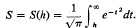
In this paper we establish the inequality

where
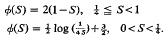
Equality holds for S = ½. The result is also fairly accurate as S→0 and S→1. The proof is analytical except in the ranges −1·1 ≦ h ≦ −0·1 and
 where the argument is concluded by means of a computer.
The following deduction is made elsewhere [2, Theorem A]. If u(x) is subharmonic in Rm(m ≧ 2) and the set E where u(x) > 0 has at least k components, where k ≧ 2, then the order ρ of u(x) is at least ϕ(1/k). In particular, if ρ < 1, E is connected. This result fails for ρ = 1.

 where the argument is concluded by means of a computer.
20.—Inequalities for the Capacity of an Electrified Conducting Annular Disc
-
- Journal:
- Proceedings of the Royal Society of Edinburgh. Section A: Mathematics / Volume 74 / 1976
- Published online by Cambridge University Press:
- 14 February 2012, pp. 257-270
- Print publication:
- 1976
-
- Article
- Export citation
Index
-
- Journal:
- Proceedings of the Royal Society of Edinburgh. Section A: Mathematics / Volume 74 / 1976
- Published online by Cambridge University Press:
- 14 February 2012, pp. 327-329
- Print publication:
- 1976
-
- Article
- Export citation
3.—A Criterion for the Existence of Solutions of Non-linear Elliptic Boundary Value Problems
-
- Journal:
- Proceedings of the Royal Society of Edinburgh. Section A: Mathematics / Volume 74 / 1976
- Published online by Cambridge University Press:
- 14 February 2012, pp. 49-54
- Print publication:
- 1976
-
- Article
- Export citation
10.—Norm Inequalities for C*-algebras*
-
- Journal:
- Proceedings of the Royal Society of Edinburgh. Section A: Mathematics / Volume 75 / Issue 2 / 1976
- Published online by Cambridge University Press:
- 14 February 2012, pp. 119-129
- Print publication:
- 1976
-
- Article
- Export citation
13.—The Functional Differential Equation y′(x) = ay(λx) + by(x)
-
- Journal:
- Proceedings of the Royal Society of Edinburgh. Section A: Mathematics / Volume 74 / 1976
- Published online by Cambridge University Press:
- 14 February 2012, pp. 165-174
- Print publication:
- 1976
-
- Article
- Export citation
-
The paper discusses the asymptotic behaviour of solutions of the functional differential equation

where a is a complex constant, 0<λ<1, and b is a constant such that Re b = 0, but b ≠ 0.
PRM volume 74 Cover and Front matter
-
- Journal:
- Proceedings of the Royal Society of Edinburgh. Section A: Mathematics / Volume 74 / 1976
- Published online by Cambridge University Press:
- 14 February 2012, pp. f1-f6
- Print publication:
- 1976
-
- Article
-
- You have access
- Export citation
16.—A Remark on a Paper by J. F. Toland and some Applications to Unilateral Problems
-
- Journal:
- Proceedings of the Royal Society of Edinburgh. Section A: Mathematics / Volume 75 / Issue 3 / 1976
- Published online by Cambridge University Press:
- 14 February 2012, pp. 179-182
- Print publication:
- 1976
-
- Article
- Export citation
Index
-
- Journal:
- Proceedings of the Royal Society of Edinburgh. Section A: Mathematics / Volume 75 / Issue 4 / 1976
- Published online by Cambridge University Press:
- 14 February 2012, pp. 339-340
- Print publication:
- 1976
-
- Article
- Export citation
PRM volume 75 issue 2 Cover and Front matter
-
- Journal:
- Proceedings of the Royal Society of Edinburgh. Section A: Mathematics / Volume 75 / Issue 2 / 1976
- Published online by Cambridge University Press:
- 14 February 2012, pp. f1-f2
- Print publication:
- 1976
-
- Article
-
- You have access
- Export citation
PRM volume 75 issue 3 Cover and Back matter
-
- Journal:
- Proceedings of the Royal Society of Edinburgh. Section A: Mathematics / Volume 75 / Issue 3 / 1976
- Published online by Cambridge University Press:
- 14 February 2012, pp. b1-b2
- Print publication:
- 1976
-
- Article
-
- You have access
- Export citation
PRM volume 76 issue 1 Cover and Front matter
-
- Journal:
- Proceedings of the Royal Society of Edinburgh. Section A: Mathematics / Volume 76 / Issue 1 / 1976
- Published online by Cambridge University Press:
- 14 February 2012, pp. f1-f2
- Print publication:
- 1976
-
- Article
-
- You have access
- Export citation
Perturbation of non-linear partial differential variational inequalities, I†
-
- Journal:
- Proceedings of the Royal Society of Edinburgh. Section A: Mathematics / Volume 76 / Issue 1 / 1976
- Published online by Cambridge University Press:
- 14 February 2012, pp. 1-12
- Print publication:
- 1976
-
- Article
- Export citation
