Refine search
Actions for selected content:
26078 results in Abstract analysis
5.—Qualitative Aspects of the Spatial Deformation of Non-linearly Elastic Rods.§
-
- Journal:
- Proceedings of the Royal Society of Edinburgh. Section A: Mathematics / Volume 73 / 1975
- Published online by Cambridge University Press:
- 14 February 2012, pp. 85-105
- Print publication:
- 1975
-
- Article
- Export citation
20.—On the Limit-point and Limit-circle Theory of Second-order Differential Equations
-
- Journal:
- Proceedings of the Royal Society of Edinburgh. Section A: Mathematics / Volume 72 / Issue 3 / 1975
- Published online by Cambridge University Press:
- 14 February 2012, pp. 245-256
- Print publication:
- 1975
-
- Article
- Export citation
4.—Comparison Theorems for a Class of Second-order Non-linear Ordinary Differential Equations
-
- Journal:
- Proceedings of the Royal Society of Edinburgh. Section A: Mathematics / Volume 73 / 1975
- Published online by Cambridge University Press:
- 14 February 2012, pp. 77-84
- Print publication:
- 1975
-
- Article
- Export citation
16.—Square Integrable Solutions of Perturbed Linear Differential Equations*
-
- Journal:
- Proceedings of the Royal Society of Edinburgh. Section A: Mathematics / Volume 73 / 1975
- Published online by Cambridge University Press:
- 14 February 2012, pp. 251-254
- Print publication:
- 1975
-
- Article
- Export citation
-
This paper is concerned with solutions of the ordinary differential equation

where ℒ is a real formally self-adjoint, linear differential expression of order 2n, and the perturbed term f satisfies

for some σ∈[0, 1]. Here λ(·) is locally integrable on [0,∞).
In particular it is shown, under circumstances detailed in the text, that (*) possesses solutions in the Hilbert function space L2(0,∞).
Khinchin's conjecture and Marstrand's theorem
-
- Journal:
- Mathematika / Volume 21 / Issue 2 / December 1974
- Published online by Cambridge University Press:
- 26 February 2010, pp. 248-260
- Print publication:
- December 1974
-
- Article
- Export citation
-
We begin by introducing some notations which will be used throughout the paper. Let
 denote a sequence of distinct positive integers. Let B denote a measurable subset of [0, 1) and {x} the fractional part of x. We write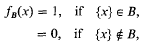
so that f has period 1 on the real line; and we write

for the number of times {mkx} falls in B, minus the expected value of this number (m(B) ≤ Lebesgue measure of B).
 denote a sequence of distinct positive integers. Let B denote a measurable subset of [0, 1) and {x} the fractional part of x. We write
Space-filling zonotopes
-
- Journal:
- Mathematika / Volume 21 / Issue 2 / December 1974
- Published online by Cambridge University Press:
- 26 February 2010, pp. 261-269
- Print publication:
- December 1974
-
- Article
- Export citation
The number of generators of the integers of a number field
-
- Journal:
- Mathematika / Volume 21 / Issue 2 / December 1974
- Published online by Cambridge University Press:
- 26 February 2010, pp. 160-167
- Print publication:
- December 1974
-
- Article
- Export citation
A dice probability problem
-
- Journal:
- Mathematika / Volume 21 / Issue 2 / December 1974
- Published online by Cambridge University Press:
- 26 February 2010, pp. 193-198
- Print publication:
- December 1974
-
- Article
- Export citation
The integral cohomology ring of

-
- Journal:
- Mathematika / Volume 21 / Issue 2 / December 1974
- Published online by Cambridge University Press:
- 26 February 2010, pp. 228-232
- Print publication:
- December 1974
-
- Article
- Export citation
-
The cohomology of the symmetric groups with coefficients in a field has been studied by several authors, see [6] and [7] for example, but hardly anything has been published with the integers as coefficients. Given the connection between the infinite symmetric group and the classifying space BG for stable spherical fibrations, the computation of
 is an interesting problem, and the purpose of this paper is to solve the first non-trivial case, n = 4. (The symmetric groups on 2 and 3 letters have cohomology of period four, which is generated by c1 and c2 of the permutation matrix representation, [8].)

 is an interesting problem, and the purpose of this paper is to solve the first non-trivial case, n = 4. (The symmetric groups on 2 and 3 letters have cohomology of period four, which is generated by c
The 3-class groups of non-Galois cubic fields–II
-
- Journal:
- Mathematika / Volume 21 / Issue 2 / December 1974
- Published online by Cambridge University Press:
- 26 February 2010, pp. 168-188
- Print publication:
- December 1974
-
- Article
- Export citation
Primitive polynomial subsequences
-
- Journal:
- Mathematika / Volume 21 / Issue 2 / December 1974
- Published online by Cambridge University Press:
- 26 February 2010, pp. 239-247
- Print publication:
- December 1974
-
- Article
- Export citation
-
A sequence {an} of integers is said to be primitive if
 whenever i ≠ j. For example, if n is any positive integer, the sequence
is primitive. This is an important example in the light of the elementary result (see [2; p. 244]) that if 0 < a1 < a2 < … < ar ≤ 2n is primitive then necessarily r ≤ n; i.e. at most half of the positive integers ≤ 2n can be members of the sequence. Besicovitch [2; p. 257] has obtained the surprising result that, given ε > 0, there exists an infinite primitive sequence {ai} such that
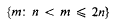
where A(n) denotes the number of ai ≤ n.
 whenever i ≠ j. For example, if n is any positive integer, the sequence
The integral closure need not be a Prüfer domain
-
- Journal:
- Mathematika / Volume 21 / Issue 2 / December 1974
- Published online by Cambridge University Press:
- 26 February 2010, pp. 233-238
- Print publication:
- December 1974
-
- Article
- Export citation
The inverse Stefan problem for the heat equation in two space variables
- Part of
-
- Journal:
- Mathematika / Volume 21 / Issue 2 / December 1974
- Published online by Cambridge University Press:
- 26 February 2010, pp. 282-286
- Print publication:
- December 1974
-
- Article
- Export citation
A lower bound for the L1 norm of exponential sums
-
- Journal:
- Mathematika / Volume 21 / Issue 2 / December 1974
- Published online by Cambridge University Press:
- 26 February 2010, pp. 155-159
- Print publication:
- December 1974
-
- Article
- Export citation
A note on the false centre problem
- Part of
-
- Journal:
- Mathematika / Volume 21 / Issue 2 / December 1974
- Published online by Cambridge University Press:
- 26 February 2010, pp. 216-227
- Print publication:
- December 1974
-
- Article
- Export citation
A decision procedure using the geometry of convex sets
- Part of
-
- Journal:
- Mathematika / Volume 21 / Issue 2 / December 1974
- Published online by Cambridge University Press:
- 26 February 2010, pp. 199-206
- Print publication:
- December 1974
-
- Article
- Export citation
Index to volume 21
-
- Journal:
- Mathematika / Volume 21 / Issue 2 / December 1974
- Published online by Cambridge University Press:
- 26 February 2010, p. 287
- Print publication:
- December 1974
-
- Article
- Export citation
The convex generation of convex Borel sets in locally convex spaces
- Part of
-
- Journal:
- Mathematika / Volume 21 / Issue 2 / December 1974
- Published online by Cambridge University Press:
- 26 February 2010, pp. 207-215
- Print publication:
- December 1974
-
- Article
- Export citation
Subsets of positive finite measure in the space of compact subsets of the unit interval
- Part of
-
- Journal:
- Mathematika / Volume 21 / Issue 2 / December 1974
- Published online by Cambridge University Press:
- 26 February 2010, pp. 189-192
- Print publication:
- December 1974
-
- Article
- Export citation
-
Definitions. We say that h is a Hausdorff measure function if it satisfies the following conditions:
(i)
 for all x > 0,
(ii) h(x) → 0 as x → 0,
(iii) h(x) is monotonic increasing.
 for all x > 0,
Kinematic measures for sets of support figures
- Part of
-
- Journal:
- Mathematika / Volume 21 / Issue 2 / December 1974
- Published online by Cambridge University Press:
- 26 February 2010, pp. 270-281
- Print publication:
- December 1974
-
- Article
- Export citation
-
1. W. Blaschke's kinematic formula in the integral geometry of Euclidean n-dimensional space gives a weighted measure to the set of positions in which a mobile figure K1 overlaps a fixed figure K0. In the simplest case, K0 and K1 are compact convex sets and all positions are equally weighted; we give this in more detail. Let Wq denote the q-th Quermassintegral of K1: Steiner's formula for the volume V of the vector sum K1 + λB of K1 and a ball of radius λ defines these set functions by the equation
see [4; p. 214]. Blaschke's formula [4; p. 243] gives
as the measure, to within a normalization, of overlapping positions of K1 relative to K0.
